
XPENG launched VLA 2.0 autonomous driving system as a shipping product in March 2026, marking a significant milestone as Tesla’s FSD remains in public testing phase. According to Forbes, the Chinese automaker’s system has already become a major sales driver in China’s competitive EV market.
The VLA 2.0 system demonstrated advanced capabilities during testing at the Beijing Auto Show, navigating urban streets, traffic, and complex junctions without human intervention across 40+ minutes of driving. He Xiaopeng, Chairman & CEO of XPENG, described autonomous driving as “our best feature,” highlighting VLA 2.0’s “very good results” in the market.
VLA 2.0 vs Tesla FSD: Real-World Performance
Field testing revealed notable differences between XPENG’s VLA 2.0 and Tesla’s FSD system. The Chinese system exhibited more human-like driving behavior, including proactive lane changes when anticipating potential conflicts with other vehicles.
Key VLA 2.0 capabilities include:
- Urban navigation through narrow streets and complicated intersections
- Traffic management with unpredictable motorbikes and pedestrians
- Predictive behavior pulling across lanes to avoid potential hazards
- Minimal intervention requirements except for barrier-controlled areas
While Tesla FSD has impressed users globally, VLA 2.0’s shipping status gives XPENG a competitive advantage in markets where autonomous features drive purchase decisions. The system’s performance in Beijing’s challenging traffic conditions suggests readiness for complex urban environments.
Enterprise AI Infrastructure Challenges
The automotive industry’s AI advancement faces broader enterprise data challenges that impact autonomous vehicle development. According to MIT Technology Review, Bavesh Patel, senior vice president of Databricks, emphasized that “the quality of that AI and how effective that AI is, is really dependent on information in your organization.”
Many automotive companies struggle with fragmented data across legacy systems, creating obstacles for AI training and deployment. Rajan Padmanabhan, unit technology officer at Infosys, noted the critical importance of precision in AI outputs driving business decisions.
Successful automotive AI requires:
- Unified data architecture combining structured and unstructured information
- Real-time context preservation for dynamic driving conditions
- Rigorous access controls for safety-critical applications
- Open format consolidation enabling cross-platform integration
Safety Concerns with In-Vehicle AI Integration
Tesla’s integration of xAI’s Grok chatbot raises safety questions about AI interaction while driving. CNBC reported on testing conducted in New York City, where a Tesla owner demonstrated months of Grok usage while driving.
Mike Nelson, a lawyer with auto insurance background, described the system as “useful, nearly irresistible, and dangerous.” The testing highlighted tensions between AI convenience and driver attention requirements in urban environments.
Safety considerations include:
- Cognitive load from AI interaction during driving tasks
- Attention diversion from road monitoring to screen interaction
- Response timing for AI queries versus immediate driving needs
- Regulatory compliance with hands-free driving laws
The automotive industry must balance AI innovation with established safety protocols as voice and visual AI interfaces become standard features.
Global Autonomous Delivery Expansion
Beyond passenger vehicles, autonomous technology continues expanding in commercial applications. Starship Technologies reached ten million autonomous deliveries across Europe and the USA, demonstrating scalable deployment of self-driving systems in controlled environments.
This milestone represents significant progress for last-mile delivery automation, with implications for broader autonomous vehicle adoption. The success of delivery robots provides valuable real-world data for passenger vehicle development, particularly in urban navigation and obstacle avoidance.
Market Implications for Tesla and Competitors
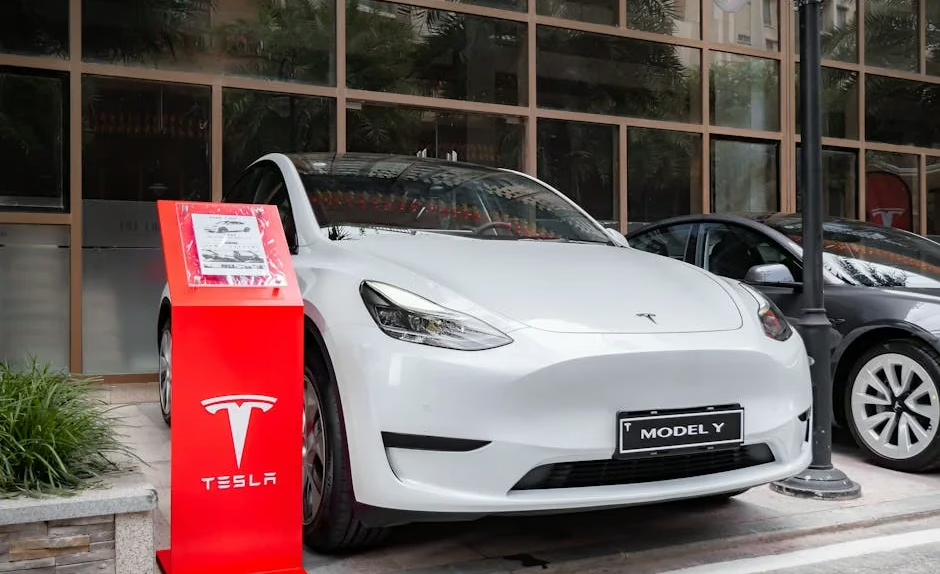
XPENG’s VLA 2.0 launch creates competitive pressure for Tesla in China, the world’s largest EV market. While Tesla maintains strong brand recognition globally, Chinese automakers are leveraging advanced autonomous features to differentiate their offerings.
The competitive landscape includes:
- Feature differentiation through autonomous driving capabilities
- Regional advantages for companies understanding local traffic patterns
- Regulatory navigation varying by market and testing requirements
- Consumer expectations shifting toward full autonomy rather than driver assistance
As Chinese automakers expand to European markets, their autonomous driving capabilities could influence consumer preferences in regions where brand heritage traditionally dominated purchase decisions.
What This Means
XPENG’s VLA 2.0 shipping status represents a strategic advantage over Tesla’s testing-phase FSD, particularly in markets prioritizing immediate autonomous functionality. The system’s human-like driving behavior and urban performance suggest Chinese automakers are closing the technology gap with established players.
For the broader automotive industry, this competition accelerates autonomous driving development while highlighting critical infrastructure requirements. Companies must address data fragmentation and safety concerns to deploy AI effectively at scale.
The success of both passenger and commercial autonomous systems indicates growing market readiness for self-driving technology, though regulatory frameworks and safety standards continue evolving. Tesla’s brand strength remains significant, but technical advantages from competitors like XPENG create pressure for faster FSD deployment.
FAQ
What makes XPENG VLA 2.0 different from Tesla FSD?
VLA 2.0 is a shipping product available to consumers, while Tesla FSD remains in public testing. XPENG’s system demonstrated more human-like driving behavior and proactive safety measures during independent testing.
Is it safe to use AI chatbots while driving?
Testing suggests AI interaction while driving can be “useful, nearly irresistible, and dangerous” according to automotive experts. The technology creates cognitive load and attention diversion that may compromise driving safety.
How do data infrastructure challenges affect automotive AI?
Fragmented enterprise data across legacy systems limits AI effectiveness in automotive applications. Companies need unified, governed data architectures to support reliable autonomous driving systems and real-time decision-making.