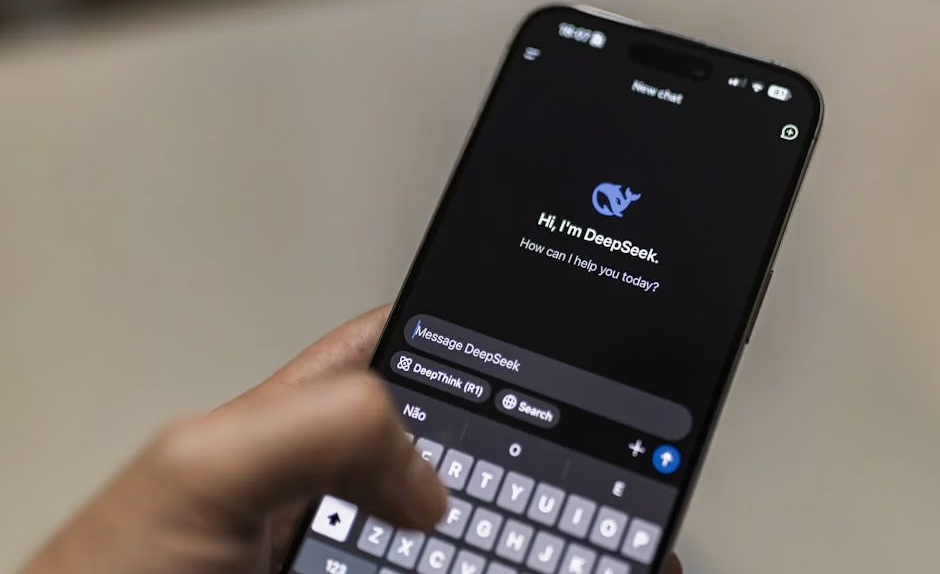

DeepSeek released its V4 model on Monday, delivering near state-of-the-art performance at approximately one-sixth the cost of proprietary alternatives like Claude Opus 4.7 and GPT-5.5. The 1.6-trillion-parameter Mixture-of-Experts model is available on Hugging Face under the MIT License and through DeepSeek’s API.
DeepSeek AI researcher Deli Chen described the release as a “labor of love” developed over 484 days since the V3 launch. The model matches or exceeds closed-source systems on multiple benchmarks while maintaining commercial-friendly licensing.
DeepSeek-V4 Performance and Capabilities
The new model represents what industry observers are calling the “second DeepSeek moment,” following the company’s breakthrough R1 release in January 2025 that became a near-overnight sensation globally. DeepSeek-V4 achieves frontier-class performance across reasoning, coding, and mathematical tasks.
Key technical specifications include:
- 1.6 trillion parameters in Mixture-of-Experts architecture
- MIT License for commercial use
- API pricing at roughly 1/6 the cost of GPT-5.5
- 1 million token context length support
According to VentureBeat’s analysis, the model “nears — and on some benchmarks, surpasses — the performance of the world’s most advanced closed-source systems.”
https://x.com/deepseek_ai/status/2047516922263285776
OpenAI Releases Privacy Filter for Enterprise Data Protection
OpenAI launched Privacy Filter this week, an open-source tool designed to detect and remove personally identifiable information from datasets before cloud processing. The 1.5-billion-parameter model is available on Hugging Face under Apache 2.0 license.
Privacy Filter addresses enterprise concerns about sensitive data exposure during AI training and inference. The model runs locally on standard laptops or in web browsers, providing “privacy-by-design” capabilities without requiring cloud connectivity.
Technical architecture features:
- Based on OpenAI’s gpt-oss family of reasoning models
- Bidirectional token classifier reading text from both directions
- On-device processing for maximum data protection
- Context-aware redaction of multiple PII categories
This release continues OpenAI’s return to open-source development, following the gpt-oss family launch and recent Symphony orchestration tools release.
Open Source Models Drive Enterprise AI Adoption
Enterprise adoption of open-source AI models accelerated significantly in 2026, driven by cost considerations and deployment flexibility. According to Google’s latest analysis, over 1,302 organizations now deploy production AI systems, with many leveraging open-source alternatives.
The shift toward open models reflects practical business needs:
- Cost control through self-hosted deployment
- Data sovereignty for sensitive workloads
- Customization capabilities through fine-tuning
- Vendor independence from proprietary platforms
Developers increasingly use platforms like Hugging Face for model distribution and collaboration. The Hugging Face ecosystem now hosts thousands of open-source models, with enterprise-grade tools for fine-tuning and deployment.
Fine-Tuning and Development Workflows
Open-source models enable sophisticated customization through fine-tuning techniques. Organizations adapt base models for specific domains, languages, or use cases without relying on vendor APIs. Popular frameworks include PyTorch and Hugging Face Transformers for model modification.
Common fine-tuning applications include:
- Domain-specific knowledge integration
- Brand voice and tone adaptation
- Multi-language support enhancement
- Task-specific optimization
The Hugging Face blog regularly publishes tutorials on fine-tuning techniques, helping developers maximize model performance for their specific requirements.
Market Impact and Competitive Pressure
DeepSeek-V4’s release intensifies pressure on proprietary AI providers to justify premium pricing. With comparable performance at significantly lower costs, open-source models challenge the value proposition of closed systems.
Industry implications include:
- Pricing pressure on API-based services
- Acceleration of open-source development
- Enterprise migration to self-hosted solutions
- Innovation democratization across global markets
The model’s MIT licensing removes barriers for commercial deployment, enabling organizations to build products without licensing restrictions or usage fees.
What This Means
DeepSeek-V4 represents a inflection point in AI accessibility, delivering frontier performance through open-source distribution. The combination of technical excellence and permissive licensing challenges the proprietary model paradigm that dominated 2023-2024.
For enterprises, these developments offer genuine alternatives to expensive API services while maintaining competitive performance. The ability to deploy models locally addresses data sovereignty concerns while reducing operational costs.
The simultaneous release of privacy-focused tools like OpenAI’s Privacy Filter suggests the industry recognizes enterprise requirements for data protection and local processing capabilities. This trend toward “privacy-by-design” tooling will likely accelerate as organizations seek greater control over sensitive data handling.
FAQ
How does DeepSeek-V4 compare to GPT-5 in terms of performance?
DeepSeek-V4 matches or exceeds GPT-5.5 performance on multiple benchmarks while offering API access at approximately one-sixth the cost. The model uses a 1.6-trillion-parameter Mixture-of-Experts architecture with commercial-friendly MIT licensing.
What is OpenAI’s Privacy Filter and how does it work?
Privacy Filter is a 1.5-billion-parameter model that detects and removes personally identifiable information from text before cloud processing. It runs locally on laptops or in browsers, using bidirectional token classification to identify and redact sensitive data across multiple PII categories.
Why are enterprises choosing open-source AI models over proprietary alternatives?
Enterprises select open-source models for cost control, data sovereignty, customization flexibility, and vendor independence. With models like DeepSeek-V4 delivering comparable performance to proprietary systems, organizations can achieve significant cost savings while maintaining control over their AI infrastructure.
Related news
- Three reasons why DeepSeek’s new model matters – MIT Technology Review
Sources
- Fine-Tuning Your First Large Language Model (LLM) with PyTorch and Hugging Face – HuggingFace Blog
- DeepSeek-V4 arrives with near state-of-the-art intelligence at 1/6th the cost of Opus 4.7, GPT-5.5 – VentureBeat
- OpenAI launches Privacy Filter, an open source, on-device data sanitization model that removes personal information from enterprise datasets – VentureBeat