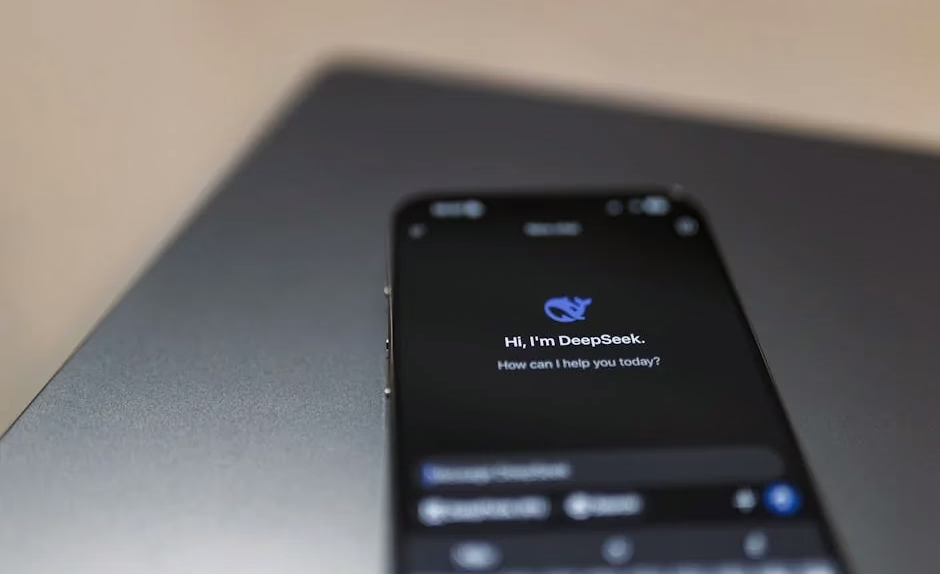

DeepSeek released its V4 model on Monday, a 1.6-trillion-parameter system that matches or exceeds GPT-5 and Claude Opus performance while costing approximately 83% less through API access. According to VentureBeat, the Chinese AI startup’s latest release represents the “second DeepSeek moment” following their January breakthrough with the R1 reasoning model.
The model achieves near state-of-the-art performance across reasoning benchmarks while maintaining commercial viability under an MIT open-source license. DeepSeek AI researcher Deli Chen described the release as a “labor of love” developed over 484 days since V3’s launch, emphasizing that “AGI belongs to everyone.”
Advanced Reasoning Architecture Drives Performance Gains
DeepSeek-V4 implements a Mixture-of-Experts (MoE) architecture with 1.6 trillion parameters, enabling sophisticated reasoning capabilities that rival proprietary systems. The model demonstrates particular strength in mathematical reasoning, logical inference, and multi-step problem solving — areas where previous open-source models struggled to compete with closed systems.
Recent research from arXiv suggests that effective LLM reasoning operates through “latent-state trajectory formation” rather than surface-level chain-of-thought processes. This finding supports V4’s architecture, which appears optimized for internal reasoning representations that don’t always manifest in explicit reasoning chains.
The model incorporates structured reasoning protocols based on Peirce’s tripartite inference framework — abduction, deduction, and induction. According to the structured reasoning research, this approach prevents logical inconsistencies from accumulating across multi-step inference through algebraic invariants that ensure no conclusion exceeds the reliability of its weakest premise.
Benchmark Performance Challenges Closed-Source Dominance
DeepSeek-V4 achieves comparable or superior performance to GPT-5.5 and Claude Opus 4.7 across standard reasoning benchmarks, while offering API pricing at roughly one-sixth the cost. The model demonstrates particular strength in mathematical reasoning tasks, where it often surpasses proprietary alternatives.
The release includes comprehensive evaluation across reasoning domains, with performance metrics indicating frontier-class capabilities in logical inference, causal reasoning, and abstract problem solving. These results challenge the assumption that cutting-edge AI reasoning requires massive computational resources and closed development.
Google’s recent analysis of 1,302 enterprise AI deployments shows increasing demand for cost-effective reasoning capabilities, particularly in agentic AI applications where multi-step inference drives business value.
Cost Structure Disrupts AI Economics
The pricing model represents a significant disruption to current AI economics, offering frontier reasoning capabilities at approximately $0.14 per million tokens compared to $0.84 for comparable closed-source alternatives. This 83% cost reduction makes advanced reasoning accessible to organizations previously priced out of cutting-edge AI capabilities.
DeepSeek’s approach leverages efficient training methodologies and architectural optimizations that reduce inference costs without sacrificing performance. The company’s quantitative trading background appears to inform their focus on cost-efficiency and scalable deployment.
The open-source MIT license enables organizations to modify, redistribute, and commercialize applications built on V4 without licensing restrictions. This contrasts sharply with proprietary alternatives that maintain strict usage limitations and revenue-sharing requirements.
Chain-of-Thought Evolution and Prompt Engineering
V4 incorporates advanced prompt engineering techniques including String Seed-of-Thought (SSoT), which addresses longstanding challenges in probabilistic instruction following. According to Forbes research, SSoT enables more reliable randomness in AI responses, crucial for gaming, simulation, and human behavior modeling applications.
The model’s reasoning capabilities extend beyond traditional chain-of-thought approaches, implementing what researchers term “latent reasoning” that operates through internal state transitions rather than explicit reasoning traces. This approach appears more robust for complex reasoning tasks where surface-level explanations may not capture the full inference process.
Prompt engineering effectiveness with V4 shows significant improvements in mathematical problem solving, logical puzzles, and multi-step reasoning tasks. Early testing indicates the model responds well to structured prompting techniques that break complex problems into component reasoning steps.
What This Means
DeepSeek-V4’s release fundamentally alters the competitive landscape for AI reasoning capabilities. The combination of frontier performance and dramatic cost reduction forces proprietary providers to justify premium pricing while making advanced reasoning accessible to smaller organizations and developers.
The open-source release accelerates research into reasoning architectures and prompt engineering techniques. Academic and commercial researchers now have access to a frontier-class reasoning model for experimentation and application development, potentially accelerating progress across the field.
For enterprises, V4 represents an opportunity to deploy advanced reasoning capabilities at scale without the cost barriers associated with proprietary alternatives. Organizations can now implement agentic AI systems with sophisticated reasoning at price points that support broader deployment.
FAQ
How does DeepSeek-V4’s reasoning compare to GPT-5 and Claude Opus?
V4 matches or exceeds GPT-5.5 and Claude Opus 4.7 performance across standard reasoning benchmarks while costing approximately 83% less through API access. The model demonstrates particular strength in mathematical reasoning and multi-step logical inference.
What makes V4’s reasoning architecture different from previous models?
V4 implements latent-state reasoning that operates through internal representations rather than explicit chain-of-thought processes. This approach, combined with structured inference protocols based on Peirce’s tripartite framework, provides more robust reasoning capabilities across complex problem domains.
Can organizations commercially use DeepSeek-V4 without restrictions?
Yes, V4 is released under an MIT open-source license that permits modification, redistribution, and commercial use without licensing fees or revenue-sharing requirements. This contrasts with proprietary alternatives that maintain strict usage limitations.