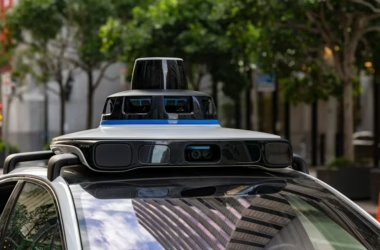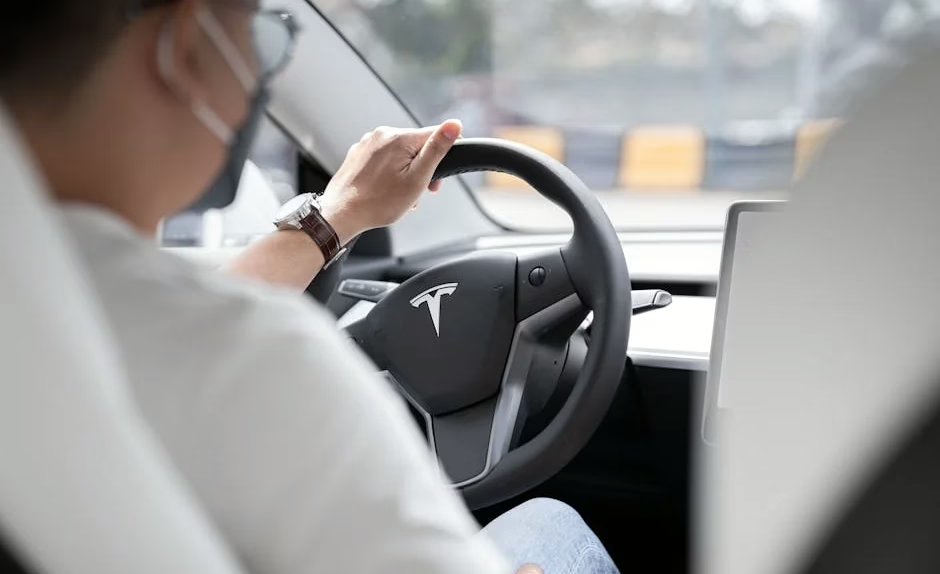

Tesla reported 1.28 million active Full Self-Driving subscriptions in Q1 2026, a 51% year-over-year increase that helped drive $22.38 billion in quarterly revenue. Meanwhile, Chinese automaker XPENG launched its VLA 2.0 autonomous driving system as a shipping product, marking a significant escalation in the global autonomous vehicle competition.
According to TechCrunch, Tesla’s FSD subscription growth contributed to a 16% revenue increase from $19.3 billion in Q1 2025, with automotive revenue rising to $16.2 billion. The company also reported positive free cash flow of $1.44 billion, more than double the previous year’s figure.
XPENG VLA 2.0 Challenges Tesla’s FSD Leadership
XPENG’s VLA 2.0 represents a direct challenge to Tesla’s autonomous driving dominance, particularly in the crucial Chinese market. Forbes reported that the system demonstrated “human-like operation” during testing at the Beijing Auto Show, successfully navigating urban streets, traffic, and complex junctions without human intervention across 40 minutes of driving.
The Chinese automaker’s system showed advanced predictive capabilities, including preemptively changing lanes when anticipating potential conflicts with other vehicles. “Our best feature is autonomous driving,” said He Xiaopeng, XPENG’s Chairman and CEO. “VLA 2.0 has had very good results.”
Unlike Tesla’s FSD, which remains in public testing phase in most markets, XPENG markets VLA 2.0 as a fully shipping product already boosting sales in China. The system comes standard on the latest XPENG P7 Ultra model.
Tesla’s Mixed Q1 Performance Despite FSD Growth
Tesla delivered 358,023 electric vehicles globally in Q1 2026, falling short of analyst expectations of approximately 368,000 units. The company produced 408,386 vehicles during the same period, creating a significant inventory buildup.
Despite delivery shortfalls, Tesla’s revenue benefited from higher average vehicle prices and growing services revenue. The 1.28 million FSD subscriptions represent a substantial recurring revenue stream for the company, though Tesla has not disclosed specific FSD pricing or revenue figures.
Tesla’s broader business faced headwinds in 2025, with profits falling 46% year-over-year to $3.8 billion, primarily due to lower EV sales following the elimination of the $7,500 federal tax credit for electric vehicles under the Trump administration.
Safety Concerns Emerge Around AI Integration in Vehicles
CNBC reported on growing safety concerns regarding AI chatbot integration in vehicles, highlighting a Tesla owner’s use of xAI’s Grok chatbot while driving in New York City. The report described the technology as “useful, nearly irresistible, and dangerous,” raising questions about driver distraction as AI becomes more prevalent in automotive applications.
The integration of conversational AI into vehicles represents a new frontier for automotive safety regulators, who must balance technological advancement with driver attention requirements. Tesla has not officially integrated Grok into its vehicles, but some owners have found ways to access the chatbot through mobile devices while driving.
Global Autonomous Driving Competition Intensifies
The automotive AI landscape extends beyond Tesla and XPENG, with major technology companies investing heavily in autonomous research capabilities. Google announced its Deep Research Max system powered by Gemini 3.1 Pro, which could accelerate autonomous vehicle development through enhanced research and analysis capabilities.
Google’s system offers “unprecedented analytical quality” for long-horizon research workflows, potentially benefiting automotive companies developing autonomous systems. The platform integrates web research with proprietary data streams, delivering “professional-grade, fully cited analyses” that could accelerate vehicle AI development.
Traditional automakers including Mercedes-Benz, BMW, and Rivian continue developing their own autonomous driving systems, though most remain in testing phases compared to XPENG’s commercial deployment.
What This Means
XPENG’s commercial deployment of VLA 2.0 represents a significant milestone in autonomous vehicle development, potentially pressuring Tesla to accelerate FSD development and deployment. The Chinese market’s acceptance of shipping autonomous systems could influence global regulatory approaches and consumer expectations.
Tesla’s 1.28 million FSD subscriptions demonstrate strong consumer interest in autonomous features, providing a foundation for future revenue growth even as vehicle deliveries face challenges. The recurring subscription model offers Tesla more predictable income streams compared to one-time vehicle sales.
The integration of AI chatbots and research systems into automotive workflows suggests the industry is moving beyond basic autonomous driving toward comprehensive AI-powered vehicle experiences. However, safety concerns around driver distraction may require new regulatory frameworks as these technologies mature.
FAQ
How does XPENG’s VLA 2.0 compare to Tesla’s FSD?
XPENG’s VLA 2.0 is marketed as a shipping product available to consumers, while Tesla’s FSD remains in beta testing in most markets. Early testing suggests VLA 2.0 demonstrates more human-like driving behavior, though both systems show impressive capabilities in urban environments.
What impact will Tesla’s FSD subscription growth have on revenue?
Tesla’s 1.28 million FSD subscriptions represent a 51% year-over-year increase, contributing to the company’s $22.38 billion Q1 revenue. The recurring subscription model provides more predictable income compared to vehicle sales, though Tesla hasn’t disclosed specific FSD revenue figures.
Are AI chatbots safe to use while driving?
Safety experts express concerns about AI chatbot use while driving, describing the technology as potentially dangerous due to driver distraction. Current implementations rely on drivers accessing chatbots through mobile devices rather than integrated vehicle systems, raising additional safety questions.