
Tesla reported 1.28 million active Full Self-Driving (Supervised) subscriptions in Q1 2026, a 51% year-over-year increase that helped drive automotive revenue to $16.2 billion. According to Tesla’s earnings report, the company’s total revenue reached $22.38 billion, up 16% from $19.3 billion in Q1 2025, with FSD subscriptions becoming a significant revenue driver alongside higher average vehicle prices.
The milestone comes as Chinese automaker XPENG claims its VLA 2.0 autonomous driving system has surpassed Tesla’s capabilities in real-world deployment. Unlike Tesla’s FSD, which remains in public testing phase, XPENG launched VLA 2.0 as a full shipping product in March 2026, reportedly boosting sales across China’s competitive EV market.
XPENG VLA 2.0 Demonstrates Advanced Urban Navigation
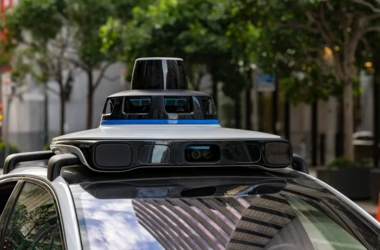
XPENG’s VLA 2.0 system showed impressive performance during testing at the Beijing Auto Show, navigating urban streets, traffic, and complex junctions without human intervention across 40 minutes of driving. Forbes reported that the system exhibited “more human-like operation” compared to Tesla FSD, including proactive lane changes when anticipating potential conflicts with other vehicles.
“Our best feature is autonomous driving,” said He Xiaopeng, Chairman & CEO of XPENG, noting that VLA 2.0 has delivered “very good results” since launch. The system comes equipped on the latest generation XPENG P7 and represents the company’s strategy to differentiate in China’s increasingly competitive automotive market.
The Chinese automaker’s success in deploying production-ready autonomous driving technology highlights the accelerating pace of innovation outside traditional automotive centers, particularly as Chinese manufacturers prepare for European market expansion.
Tesla Integrates xAI’s Grok for Enhanced Driver Experience
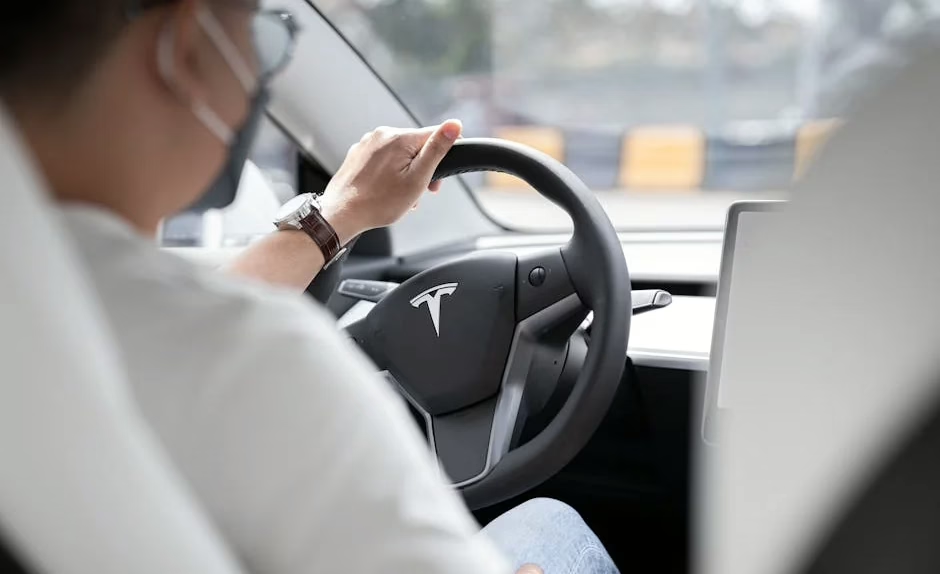
Tesla owners have begun integrating Elon Musk’s xAI Grok chatbot into their vehicles, creating new interaction paradigms between drivers and AI systems. CNBC testing revealed both the utility and potential safety concerns of using conversational AI while driving in urban environments like New York City.
Mike Nelson, a Tesla owner and lawyer with auto insurance background, demonstrated Grok’s integration over several months of use. While finding the system “useful” and “nearly irresistible,” Nelson also characterized it as “dangerous” when used while actively driving, highlighting the ongoing challenge of balancing AI capabilities with driver safety.
The integration represents Tesla’s broader strategy of leveraging Musk’s AI ecosystem, potentially creating competitive advantages through cross-platform synergies between Tesla’s automotive hardware and xAI’s language model capabilities.
Autonomous Driving Market Dynamics Shift
Tesla’s Q1 2026 results showed mixed signals for the autonomous driving leader. While FSD subscriptions grew substantially, vehicle deliveries of 358,023 units fell short of analyst expectations around 368,000. The company produced 408,386 vehicles during the quarter, indicating inventory buildup amid softer demand.
The delivery shortfall occurred despite positive free cash flow of $1.44 billion, more than double Q1 2025 levels, surprising analysts who expected higher cash burn. Tesla’s automotive revenue growth was driven by higher average vehicle prices and services revenue, including the expanding FSD subscription base.
Chinese competitors like XPENG are positioning advanced autonomous driving as a key differentiator, potentially pressuring Tesla’s technological leadership in markets where brand heritage carries less weight than in Europe and North America.
Global AI Integration Accelerates Across Industries
Google’s latest compilation identified 1,302 real-world generative AI use cases across leading organizations, with automotive applications representing a significant portion of enterprise AI adoption. The list, updated from 101 use cases two years ago, demonstrates what Google calls “the fastest technological transformation we’ve seen.”
Google simultaneously launched Deep Research Max, built with Gemini 3.1 Pro, offering autonomous research capabilities that blend open web data with proprietary sources. The system targets enterprise workflows across finance, life sciences, and market research, potentially accelerating AI-driven decision making in automotive development cycles.
These developments indicate broader AI infrastructure maturation supporting automotive innovation, from autonomous driving algorithms to supply chain optimization and customer experience enhancement.
What This Means
The automotive AI landscape is fragmenting along geographic and technological lines. Tesla’s FSD subscription growth validates the revenue potential of autonomous driving features, but XPENG’s production deployment of VLA 2.0 suggests Chinese manufacturers are moving beyond testing phases faster than established players.
This shift has implications for global automotive competitiveness. Chinese automakers leveraging advanced AI capabilities could disrupt traditional market hierarchies, particularly in regions where consumers prioritize technological capability over brand heritage. Tesla’s integration of xAI capabilities represents one response, but execution and safety validation remain critical factors.
The broader enterprise AI adoption documented by Google indicates automotive companies have access to increasingly sophisticated AI tools for development, manufacturing, and customer experience. Success will likely depend on effective integration rather than AI capability alone.
FAQ
How many Tesla FSD subscriptions are currently active?
Tesla reported 1.28 million active Full Self-Driving (Supervised) subscriptions in Q1 2026, representing 51% year-over-year growth and contributing significantly to the company’s $16.2 billion automotive revenue.
What makes XPENG’s VLA 2.0 different from Tesla FSD?
XPENG’s VLA 2.0 is a production shipping product available to customers, while Tesla FSD remains in public testing phase. VLA 2.0 demonstrated human-like driving behavior including proactive lane changes during 40 minutes of urban testing without human intervention.
Is using AI chatbots while driving safe?
Testing of xAI’s Grok in Tesla vehicles revealed both utility and safety concerns. While the system provides useful functionality, experts characterize conversational AI use while actively driving as potentially dangerous, highlighting the need for careful integration of AI systems in automotive environments.