
Tesla reported 1.28 million active Full Self-Driving (Supervised) subscriptions in Q1, a 51% year-over-year increase that helped drive automotive revenue to $16.2 billion despite lower-than-expected vehicle deliveries. The milestone underscores how AI-powered autonomous driving features are becoming a significant revenue stream for automakers as the industry shifts toward software-defined vehicles.
According to TechCrunch, Tesla’s total revenue reached $22.38 billion in Q1, up 16% from $19.3 billion in the same quarter last year. The company delivered 358,023 electric vehicles globally, below analyst expectations of around 368,000 units.
Tesla’s AI-Driven Revenue Strategy
Tesla’s FSD subscription growth represents a fundamental shift in automotive business models. The company’s advanced driver assistance system generates recurring revenue independent of vehicle sales, providing a buffer against traditional automotive market volatility.
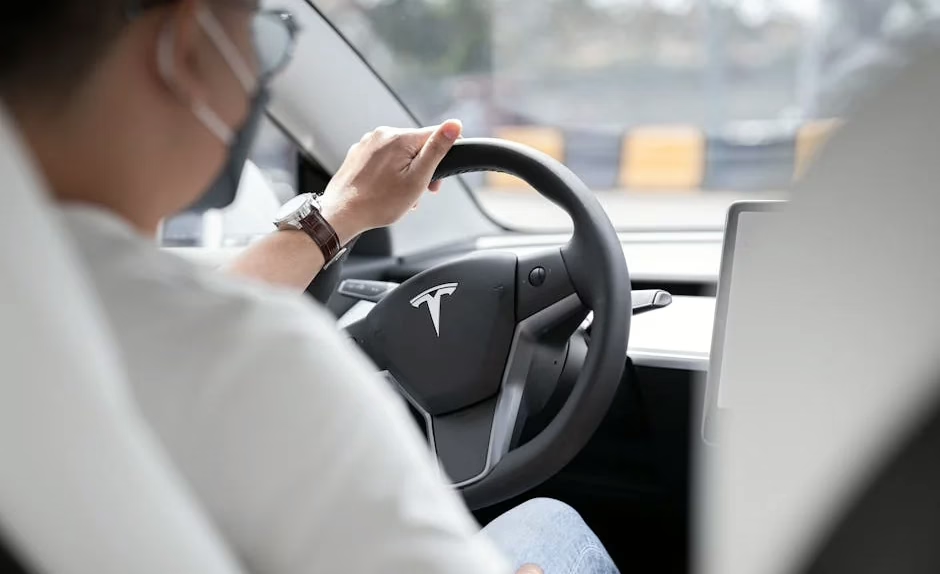
The 51% year-over-year growth in FSD subscriptions demonstrates strong consumer adoption of AI-powered driving features. Tesla’s FSD system uses neural networks and computer vision to enable features like automated lane changes, traffic light recognition, and city street navigation under driver supervision.
Tesla reported positive free cash flow of $1.44 billion, more than double the previous year’s Q1 figure. This surprised analysts who expected higher cash burn during the quarter. The company’s automotive revenue increase came despite producing 408,386 vehicles while delivering only 358,023, indicating inventory buildup.
Autonomous AI Beyond Automotive
The automotive industry’s AI transformation extends beyond Tesla’s FSD system. Google’s recent blog post documented over 1,300 real-world generative AI use cases across leading organizations, with many applications spanning transportation and logistics.
Google’s Deep Research Max, built with Gemini 3.1 Pro, represents a new class of autonomous research agents capable of complex analytical workflows. According to Google DeepMind, these agents can blend open web data with proprietary information streams to deliver professional-grade analyses across finance, life sciences, and market research.
Palo Alto Networks research demonstrated that AI systems can autonomously execute sophisticated cyberattacks with minimal oversight. Their proof-of-concept system “Zealot” successfully infiltrated cloud infrastructure and exfiltrated sensitive data without specific instructions, highlighting both the potential and risks of autonomous AI systems.
Industry-Wide AI Integration
Automotive AI development increasingly involves partnerships between technology companies and traditional manufacturers. NVIDIA’s expanded collaborations with Adobe and WPP bring agentic AI to enterprise marketing operations, including automotive advertising and customer experience management.
These partnerships enable automotive brands to deliver personalized content across millions of product, audience, and channel combinations. The integration of NVIDIA’s Nemotron models with Adobe’s creative platforms allows real-time content generation and optimization for automotive marketing campaigns.
The convergence of AI capabilities across industries suggests that automotive companies must develop comprehensive AI strategies beyond vehicle autonomy. Tesla’s FSD subscription success demonstrates that software and services can become primary revenue drivers in an increasingly competitive EV market.
Challenges and Market Dynamics
Tesla’s Q1 results reflect broader automotive industry challenges. The company’s 2025 profits fell 46% year-over-year to $3.8 billion, primarily due to lower EV sales following the Trump administration’s elimination of the $7,500 federal tax credit for electric vehicles.
Other automakers face similar pressures as EV adoption rates fluctuate with policy changes and economic conditions. This volatility makes AI-powered software services increasingly attractive as supplementary revenue streams that can offset traditional automotive market cycles.
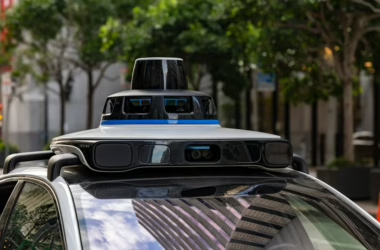
The autonomous driving sector continues evolving rapidly, with companies like Waymo expanding robotaxi services while Tesla focuses on consumer-oriented FSD features. Each approach represents different strategies for monetizing autonomous driving AI technology.
Regulatory and Safety Considerations
As AI systems demonstrate increasing autonomy, regulatory frameworks struggle to keep pace. The Palo Alto Networks research showing AI’s ability to autonomously hack systems raises questions about deploying similar capabilities in safety-critical automotive applications.
Tesla’s FSD system operates under “supervised” conditions, requiring driver attention and intervention capability. This approach balances AI advancement with safety requirements while regulatory bodies develop comprehensive autonomous vehicle standards.
The automotive industry must navigate complex safety, security, and liability questions as AI capabilities expand. Tesla’s subscription model provides a framework for gradual AI feature deployment while maintaining user oversight and control.
What This Means
Tesla’s 1.28 million FSD subscriptions signal that consumers are willing to pay for AI-powered automotive features, validating software-as-a-service models in the automotive sector. This trend suggests that future automotive competition will increasingly center on AI capabilities rather than traditional mechanical engineering.
The broader AI landscape demonstrates that autonomous systems are rapidly advancing across industries, from Google’s research agents to enterprise marketing automation. Automotive companies must develop comprehensive AI strategies that extend beyond vehicle autonomy to encompass the entire customer experience.
As AI systems become more capable and autonomous, the automotive industry faces both unprecedented opportunities and complex challenges in safety, security, and regulation. Success will depend on balancing innovation with responsible deployment of increasingly powerful AI technologies.
FAQ
How much revenue does Tesla generate from FSD subscriptions?
Tesla doesn’t break out specific FSD subscription revenue, but the service contributed to the company’s $16.2 billion automotive revenue in Q1. With 1.28 million active subscriptions growing 51% year-over-year, FSD represents a significant and rapidly expanding revenue stream.
What makes Tesla’s FSD different from other autonomous driving systems?
Tesla’s FSD operates as a supervised system requiring driver attention, using neural networks and computer vision for features like automated lane changes and city street navigation. Unlike fully autonomous systems like Waymo’s robotaxis, Tesla’s approach focuses on consumer-owned vehicles with driver oversight.
How are other companies using AI in automotive applications?
Beyond autonomous driving, automotive AI applications include personalized marketing through NVIDIA-Adobe partnerships, supply chain optimization, and predictive maintenance. Google’s enterprise AI tools are being deployed across automotive operations for research, analysis, and customer experience management.