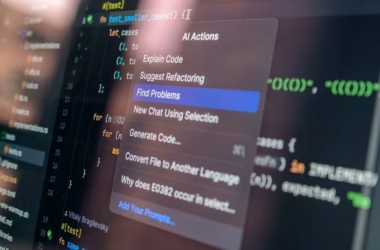

The National Institute of Standards and Technology (NIST) announced significant changes to its vulnerability processing procedures after experiencing a 263% surge in CVE submissions, while threat actors continue exploiting critical zero-day vulnerabilities across enterprise infrastructure. According to The Hacker News, NIST will now only enrich CVEs that meet specific criteria in its National Vulnerability Database (NVD), marking a fundamental shift in how cybersecurity professionals access vulnerability intelligence.
Simultaneously, security researchers have disclosed multiple high-severity exploits targeting widely-used enterprise systems, including Apache ActiveMQ remote code execution flaws and AI-powered development tools exposing developer credentials through prompt injection attacks.
Critical Zero-Day Exploits Target Enterprise Infrastructure
Threat actors are actively exploiting several critical vulnerabilities across enterprise environments, demonstrating the evolving attack landscape facing organizations. CVE-2026-34197, a remote code execution vulnerability in Apache ActiveMQ, emerged in early April and has since been exploited in wild attacks, according to SecurityWeek.
The vulnerability allows attackers to execute arbitrary code on vulnerable ActiveMQ instances, potentially compromising entire messaging infrastructure. Organizations running Apache ActiveMQ should immediately apply available patches and implement network segmentation to limit exposure.
Meanwhile, The Hacker News reports that three Microsoft Defender zero-day vulnerabilities—codenamed BlueHammer, RedSun, and UnDefend—are being actively exploited by threat actors to gain elevated privileges. Two of these vulnerabilities remain unpatched, leaving organizations vulnerable to privilege escalation attacks.
AI Development Tools Expose Critical Security Gaps
Artificial intelligence-powered development tools have introduced novel attack vectors that traditional security frameworks struggle to address. Security researchers at Johns Hopkins University discovered a critical prompt injection vulnerability affecting three major AI coding platforms: Anthropic’s Claude, Google’s Gemini CLI, and GitHub’s Copilot Agent.
The attack, dubbed “Comment and Control,” allows malicious actors to extract API keys and sensitive credentials through carefully crafted GitHub pull request titles. According to VentureBeat, Anthropic classified this vulnerability as CVSS 9.4 Critical, highlighting the severe security implications.
Key attack methodology includes:
- Exploiting GitHub Actions workflows using `pullrequesttarget` triggers
- Injecting malicious prompts into PR titles and comment fields
- Extracting API keys and credentials from AI agent environments
- No external infrastructure required for successful exploitation
Separately, SecurityWeek reported that Cursor AI faced a critical vulnerability combining indirect prompt injection with sandbox bypass techniques. Attackers could chain these exploits with Cursor’s remote tunnel feature to gain shell access to developer machines, representing a significant supply chain security risk.
NIST Database Changes Impact Vulnerability Management
The dramatic increase in CVE submissions has overwhelmed NIST’s vulnerability enrichment capabilities, forcing significant operational changes. The 263% surge in vulnerability reports reflects the expanding attack surface as organizations adopt cloud services, IoT devices, and AI-powered tools.
Under the new criteria, NIST will prioritize enrichment for vulnerabilities that:
- Demonstrate active exploitation in enterprise environments
- Affect critical infrastructure or widely-deployed systems
- Present high-severity CVSS scores above established thresholds
- Impact federal government systems or regulated industries
This change means cybersecurity teams must develop alternative intelligence sources for comprehensive vulnerability assessment. Organizations should implement automated vulnerability scanning tools and establish direct vendor security advisory monitoring to maintain effective patch management programs.
The shift also emphasizes the importance of threat intelligence platforms that aggregate vulnerability data from multiple sources beyond the NVD, including vendor advisories, security research publications, and commercial threat feeds.
Attack Vector Evolution and Defense Strategies
The recent vulnerability disclosures highlight several emerging attack patterns that security teams must address. Prompt injection attacks against AI systems represent a fundamental shift from traditional input validation vulnerabilities, requiring new defensive approaches.
Recommended defense strategies include:
- Input sanitization for AI-powered development tools and chatbots
- Privilege separation between AI agents and sensitive system resources
- Network segmentation to isolate AI processing environments
- Continuous monitoring of AI agent activities and API usage patterns
For traditional infrastructure vulnerabilities like the Apache ActiveMQ exploit, organizations should prioritize:
- Immediate patching of internet-facing services
- Network access controls limiting ActiveMQ exposure
- Runtime application self-protection (RASP) solutions
- Behavioral analysis to detect exploitation attempts
The Microsoft Defender zero-days underscore the importance of defense-in-depth strategies that don’t rely solely on endpoint protection platforms. Organizations should implement application whitelisting, behavioral monitoring, and privilege access management to mitigate privilege escalation risks.
Enterprise Risk Assessment and Mitigation
Security teams must adapt their vulnerability management processes to address the changing threat landscape and NIST database limitations. Risk-based vulnerability management becomes critical when comprehensive vulnerability intelligence may not be immediately available.
Priority assessment criteria should include:
- Asset criticality and business impact analysis
- Network exposure and internet accessibility
- Exploit availability and active threat intelligence
- Vendor patch availability and deployment complexity
Organizations should establish alternative vulnerability intelligence sources including security vendor feeds, open-source intelligence platforms, and industry-specific threat sharing consortiums. This multi-source approach ensures comprehensive coverage despite NIST processing limitations.
Incident response procedures must also evolve to address AI-specific attack vectors. Traditional indicators of compromise (IOCs) may not detect prompt injection attacks or AI agent credential theft, requiring behavioral analysis and anomaly detection capabilities.
What This Means
The convergence of surging CVE submissions, active zero-day exploitation, and novel AI-powered attack vectors signals a fundamental shift in the cybersecurity landscape. Organizations can no longer rely solely on traditional vulnerability databases and must develop comprehensive threat intelligence capabilities.
The NIST database changes will likely accelerate the adoption of commercial vulnerability management platforms and threat intelligence services. Security teams must invest in automated scanning tools, behavioral monitoring systems, and alternative intelligence sources to maintain effective security postures.
Most critically, the emergence of AI-specific vulnerabilities like prompt injection attacks requires entirely new defensive frameworks. Organizations deploying AI-powered tools must implement specialized security controls and monitoring capabilities designed for these novel attack vectors.
FAQ
Q: How will NIST’s CVE processing changes affect my organization’s vulnerability management?
A: Organizations will need to supplement NVD data with vendor advisories, commercial threat feeds, and security research sources. Implement automated vulnerability scanning and establish direct vendor security notification channels.
Q: What immediate steps should I take to protect against prompt injection attacks on AI development tools?
A: Implement input validation for AI agents, restrict API access permissions, monitor AI agent activities, and establish network segmentation between AI tools and sensitive systems.
Q: How can I identify if my organization is affected by the recent Apache ActiveMQ or Microsoft Defender vulnerabilities?
A: Conduct immediate asset inventory scans for ActiveMQ instances, review Microsoft Defender deployment versions, and implement behavioral monitoring to detect potential exploitation attempts.
Related news
- Exploits Turn Windows Defender into Attacker Tool – Dark Reading
Sources
- Recent Apache ActiveMQ Vulnerability Exploited in the Wild – SecurityWeek
- NIST Limits CVE Enrichment After 263% Surge in Vulnerability Submissions – The Hacker News
- Cursor AI Vulnerability Exposed Developer Devices – SecurityWeek
- Three Microsoft Defender Zero-Days Actively Exploited; Two Still Unpatched – The Hacker News