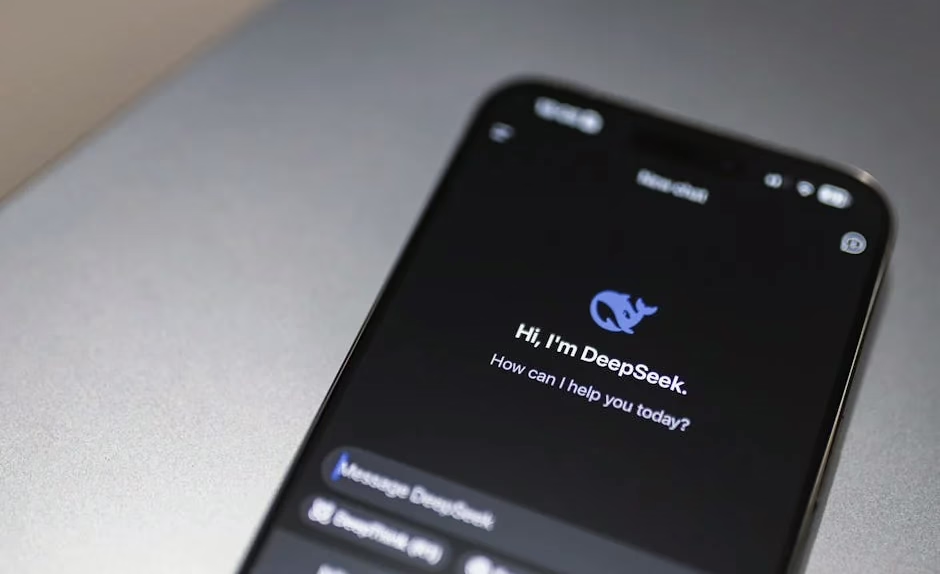

DeepSeek released its V4 model on Thursday, a 1.6-trillion-parameter Mixture-of-Experts architecture that matches or exceeds closed-source systems like GPT-5.5 and Opus 4.7 while operating at approximately one-sixth the API cost. The Chinese AI startup‘s latest release arrives 484 days after V3, marking what researchers call the “second DeepSeek moment” in open-source AI development.
According to VentureBeat, the model is available under the commercially-friendly MIT License on Hugging Face and through DeepSeek’s API. DeepSeek AI researcher Deli Chen described the release as a “labor of love” in a post on X, stating “AGI belongs to everyone.”
Architecture Innovations Drive Efficiency Gains
DeepSeek-V4’s Mixture-of-Experts architecture represents a significant advancement in parameter efficiency. The 1.6-trillion-parameter model activates only a subset of parameters for each computation, enabling frontier-level performance while maintaining manageable inference costs.
This architectural approach aligns with emerging research on optimal compute allocation. University of Wisconsin-Madison and Stanford researchers recently introduced Train-to-Test (T²) scaling laws, demonstrating that training smaller models on larger datasets and generating multiple inference samples often outperforms traditional scaling approaches.
The T² framework shows that compute-optimal strategies favor smaller models trained on vastly more data, then leverage saved computational overhead for multiple test-time samples. This methodology directly challenges conventional scaling laws that optimize only for training costs while ignoring inference expenses.
Hardware Infrastructure Supports New Model Architectures
Google’s eighth-generation Tensor Processing Units provide the computational foundation for next-generation AI architectures. The company announced two specialized chips: TPU 8t for training and TPU 8i for inference, both engineered for the iterative demands of agentic AI systems.
According to Google’s blog post, these custom processors deliver significant gains in power efficiency and performance compared to previous generations. The TPU 8t accelerates complex model development, while the TPU 8i specializes in low-latency inference for collaborative AI agents.
The infrastructure improvements come as organizations deploy AI across 1,302 documented real-world use cases, according to Google’s expanded customer showcase. This represents massive growth from the original 101 use cases published two years ago, demonstrating the rapid enterprise adoption of production AI systems.
Privacy-First Architecture Emerges in Open Source
OpenAI’s release of Privacy Filter introduces a new category of specialized models designed for on-device data sanitization. The 1.5-billion-parameter model runs locally on laptops or in web browsers, detecting and redacting personally identifiable information before data reaches cloud servers.
Released under the Apache 2.0 license on Hugging Face, Privacy Filter represents a derivative of OpenAI’s gpt-oss family with a bidirectional token classifier that reads text from both directions. This architectural modification enables more accurate PII detection compared to traditional autoregressive models.
The tool addresses growing enterprise concerns about sensitive data exposure during high-throughput inference. By providing “privacy-by-design” capabilities that function as a sophisticated digital shredder, Privacy Filter enables organizations to implement local-first privacy infrastructure without sacrificing model performance.
Training Methodology Innovations
The bidirectional architecture allows Privacy Filter to analyze context from both preceding and following tokens simultaneously. This approach improves accuracy in identifying PII that might be missed by unidirectional models, particularly in cases where sensitive information appears in complex sentence structures.
OpenAI’s return to open-source development, including the gpt-oss family and agentic orchestration tools, signals renewed investment in community-driven AI development. This shift contrasts with the company’s proprietary focus during the ChatGPT era.
Cost-Performance Paradigm Shifts Market Dynamics
DeepSeek-V4’s pricing model fundamentally challenges the economics of frontier AI deployment. At one-sixth the cost of comparable closed-source systems, the model forces proprietary providers to justify premium pricing structures.
Industry analysts note that this “second DeepSeek moment” effectively resets competitive dynamics, placing pressure on companies like OpenAI and Anthropic to demonstrate clear value propositions beyond raw performance metrics. The availability of frontier-class capabilities at dramatically reduced costs opens advanced AI applications to organizations previously priced out of the market.
The model’s performance on standard benchmarks approaches or exceeds systems costing six times more per API call. This cost-performance ratio enables new use cases where inference volume was previously prohibitive, particularly for applications requiring multiple reasoning samples or extended context processing.
What This Means
The convergence of architectural innovations, specialized hardware, and cost-effective open-source models represents a fundamental shift in AI development economics. DeepSeek-V4’s performance-to-cost ratio democratizes access to frontier capabilities, while new training methodologies like T² scaling laws optimize resource allocation across the entire model lifecycle.
Google’s specialized TPU architecture and OpenAI’s privacy-focused tools indicate the industry’s movement toward purpose-built solutions rather than general-purpose scaling. This specialization enables more efficient resource utilization and addresses specific deployment challenges like privacy compliance and inference latency.
For enterprises, these developments suggest that competitive AI capabilities no longer require massive capital investments in proprietary systems. The combination of efficient architectures, optimized training approaches, and open-source availability creates viable alternatives to closed-source providers while maintaining or improving performance standards.
FAQ
What makes DeepSeek-V4’s architecture more efficient than previous models?
DeepSeek-V4 uses a Mixture-of-Experts architecture that activates only a subset of its 1.6 trillion parameters for each computation, reducing inference costs while maintaining frontier-level performance. This approach contrasts with dense models that activate all parameters for every operation.
How do Train-to-Test scaling laws change model development strategies?
T² scaling laws demonstrate that training smaller models on larger datasets and generating multiple inference samples often outperforms traditional approaches focused solely on parameter scaling. This methodology optimizes the entire compute budget from training through deployment rather than just the training phase.
Why is on-device privacy filtering significant for enterprise AI deployment?
On-device privacy filtering eliminates the risk of sensitive data exposure during cloud-based inference by sanitizing information locally before transmission. This approach enables organizations to leverage powerful AI models while maintaining strict data governance and compliance requirements.
Related news
- Three reasons why DeepSeek’s new model matters – MIT Technology Review
- Causal Inference Is Different in Business – Towards Data Science
Sources
- Train-to-Test scaling explained: How to optimize your end-to-end AI compute budget for inference – VentureBeat
- DeepSeek-V4 arrives with near state-of-the-art intelligence at 1/6th the cost of Opus 4.7, GPT-5.5 – VentureBeat
- OpenAI launches Privacy Filter, an open source, on-device data sanitization model that removes personal information from enterprise datasets – VentureBeat