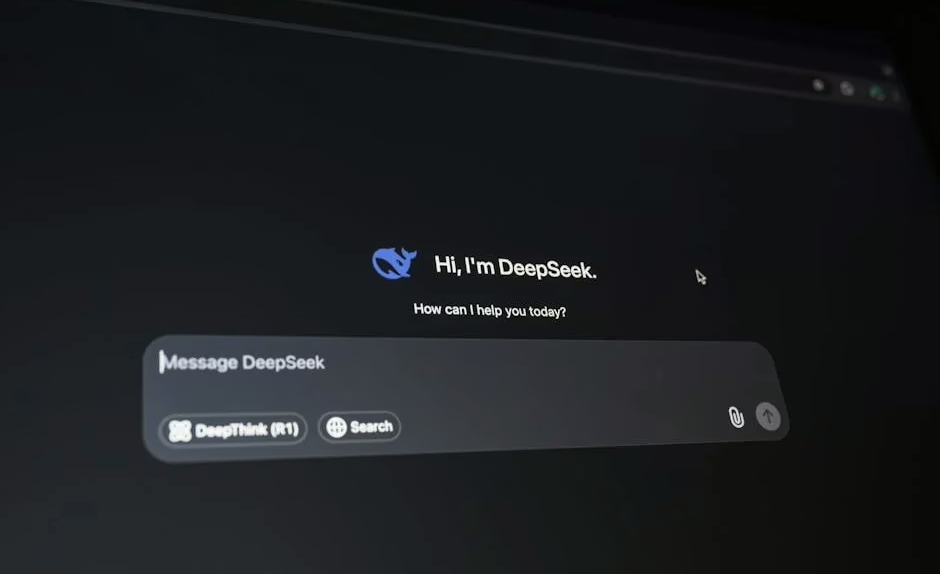

DeepSeek released its V4 model on Monday, a 1.6-trillion-parameter system that matches or exceeds closed-source AI performance at approximately one-sixth the cost of GPT-5.5 and Claude Opus 4.7. According to VentureBeat, the Chinese AI startup‘s latest release represents a “second DeepSeek moment” following their breakthrough R1 model in January 2025.
The model is available under the MIT License on Hugging Face and through DeepSeek’s API, marking 484 days of development since the V3 launch. DeepSeek AI researcher Deli Chen described the release as a “labor of love,” emphasizing that “AGI belongs to everyone.”
Advanced Reasoning Architecture Powers Performance Gains
DeepSeek-V4 implements structured reasoning protocols that address fundamental limitations in large language model inference. Recent research from arXiv demonstrates that effective AI reasoning operates through latent-state trajectory formation rather than explicit chain-of-thought processes, challenging conventional approaches to AI problem-solving.
The model incorporates algebraic invariants based on Peirce’s tripartite inference framework — abduction, deduction, and induction — to maintain logical consistency across multi-step reasoning chains. According to the research paper, the “Weakest Link bound” ensures no conclusion exceeds the reliability of its least-supported premise, preventing logical inconsistencies from accumulating.
Property-based testing validated these reasoning mechanisms across 100 properties and 16 fuzz tests over 100,000+ generated cases. This systematic approach to reasoning verification represents a significant advancement in AI reliability for complex problem-solving tasks.
Mixture-of-Experts Design Optimizes Cost-Performance Ratio
The 1.6-trillion-parameter Mixture-of-Experts (MoE) architecture enables DeepSeek-V4 to deliver frontier-class performance while maintaining computational efficiency. Unlike dense models that activate all parameters for every inference, MoE selectively engages specialized expert networks based on input requirements.
This architectural choice directly impacts pricing competitiveness. While proprietary models like GPT-5.5 and Claude Opus 4.7 command premium rates, DeepSeek-V4’s API pricing reflects approximately 83% cost reduction for equivalent reasoning capabilities. The open-source MIT License further eliminates licensing fees that typically accompany closed-source alternatives.
Industry analysts note this pricing disruption forces proprietary providers to justify their premium positioning. The cost-effectiveness extends beyond API usage to self-hosted deployments, where organizations can implement the model without ongoing usage fees or data privacy concerns associated with third-party services.
Prompt Engineering Advances Enable Better Reasoning Control
Recent developments in prompt engineering complement DeepSeek-V4’s reasoning capabilities through techniques like String Seed-of-Thought (SSoT). According to Forbes Tech coverage, SSoT addresses probabilistic instruction following (PIF) challenges that affect randomness in AI outputs.
Traditional chain-of-thought prompting often produces deterministic responses when probabilistic behavior is desired. SSoT provides template structures that guide models toward appropriate random number generation and probabilistic decision-making. This proves particularly valuable for simulation tasks, game mechanics, and human behavior modeling.
The combination of advanced reasoning architecture and sophisticated prompting techniques positions DeepSeek-V4 for applications requiring both logical consistency and controlled randomness. Organizations implementing the model can leverage these capabilities for complex analytical tasks while maintaining predictable operational costs.
Real-World Applications Demonstrate Reasoning Impact
Enterprise adoption of advanced reasoning models accelerates across multiple sectors, with Google Cloud documenting 1,302 real-world generative AI use cases from leading organizations. Mathematical reasoning, logical inference, and structured problem-solving represent core requirements across these implementations.
Financial services leverage reasoning models for risk assessment, fraud detection, and regulatory compliance analysis. Healthcare organizations apply structured reasoning to diagnostic support, treatment planning, and clinical decision-making. Manufacturing companies implement reasoning systems for predictive maintenance, quality control, and supply chain optimization.
The availability of frontier-class reasoning capabilities at reduced cost through DeepSeek-V4 democratizes access to these applications. Smaller organizations previously priced out of advanced AI reasoning can now implement sophisticated analytical capabilities without prohibitive infrastructure investments or ongoing API costs.
Open Source Release Challenges Proprietary Model Economics
DeepSeek-V4’s MIT License release fundamentally disrupts the AI model market by providing unrestricted commercial usage rights. Unlike restrictive licenses that limit deployment scenarios or require revenue sharing, the MIT License enables organizations to modify, distribute, and commercialize derivatives without ongoing obligations.
This licensing approach contrasts sharply with proprietary providers who maintain control through API access and usage-based pricing. Organizations gain independence from vendor lock-in while retaining full control over model deployment, data processing, and performance optimization.
The economic implications extend beyond direct cost savings. Internal deployment eliminates data transmission requirements, reducing latency and privacy concerns. Organizations can optimize hardware configurations for specific use cases without constraints imposed by shared cloud infrastructure.
What This Means
DeepSeek-V4 represents a inflection point in AI accessibility, delivering frontier reasoning capabilities at dramatically reduced costs while maintaining open-source flexibility. The 83% cost reduction compared to proprietary alternatives fundamentally alters the economic calculus for AI adoption across organizations of all sizes.
The technical advances in reasoning architecture, particularly the algebraic invariant framework and latent-state trajectory formation, establish new standards for logical consistency in AI systems. These improvements directly address reliability concerns that have limited AI deployment in critical applications requiring verified reasoning chains.
For the broader AI industry, DeepSeek-V4’s release intensifies competitive pressure on closed-source providers to justify premium pricing. The combination of superior cost-performance ratios and unrestricted licensing creates compelling alternatives to proprietary ecosystems, potentially accelerating the shift toward open-source AI infrastructure.
FAQ
How does DeepSeek-V4’s reasoning compare to GPT-5.5 and Claude Opus 4.7?
DeepSeek-V4 matches or exceeds the performance of these proprietary models on reasoning benchmarks while costing approximately one-sixth the price through API access. The model implements structured reasoning protocols with algebraic invariants that ensure logical consistency across multi-step inference chains.
What makes the MIT License significant for enterprise adoption?
The MIT License provides unrestricted commercial usage rights, allowing organizations to modify, distribute, and commercialize derivatives without ongoing obligations or revenue sharing. This contrasts with proprietary models that require API access and usage-based pricing, giving organizations full control over deployment and data processing.
Can DeepSeek-V4 handle probabilistic reasoning and randomness?
Yes, the model works with advanced prompt engineering techniques like String Seed-of-Thought (SSoT) to handle probabilistic instruction following. This enables appropriate random number generation and probabilistic decision-making for applications requiring both logical consistency and controlled randomness, such as simulations and game mechanics.