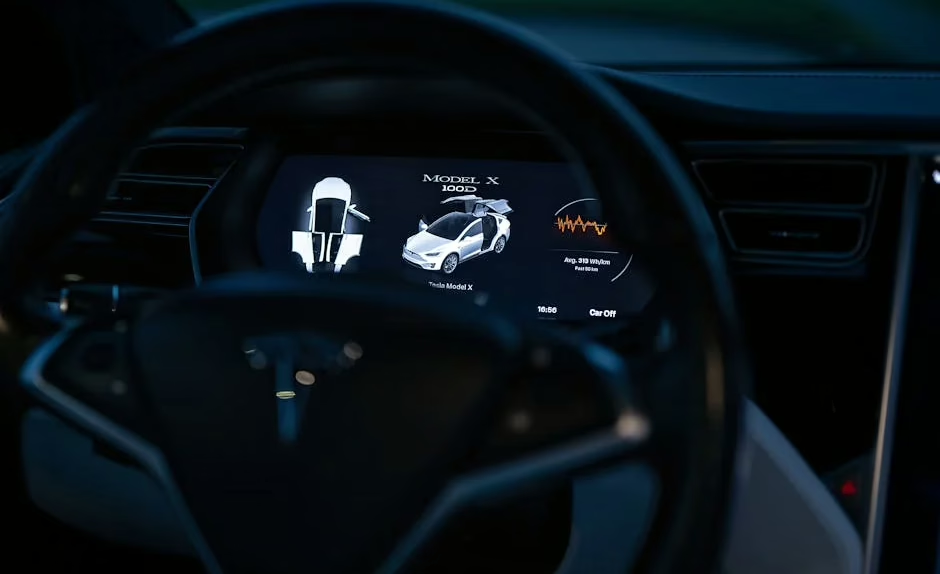

Tesla’s Full Self-Driving (Supervised) system reached 1.28 million active subscribers in Q1 2024, representing a 51% year-over-year growth that helped boost the company’s revenue to $22.38 billion. This milestone comes as the automotive industry rapidly adopts AI-powered features, from advanced driver assistance systems (ADAS) to fully autonomous vehicles, fundamentally changing how we interact with our cars.
Tesla’s FSD Success Drives Revenue Growth
According to TechCrunch, Tesla’s automotive revenue climbed to $16.2 billion in Q1 2024, up from $13.96 billion in the previous year. The company’s FSD subscription service has become a significant revenue driver, with users paying monthly fees to access Tesla’s most advanced autonomous driving features.
The FSD system represents Tesla’s approach to achieving full autonomy through over-the-air software updates rather than expensive hardware retrofits. For everyday drivers, this means your Tesla can potentially become more capable over time without visiting a service center. The system currently handles highway driving, lane changes, and parking, though it still requires driver supervision.
Tesla’s positive free cash flow of $1.44 billion surprised analysts who expected higher cash burn during the quarter. This financial stability allows the company to continue investing heavily in AI development and expanding its autonomous driving capabilities.
How ADAS Features Are Changing Daily Driving
Advanced Driver Assistance Systems have evolved from simple cruise control to sophisticated AI-powered co-pilots. Modern ADAS features include:
- Adaptive cruise control that maintains safe following distances
- Lane-keeping assist that gently steers to prevent drift
- Automatic emergency braking that can prevent collisions
- Blind spot monitoring with visual and audio alerts
- Traffic sign recognition that displays speed limits and warnings
These features work together to create a safety net around drivers, reducing fatigue on long trips and providing extra protection in challenging conditions. The user experience feels like having a co-pilot who never gets tired or distracted, though drivers must remain engaged and ready to take control.
Real-World Benefits for Consumers
Everyday users report that ADAS features significantly reduce stress during commutes. Highway driving becomes less taxing when the car handles speed adjustments and lane positioning. Parents particularly appreciate features like automatic emergency braking, which can react faster than human reflexes when children unexpectedly enter the road.
The learning curve varies by manufacturer. Tesla’s interface is relatively minimalist, relying heavily on the touchscreen, while traditional automakers often use physical buttons and dashboard displays that some users find more intuitive.
Waymo and the Race for Full Autonomy
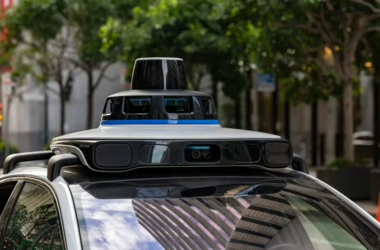
While Tesla focuses on consumer vehicles, Waymo has taken a different approach with dedicated robotaxi fleets. Waymo’s vehicles use a combination of cameras, radar, and LiDAR sensors to create detailed 3D maps of their environment. For passengers, riding in a Waymo feels like being chauffeur-driven, with smooth acceleration and cautious driving behavior.
The company operates commercial robotaxi services in Phoenix and San Francisco, with plans to expand to other cities. Unlike Tesla’s approach, Waymo vehicles are designed to operate without any human driver, representing a fundamentally different user experience.
Key differences passengers notice:
- Waymo vehicles drive more conservatively than human drivers
- The ride-hailing app shows real-time vehicle positioning and route updates
- Vehicles can handle complex urban scenarios like construction zones and emergency vehicles
- No driver interaction means passengers can work or relax during the journey
Uber’s $10 Billion Autonomous Vehicle Investment Strategy
According to TechCrunch Mobility, Uber has committed over $10 billion to autonomous vehicle technology through direct investments and vehicle purchase agreements. This includes $2.5 billion in equity stakes and $7.5 billion earmarked for buying robotaxis over the coming years.
Uber’s strategy differs from both Tesla and Waymo. Rather than developing technology in-house, the company is partnering with multiple autonomous vehicle manufacturers including WeRide, Rivian, and Wayve. For Uber users, this means access to various types of autonomous vehicles depending on location and service tier.
This approach could accelerate autonomous vehicle adoption by providing immediate scale and distribution for AV companies. Users might soon choose between different autonomous vehicle brands within the same Uber app, similar to selecting different car categories today.
The User Interface Evolution in Autonomous Vehicles
As vehicles become more autonomous, the user interface is evolving dramatically. Traditional dashboards with speedometers and fuel gauges are giving way to large touchscreens and voice controls. The driving experience is becoming more like using a smartphone app than operating traditional machinery.
Key Interface Trends:
- Voice commands for navigation and climate control
- Gesture recognition for hands-free operation
- Eye tracking to ensure driver attention during semi-autonomous modes
- Predictive interfaces that anticipate user needs based on driving patterns
- Over-the-air updates that add new features without hardware changes
These changes require users to adapt to new interaction patterns. Older drivers sometimes struggle with touchscreen-heavy interfaces, while younger users appreciate the smartphone-like experience.
What This Means
The automotive AI revolution is accelerating, with Tesla’s FSD subscriber growth demonstrating consumer appetite for autonomous features. For everyday drivers, this means safer, less stressful commutes and the gradual transition from driving to being driven.
The competition between different approaches—Tesla’s vision-only system, Waymo’s sensor-rich robotaxis, and Uber’s platform strategy—will likely benefit consumers through faster innovation and more choices. However, the transition period requires drivers to learn new interfaces and trust AI systems with their safety.
The $10+ billion in investments flowing into autonomous vehicle technology suggests this transformation will accelerate over the next few years. Early adopters are already experiencing the benefits, while mainstream adoption awaits further cost reductions and regulatory clarity.
FAQ
Q: How much does Tesla’s Full Self-Driving cost and what does it include?
A: Tesla FSD currently costs $199/month or $12,000 upfront. It includes highway autopilot, automatic lane changes, summon features, and traffic light/stop sign recognition, though it requires driver supervision.
Q: Are autonomous vehicles safer than human drivers?
A: Current data suggests ADAS features reduce accident rates, but fully autonomous vehicles are still being tested. Tesla reports lower accident rates for vehicles using Autopilot, though independent verification of these claims continues.
Q: When will fully autonomous vehicles be widely available?
A: Timeline predictions vary widely. Waymo operates limited robotaxi services now, while Tesla targets broader FSD deployment by 2025. Widespread adoption likely depends on regulatory approval and cost reduction over the next 5-10 years.