
XPENG launched its VLA 2.0 autonomous driving system in March 2026 as a full shipping product, positioning it ahead of Tesla’s still-testing Full Self-Driving system in the competitive Chinese market. According to Forbes, the system has already become a major factor boosting XPENG sales, with real-world testing showing confident navigation through Beijing’s urban streets without human intervention.
VLA 2.0 Performance Demonstrates Market Readiness
Forbes contributor James Morris tested VLA 2.0 firsthand at the Beijing Auto Show, driving an XPENG P7 Ultra through Beijing’s challenging urban environment. The system navigated traffic, unpredictable motorbikes, narrow streets, and complicated junctions without requiring human intervention across 40 minutes of driving.
The autonomous system displayed human-like decision-making, including preemptively changing lanes when a truck appeared likely to enter their lane. This level of sophistication contrasts with Tesla’s FSD, which remains in public testing phase rather than full commercial deployment.
“Our best feature is autonomous driving,” XPENG Chairman and CEO He Xiaopeng told Forbes. “VLA 2.0 has had very good results. The first generation was already the top autonomous driving system.”
Tesla FSD Subscription Growth Amid Competitive Pressure
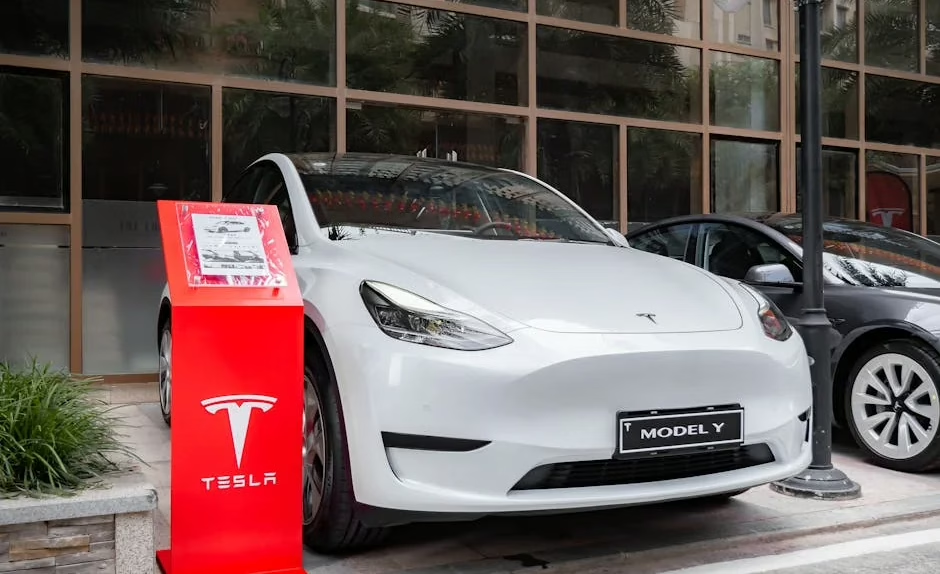
Despite facing new competition, Tesla reported strong FSD adoption numbers in its Q1 2026 earnings. According to TechCrunch, active FSD subscriptions reached 1.28 million, representing 51% year-over-year growth and contributing to Tesla’s $22.38 billion quarterly revenue.
Tesla’s automotive revenue rose to $16.2 billion compared to $13.96 billion in Q1 2025, with higher average vehicle prices and FSD subscriptions helping offset delivery challenges. The company delivered 358,023 EVs globally in Q1 2026, below analyst expectations of around 368,000 vehicles.
The revenue boost from FSD subscriptions highlights the growing importance of software-based revenue streams in the automotive industry, as manufacturers seek recurring income beyond one-time vehicle sales.
Safety Concerns Emerge with AI Integration
CNBC reported on growing concerns about AI chatbot integration in vehicles, featuring Tesla owner Mike Nelson’s experience using xAI’s Grok while driving in New York City. Nelson, a lawyer with auto insurance background, described the AI chatbot as “useful, nearly irresistible, and dangerous” when used while driving.
The integration of conversational AI systems in vehicles raises questions about driver distraction and safety protocols. While autonomous driving systems aim to reduce human intervention, the addition of interactive AI features could paradoxically increase cognitive load on drivers who aren’t fully autonomous.
Regulatory frameworks for AI-vehicle integration remain largely undeveloped, creating potential liability gaps as these technologies become more widespread in consumer vehicles.
Enterprise AI Adoption Accelerates Across Industries
Google’s latest enterprise AI report documented 1,302 real-world generative AI use cases across leading organizations, with automotive applications representing a growing segment. The report highlights the automotive industry’s rapid adoption of AI for manufacturing optimization, predictive maintenance, and customer service enhancement.
Google also announced Deep Research Max, an enhanced autonomous research agent built with Gemini 3.1 Pro, designed for enterprise workflows including automotive market research and competitive analysis. The system can blend open web data with proprietary information streams to deliver professional-grade analyses.
These enterprise AI tools enable automotive companies to accelerate research and development cycles, potentially shortening the time from concept to market for new autonomous driving features.
Market Dynamics Shift Toward Chinese Innovation
The automotive AI landscape shows Chinese manufacturers gaining technological advantages in specific markets. XPENG’s VLA 2.0 commercial deployment contrasts with Tesla’s continued beta testing approach, suggesting different regulatory environments and risk tolerances between markets.
Chinese automakers face intense domestic competition, driving rapid innovation cycles and feature differentiation. This competitive pressure has produced shipping autonomous driving products while Western counterparts remain in extended testing phases.
European market entry for Chinese autonomous driving technology faces additional challenges, including emotional brand attachment and heritage preferences that may limit adoption regardless of technical superiority.
What This Means
The automotive AI market is fragmenting along geographic lines, with Chinese manufacturers shipping commercial autonomous driving products while Western companies maintain cautious testing approaches. XPENG’s VLA 2.0 commercial success demonstrates that consumers will adopt advanced autonomous features when they’re reliable and readily available.
Tesla’s strong FSD subscription growth shows continued market demand for autonomous driving capabilities, even in beta form. The 51% year-over-year increase in FSD subscriptions indicates consumers are willing to pay for incremental autonomous improvements while waiting for full self-driving capabilities.
Safety concerns around AI integration in vehicles will likely drive new regulatory frameworks as conversational AI becomes standard in automotive interfaces. The tension between helpful AI assistance and driver distraction represents a key challenge for automakers implementing these features.
FAQ
How does XPENG’s VLA 2.0 differ from Tesla’s FSD?
VLA 2.0 is a commercially shipping product available to consumers, while Tesla’s FSD remains in supervised beta testing. VLA 2.0 demonstrated autonomous urban driving without human intervention, whereas FSD still requires driver supervision and intervention capability.
What are Tesla’s FSD subscription numbers?
Tesla reported 1.28 million active FSD subscriptions in Q1 2026, representing 51% year-over-year growth. These subscriptions contributed significantly to Tesla’s $22.38 billion quarterly revenue alongside higher average vehicle prices.
Are AI chatbots safe to use while driving?
Experts express concerns about AI chatbot integration in vehicles, with one Tesla owner describing Grok as “useful, nearly irresistible, and dangerous” while driving. The technology may increase cognitive load and distraction risks, especially in non-autonomous vehicles requiring active driver attention.