
The autonomous vehicle industry is experiencing an unprecedented talent exodus, with companies like Tesla and Waymo watching their top engineers leave for defense tech and robotics startups offering salaries between $300,000 and $500,000. According to TechCrunch, this new “poaching war” is forcing automotive companies to dramatically increase compensation packages or risk losing critical AI talent to better-paying physical AI positions.
The competition has intensified as defense tech companies, backed by generous Department of Defense contracts, aggressively recruit engineers with hybrid skills combining classical robotics and AI expertise. This talent drain threatens to slow progress on self-driving cars and advanced driver assistance systems (ADAS) just as the technology reaches critical mass.
Physical AI Companies Lure Automotive Engineers
The buzzworthy physical AI sector encompasses robotics companies developing humanoid robots, industrial automation, and defense technologies. These firms specifically target engineers from autonomous vehicle companies because they possess the rare combination of skills needed to integrate AI into hardware systems.
Key factors driving the talent war:
- Salary inflation: Base salaries reaching $300K-$500K annually
- Defense spending: DoD’s open wallet funding aggressive recruitment
- Skill scarcity: Limited pool of engineers with hybrid AI-robotics expertise
- Industry overlap: Similar technical challenges across autonomous systems
One autonomous vehicle founder described the ideal candidate as someone with “hybrid skills, a mix of classical robotics and AI know-how.” This specific understanding of AI-hardware integration makes these engineers valuable across multiple industries, from construction equipment to agricultural machinery.
The talent shortage particularly impacts applied researcher and AI enablement engineer positions, which have become “hot tickets” in the current market. Companies developing self-driving trucks and robotaxis find themselves competing not just with traditional automotive rivals but with well-funded startups in entirely different sectors.
ADAS Technology Advances Despite Talent Challenges
While companies scramble for talent, advanced driver assistance systems continue evolving rapidly. Modern ADAS features like adaptive cruise control, lane-keeping assist, and automatic emergency braking have become standard across vehicle segments, making cars safer and more user-friendly.
Current ADAS capabilities include:
- Traffic jam assist: Handles stop-and-go driving automatically
- Highway pilot: Manages steering, acceleration, and braking on freeways
- Parking assistance: Automated parallel and perpendicular parking
- Blind spot monitoring: Alerts drivers to vehicles in adjacent lanes
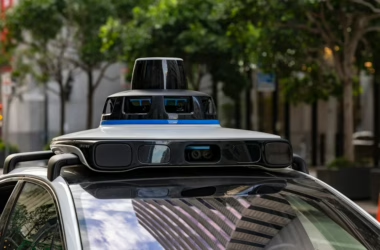
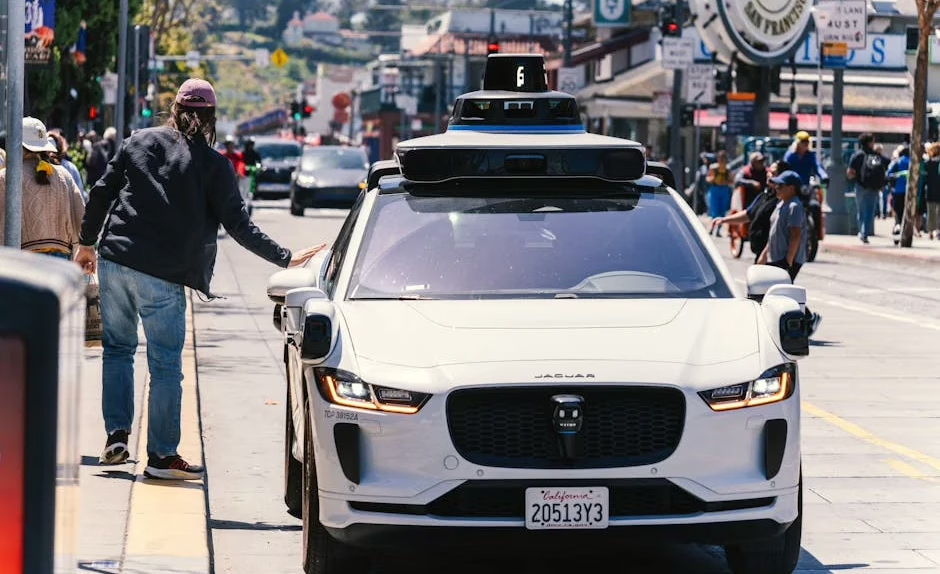
Tesla’s Autopilot and Full Self-Driving (FSD) systems represent the most advanced consumer-available ADAS technology, though they still require driver supervision. Waymo takes a different approach with fully autonomous robotaxis operating in select cities without human drivers.
The user experience varies significantly between systems. Tesla’s interface feels more like a smartphone app, with over-the-air updates adding new features regularly. Traditional automakers often provide more conservative systems that prioritize safety over cutting-edge capabilities.
For everyday drivers, these systems reduce fatigue during long commutes and highway driving. However, users must remain attentive and ready to take control, as current technology cannot handle all driving scenarios reliably.
EV Integration Accelerates Autonomous Development
Electric vehicles provide an ideal platform for autonomous driving technology. EVs’ digital architecture and instant torque delivery enable more precise control than traditional internal combustion engines. This synergy explains why companies like Tesla lead both EV adoption and self-driving development.
Advantages of EV platforms for autonomy:
- Instant response: Electric motors provide immediate acceleration and braking
- Digital control: Software can precisely manage power delivery
- Sensor integration: Clean electrical systems support advanced sensors
- Over-the-air updates: Connected architecture enables remote improvements
Tesla leverages this integration advantage by collecting real-world driving data from its entire fleet. Every Tesla on the road contributes to improving the company’s neural networks, creating a massive training dataset that traditional automakers struggle to match.
Waymo partners with multiple automakers to deploy its technology across different vehicle platforms, including Chrysler Pacifica minivans and Jaguar I-PACE electric SUVs. This approach allows Waymo to focus on software development while leveraging established manufacturing capabilities.
The combination of electric powertrains and autonomous technology also appeals to fleet operators. Companies like Uber and Lyft see autonomous EVs as the future of ride-sharing, offering lower operating costs and reduced emissions.
Enterprise AI Development Challenges
Beyond automotive applications, AI development faces scaling challenges across industries. According to VentureBeat, enterprise teams are adopting “spec-driven development” to manage autonomous coding agents safely and effectively.
This approach requires AI systems to work from structured specifications that define system requirements and success criteria before writing code. The methodology has proven successful for enterprise teams, with some completing projects in 76 days that originally required 18 months and 30 developers.
Similar principles apply to automotive AI development. Self-driving systems must operate within clearly defined parameters, with extensive testing and validation before deployment. The complexity of real-world driving scenarios demands rigorous specification-driven development to ensure safety and reliability.
Key development principles:
- Specification-first: Define requirements before implementation
- Continuous validation: Test against specifications throughout development
- Structured reasoning: AI agents must explain decision-making processes
- Safety constraints: Hard limits on system behavior in critical scenarios
What This Means
The talent war in autonomous vehicles reflects the broader transformation of AI from experimental technology to essential business capability. Companies that secure top engineering talent will likely lead the next phase of automotive innovation, while those that lose key personnel may fall behind in the race to deploy safe, reliable self-driving systems.
For consumers, this competition ultimately benefits vehicle safety and capability. As companies invest heavily in talent and technology, ADAS features become more sophisticated and accessible across price segments. The challenge lies in managing this rapid development responsibly, ensuring that autonomous systems meet rigorous safety standards before widespread deployment.
The intersection of EVs and autonomous technology creates new opportunities for innovative user experiences. Future vehicles will likely function more like mobile computers, with AI assistants managing not just driving tasks but also entertainment, productivity, and connectivity features.
FAQ
What salary ranges are autonomous vehicle engineers commanding?
Base salaries for experienced AI engineers in the autonomous vehicle sector now range from $300,000 to $500,000 annually, not including equity and benefits packages.
Which companies are most aggressively recruiting automotive AI talent?
Defense tech startups backed by Department of Defense contracts are offering the highest compensation packages, followed by physical AI companies developing robotics and industrial automation systems.
How do Tesla and Waymo differ in their autonomous driving approaches?
Tesla focuses on camera-based systems with neural networks trained on data from its entire vehicle fleet, while Waymo uses a combination of cameras, lidar, and radar sensors for fully autonomous operation in mapped areas.