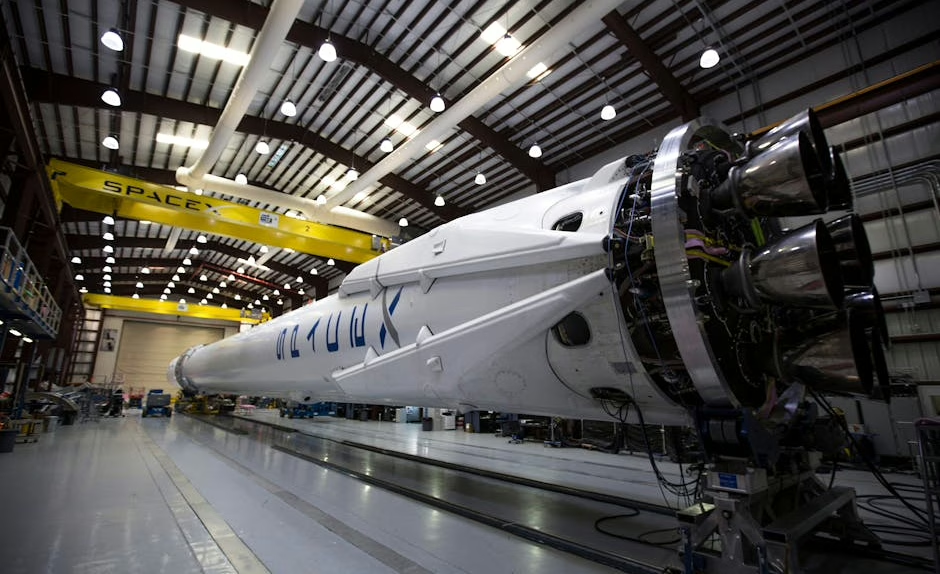

SpaceX has struck a partnership deal with AI coding platform Cursor that includes an option to acquire the startup for $60 billion later this year, marking one of the largest potential AI acquisitions on record. The deal comes as AI companies command unprecedented valuations, with Cursor’s potential $60 billion price tag representing a 24x increase from its $2.5 billion valuation just 15 months ago.
According to TechCrunch, the partnership combines Cursor’s software development expertise with SpaceX’s Colossus supercomputer, which reportedly has compute power equivalent to one million Nvidia H100 chips. The arrangement gives SpaceX the option to either pay Cursor $10 billion for development work or acquire the entire company for $60 billion.
AI Valuations Reach Stratospheric Levels
The Cursor deal exemplifies the explosive growth in AI company valuations across the sector. Cursor’s journey from a $2.5 billion valuation in January 2024 to a potential $60 billion acquisition price demonstrates the market’s appetite for AI development tools.
Key valuation milestones:
- January 2024: $2.5 billion
- May 2024: $9 billion
- November 2024: $29.3 billion post-money (Series D)
- April 2026: $60 billion potential acquisition
Meanwhile, Forbes reports that General Catalyst’s portfolio company Anthropic achieved a $380 billion valuation in its Series G funding round, further highlighting the premium investors place on leading AI platforms.
The rapid appreciation reflects both the technical capabilities of these platforms and their potential to transform entire industries. Cursor’s AI-powered coding tools have gained significant traction among software engineers, while Anthropic’s Claude models compete directly with OpenAI’s GPT series.
Enterprise AI Adoption Drives Market Demand
The appetite for AI acquisitions stems from accelerating enterprise adoption across industries. Google Cloud’s blog documents 1,302 real-world generative AI use cases from leading organizations, demonstrating that AI has moved from experimentation to production deployment.
Production AI deployment trends:
- Agentic systems: Organizations deploy AI agents for autonomous task completion
- Enterprise integration: AI embedded into core business processes
- Infrastructure scaling: Companies invest in AI-specific computing infrastructure
- Revenue generation: AI applications directly contribute to business outcomes
Google’s analysis reveals that the “agentic enterprise” era has arrived, with organizations using tools like Gemini Enterprise and AI Hypercomputer infrastructure to build scalable AI systems. This enterprise demand creates substantial value for AI platform providers, justifying premium acquisition prices.
Microsoft’s blog reinforces this trend, describing “Frontier Transformation” where AI becomes a repeatable, governed capability across organizations. The company’s partner ecosystem focuses on delivering measurable business outcomes with built-in security and governance.
Fintech Consolidation Contrasts with AI Boom
While AI companies command record valuations, other sectors face different dynamics. The fintech space illustrates how strategic decisions can significantly impact company trajectories and acquisition opportunities.
Airwallex CEO Jack Zhang’s decision to reject Stripe’s $1.2 billion acquisition offer in 2018 demonstrates the importance of timing and vision in startup exits. TechCrunch reports that Airwallex now generates over $1.3 billion in annualized revenue with 85% year-over-year growth, processing nearly $300 billion in transaction volume.
Airwallex’s growth trajectory:
- 2018: $2 million annualized revenue, $1.2B acquisition offer
- 2026: $1.3 billion annualized revenue, 85% YoY growth
- Revenue multiple: From 600x offer to sustainable growth model
This example highlights how founders’ long-term vision can create significantly more value than early acquisition offers, particularly in rapidly evolving technology sectors.
Private Market Dynamics Shift Investment Strategies
The current market environment presents challenges for traditional growth-stage investing models. General Catalyst’s investor letter reveals that software buyouts structured around terminal value rather than cash flow now deliver negative returns even when underlying businesses perform well.
Market compression impacts:
- Public software multiples: Compressed to 12.7x EBITDA
- Historical entry multiples: 25x EBITDA (2019-2021)
- Performance impact: Deals entering at 25x returning 0.68x MOIC with -7% IRR
General Catalyst’s $43 billion AUM positions the firm to capitalize on this market dislocation, focusing on companies with strong cash flow generation rather than pure growth metrics. This shift affects how investors evaluate AI companies, emphasizing sustainable business models alongside technological innovation.
The firm’s analysis suggests that successful AI investments will require different evaluation criteria, focusing on revenue quality, customer retention, and path to profitability rather than solely on user growth or technical capabilities.
Strategic Implications for Tech Giants
SpaceX’s potential Cursor acquisition reflects broader strategic positioning by major technology companies. The deal connects to Elon Musk’s broader AI ecosystem, including xAI’s computing infrastructure and talent pipeline.
Cross-platform synergies:
- xAI provides computing power to Cursor for model training
- Former Cursor executives Andrew Milich and Jason Ginsberg joined xAI
- SpaceX’s Colossus supercomputer enhances development capabilities
- Integration supports SpaceX’s anticipated IPO strategy
This interconnected approach allows technology conglomerates to create value across multiple AI platforms while building competitive moats through integrated infrastructure and talent.
The timing aligns with SpaceX’s IPO preparations, where AI capabilities could enhance the company’s valuation by demonstrating diversification beyond aerospace applications.
What This Means
The SpaceX-Cursor deal signals a maturation in AI company valuations, where leading platforms command prices typically reserved for established technology giants. The $60 billion potential acquisition represents more than many Fortune 500 companies’ market capitalizations, reflecting AI’s perceived strategic value.
For investors, these valuations require careful evaluation of sustainable competitive advantages and revenue models. While AI companies demonstrate impressive growth rates, the ultimate success depends on their ability to maintain market position as competition intensifies.
The contrast between AI boom valuations and compressed software multiples suggests that investors increasingly distinguish between transformative technologies and incremental improvements. Companies that can demonstrate clear AI differentiation and enterprise adoption will likely command premium valuations, while traditional software businesses face multiple compression.
FAQ
What makes Cursor worth $60 billion to SpaceX?
Cursor’s AI-powered coding platform provides strategic value through its developer ecosystem and technical capabilities, which complement SpaceX’s computing infrastructure and support the company’s broader AI initiatives across Musk’s technology portfolio.
How do current AI valuations compare to historical technology deals?
Cursor’s potential $60 billion price tag represents one of the largest AI acquisitions proposed, comparable to major technology acquisitions like Microsoft’s LinkedIn ($26B) or Facebook’s WhatsApp ($19B), but reflects AI’s perceived transformative potential.
Why are software companies facing valuation pressure while AI companies thrive?
Public market software multiples have compressed from 25x to 12.7x EBITDA, making traditional software investments less attractive, while AI companies benefit from enterprise adoption trends and perceived competitive advantages in emerging technology categories.
Related news
- Microsoft considered acquiring Cursor before SpaceX deal – Yahoo Finance – Google News – Microsoft
- Microsoft looked at buying Cursor before SpaceX deal: report (MSFT:NASDAQ) – Seeking Alpha – Google News – Microsoft