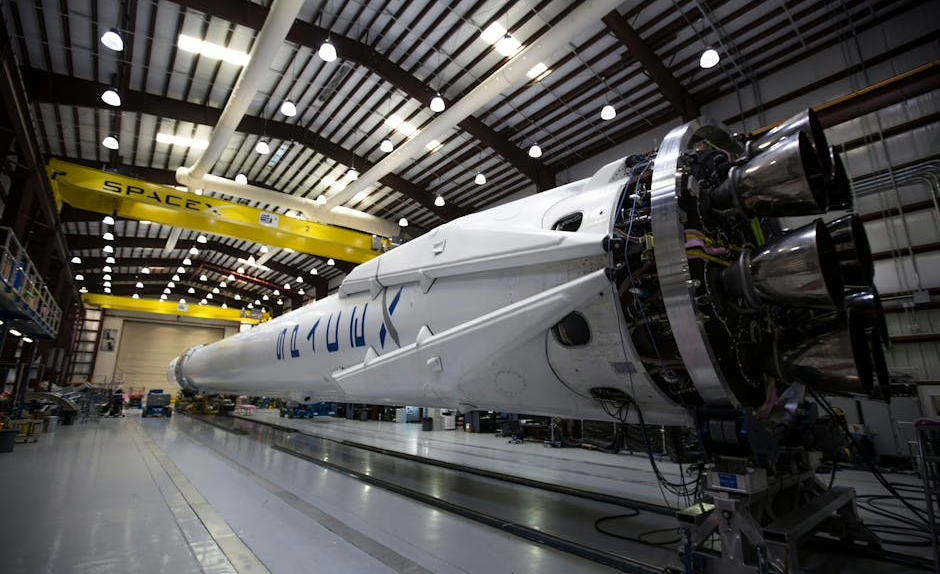

SpaceX has struck a partnership deal with AI coding platform Cursor that includes an option to acquire the startup for $60 billion later this year, according to TechCrunch. The arrangement represents one of the largest potential AI acquisitions on record and signals how artificial intelligence capabilities are becoming strategic imperatives for major technology companies preparing for public offerings.
The deal comes as AI-focused investments and acquisitions are driving unprecedented valuations across the sector, with companies like Anthropic reaching $380 billion in Series G funding and venture capital firms fundamentally reassessing traditional software investment models.
Strategic AI Partnerships Drive Massive Valuations
The SpaceX-Cursor arrangement demonstrates how AI capabilities have become essential infrastructure for technology companies. Under the partnership, Cursor will leverage SpaceX’s Colossus supercomputer, which the company claims has computing power equivalent to one million Nvidia H100 chips, to develop next-generation coding and knowledge work AI systems.
Cursor’s valuation trajectory reflects the AI boom’s impact on startup funding:
- January 2023: $2.5 billion valuation
- May 2024: $9 billion valuation
- November 2024: $29.3 billion post-money valuation on $2.3 billion Series D
- Current potential acquisition: $60 billion
The partnership also includes a $10 billion alternative payment structure, giving SpaceX flexibility in how it structures the eventual transaction. This approach mirrors broader trends in AI M&A, where companies are using creative deal structures to access cutting-edge capabilities while managing capital requirements.
Traditional Software Buyout Models Face Crisis
While AI companies command premium valuations, traditional software investments are experiencing significant headwinds. General Catalyst’s first quarterly investor letter reveals that software buyouts structured around terminal value rather than cash flow are delivering negative returns even when underlying businesses perform well, according to Forbes.
The math behind the crisis is stark:
- Public software multiples have compressed to 12.7x EBITDA
- 2019-2021 buyouts typically entered at 25x EBITDA multiples
- Even with 50% EBITDA growth, deals now return 0.68x MOIC and negative 7% IRR
General Catalyst CEO Hemant Taneja argues this represents a fundamental shift requiring new investment approaches. The firm’s $43 billion in assets under management positions it to capitalize on the emerging AI-driven investment landscape, particularly as traditional software models face structural challenges.
Corporate AI Transformation Accelerates
Microsoft’s partner ecosystem demonstrates how enterprise AI adoption is moving from experimentation to production deployment. The company’s “Frontier Transformation” framework focuses on embedding AI capabilities into business processes with built-in security, governance, and responsible AI practices from day one, according to the Microsoft Blog.
Key elements of enterprise AI transformation include:
- Intelligence grounded in unique business data and context
- Trust-by-design with observable, managed AI systems
- Enriched employee experiences through AI-powered tools
- Reinvented customer engagement via agentic solutions
This enterprise focus creates significant revenue opportunities for AI companies that can demonstrate measurable business outcomes. Microsoft’s emphasis on partner-delivered solutions also highlights how AI capabilities are becoming differentiators in competitive markets.
Strategic Positioning in Competitive Landscapes
The Airwallex-Stripe rivalry illustrates how companies are choosing strategic independence over acquisition premiums to capture long-term market opportunities. Airwallex CEO Jack Zhang rejected Stripe’s $1.2 billion acquisition offer in 2018 when the company had just $2 million in annualized revenue, according to TechCrunch.
Airwallex’s post-rejection performance validates the strategic decision:
- Current annualized revenue: Over $1.3 billion
- Year-over-year growth rate: 85%
- Annualized transaction volume: Nearly $300 billion
- Revenue multiple at offer time: Approximately 600x
This case demonstrates how founders are increasingly confident in their ability to build independent, scaled businesses rather than accepting early acquisition offers. The decision reflects broader market dynamics where access to capital and growing addressable markets support longer independent growth trajectories.
Asset-Heavy Strategies Return to Tech
Uber’s commitment of over $10 billion to autonomous vehicle investments represents a return to asset-heavy strategies after years of asset-light operations. The company has allocated approximately $2.5 billion in direct investments and $7.5 billion for robotaxi purchases over the coming years, according to TechCrunch.
Uber’s current AV investment portfolio includes:
- WeRide partnership and investment
- Lucid and Nuro equity stakes
- Rivian strategic investment
- Wayve funding participation
This approach contrasts with Uber’s 2015-2020 strategy, when it developed in-house capabilities through Uber ATG and acquisitions like Otto and Jump, only to divest these assets while retaining equity stakes. The current strategy focuses on partnerships and strategic investments rather than internal development, potentially offering better risk-adjusted returns.
What This Means
The convergence of AI capabilities, enterprise transformation needs, and evolving investment models is reshaping technology M&A fundamentals. Companies like SpaceX are willing to pay unprecedented premiums for AI capabilities that provide competitive advantages, while traditional software investments face structural headwinds from multiple compression.
This environment creates opportunities for AI-focused companies to command premium valuations while forcing traditional software businesses to demonstrate sustainable cash flow generation rather than relying on terminal value expectations. The shift suggests that AI capabilities are becoming essential infrastructure rather than optional enhancements, driving strategic acquisition activity across industries.
For investors, the divergence between AI and traditional software returns indicates a fundamental reallocation of capital toward companies that can demonstrate measurable AI-driven business outcomes. This trend is likely to accelerate as enterprise customers move from AI experimentation to production deployment at scale.
FAQ
What makes the SpaceX-Cursor deal significant for AI M&A?
The potential $60 billion acquisition price represents one of the largest AI deals on record and demonstrates how coding AI platforms have become strategic infrastructure for major technology companies, particularly those preparing for public offerings.
Why are traditional software buyouts underperforming?
Public market multiple compression from 25x to 12.7x EBITDA has destroyed equity value in software buyouts, creating negative returns even when underlying businesses grow EBITDA by 50%, according to General Catalyst’s analysis.
How are companies structuring AI partnerships differently?
Companies are using hybrid models combining partnerships, equity stakes, and acquisition options rather than traditional buyouts, allowing access to AI capabilities while managing capital requirements and risk exposure.