
Tesla’s Full Self-Driving (FSD) subscriptions reached 1.28 million active users in Q1, representing a 51% year-over-year increase that helped drive the company’s revenue to $22.38 billion. This milestone comes as the automotive industry accelerates its push toward autonomous driving, with companies like Uber committing over $10 billion to autonomous vehicle technology and AI agents transforming how we think about transportation.
The surge in FSD adoption reflects growing consumer confidence in advanced driver assistance systems (ADAS), even as the broader electric vehicle market faces headwinds from policy changes and economic pressures.
Tesla’s FSD Success Signals Growing ADAS Acceptance
Tesla’s FSD subscription growth tells a compelling story about consumer readiness for autonomous features. According to TechCrunch, the 1.28 million active subscribers represent real users paying monthly fees to access Tesla’s most advanced driver assistance capabilities.
What makes this particularly interesting from a user experience perspective is how Tesla has packaged these features. Rather than requiring a massive upfront purchase, the subscription model lets drivers experience autonomous capabilities gradually. Users can try features like:
- Navigate on Autopilot for highway driving
- Auto Lane Change for safer merging
- Summon for parking lot retrieval
- Traffic Light and Stop Sign Control for city driving
The subscription approach removes the psychological barrier of a large one-time payment while giving Tesla ongoing revenue and user feedback to improve the system. It’s a smart business model that makes cutting-edge technology more accessible to everyday drivers.
The Broader Autonomous Vehicle Investment Boom
Tesla isn’t alone in this space. TechCrunch reports that Uber has committed more than $10 billion to autonomous vehicle technology, with $2.5 billion in direct investments and $7.5 billion earmarked for purchasing robotaxis over the coming years.
This represents a fundamental shift in Uber’s strategy. After previously divesting from in-house development projects like Uber ATG, the company is now taking an “asset-heavy” approach by investing in and purchasing autonomous vehicles from partners like:
- Waymo for robotaxi operations
- WeRide for international expansion
- Rivian for delivery vehicles
- Wayve for AI-powered driving systems
For consumers, this means we’re likely to see autonomous ride-sharing options become available much sooner than many expected. Instead of waiting for one company to perfect the technology, Uber’s approach of partnering with multiple autonomous vehicle developers creates redundancy and accelerates deployment.
AI Agents Transform Automotive Development
The automotive industry’s AI transformation extends beyond just self-driving cars. Google’s research capabilities and NVIDIA’s AI collaborations show how AI agents are revolutionizing everything from vehicle design to customer experience.
Modern automotive AI systems can now:
- Analyze traffic patterns in real-time to optimize routing
- Predict maintenance needs before components fail
- Personalize in-vehicle experiences based on driver preferences
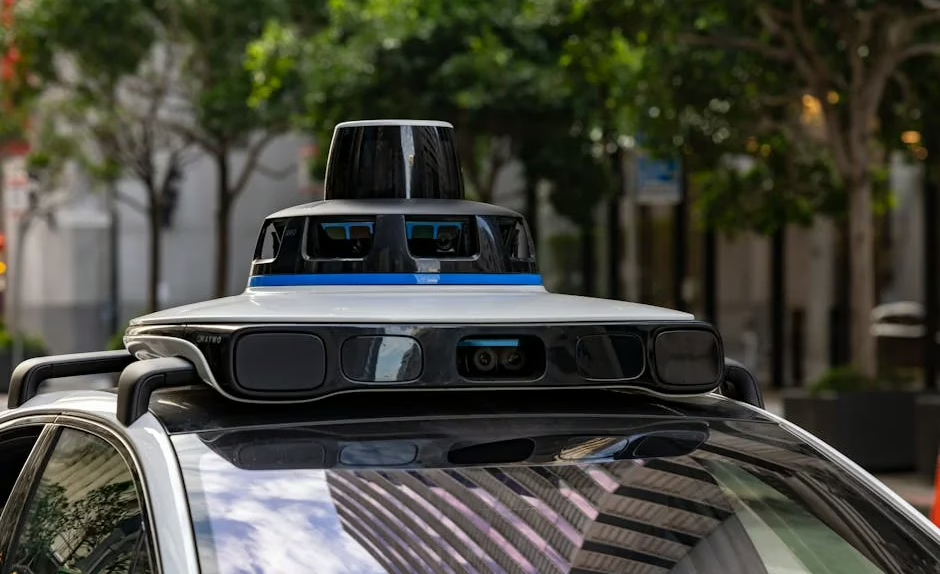
- Process sensor data from cameras, radar, and LiDAR simultaneously
What’s particularly exciting is how these AI systems learn and improve over time. Unlike traditional automotive features that remain static, AI-powered systems in vehicles like Tesla’s FSD continuously update and enhance their capabilities through over-the-air updates.
User Experience Challenges in Autonomous Driving
Despite the technological progress, significant user experience challenges remain. The transition from human to machine control requires careful interface design and clear communication about system capabilities and limitations.
Key UX considerations include:
Trust Building: Users need clear feedback about what the system can and cannot do. Tesla’s approach of gradual feature rollout helps build confidence, but other manufacturers struggle with transparency.
Handoff Protocols: The moment when control transfers between human and machine is critical. Poor handoff design has led to accidents in other systems, making this a crucial safety and usability issue.
Interface Design: Dashboard displays must communicate complex system status information simply and clearly. Drivers need to understand sensor coverage, system confidence levels, and when intervention might be needed.
Emergency Scenarios: Systems must gracefully handle edge cases and communicate clearly when human intervention is required.
Market Dynamics and Consumer Adoption
The autonomous driving market is experiencing rapid evolution, with different companies taking varied approaches to reach consumers. Tesla’s direct-to-consumer model contrasts sharply with traditional automakers who rely on dealership networks and longer development cycles.
Consumer adoption patterns show interesting trends:
- Early adopters gravitate toward Tesla’s frequent updates and beta features
- Safety-conscious buyers prefer traditional automakers’ more conservative approaches
- Urban users show higher interest in ride-sharing autonomous options
- Rural drivers remain skeptical due to infrastructure limitations
The subscription model appears to be winning over consumers who might otherwise hesitate to purchase expensive autonomous features outright. This suggests that flexible pricing models will be crucial for widespread adoption.
What This Means
Tesla’s FSD subscription success represents more than just a business milestone—it signals that consumers are ready to pay for and actively use autonomous driving features. The 51% year-over-year growth in subscriptions demonstrates genuine market demand, not just technological capability.
For the broader automotive industry, this validates the subscription model approach and suggests that incremental feature rollouts may be more effective than waiting for fully autonomous systems. Uber’s massive investment commitments indicate that the race for autonomous transportation is accelerating, with multiple pathways to market emerging.
Consumers can expect to see autonomous features become more commonplace and affordable over the next few years. However, the user experience will be crucial—companies that can make these complex systems feel intuitive and trustworthy will likely capture the largest market share.
The convergence of subscription models, AI advancement, and significant industry investment suggests we’re approaching a tipping point where autonomous driving transitions from experimental technology to mainstream transportation option.
FAQ
How much does Tesla’s FSD subscription cost?
Tesla’s FSD subscription typically costs $199 per month, though pricing can vary by region and may change based on feature updates.
When will fully autonomous vehicles be available to consumers?
While advanced ADAS features are available now, fully autonomous vehicles for consumer purchase remain several years away, though autonomous ride-sharing services are expanding in select cities.
Are autonomous driving features safe for everyday use?
Current ADAS systems require active driver supervision and are designed to assist rather than replace human drivers. Safety depends on proper use and understanding of system limitations.