
Major AI companies have unveiled significant model releases and updates this week, with OpenAI launching ChatGPT Images 2.0, Anthropic introducing Claude Design powered by Claude Opus 4.7, and Google releasing enhanced Deep Research and Deep Research Max agents built on Gemini 3.1 Pro. These launches represent substantial technical advances in multimodal AI capabilities, from improved text-in-image generation to autonomous research agents that can process both web and private enterprise data.
OpenAI’s ChatGPT Images 2.0 Breakthrough in Text Generation
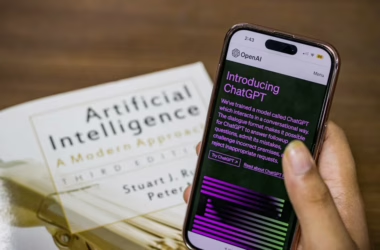
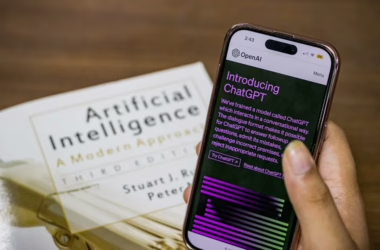
OpenAI’s latest image generation model marks a significant leap forward in addressing one of AI’s most persistent challenges: accurate text rendering within images. According to TechCrunch, the new ChatGPT Images 2.0 model can now generate restaurant menus with properly spelled items, a stark contrast to previous models that produced garbled text like “enchuita” and “burrto.”
The technical architecture behind this improvement remains undisclosed, though researchers have explored autoregressive models as alternatives to traditional diffusion approaches. Unlike diffusion models that reconstruct images from noise, autoregressive models make sequential predictions about image content, functioning more similarly to large language models.
Key technical improvements include:
- Enhanced reasoning capabilities through ChatGPT integration
- Internet search functionality for real-time information
- Multi-image generation from single prompts
- Knowledge cutoff updated to December 2025
- Flexible aspect ratios from 3:1 wide to 1:3 tall
The model demonstrates remarkable granularity in complex image generation, as reported by Wired, successfully creating detailed infographics with accurate weather data and recognizable San Francisco landmarks including the Ferry Building and Transamerica Pyramid.
Anthropic’s Claude Design Enters Visual Creation Space
Anthropic has made its most aggressive expansion beyond core language modeling with the launch of Claude Design, powered by the newly released Claude Opus 4.7 vision model. According to VentureBeat, this represents a direct challenge to established design platforms like Figma, Adobe, and Canva.
The technical foundation of Claude Design leverages Anthropic’s most capable vision model to transform conversational prompts into polished visual outputs. The system can generate:
- Interactive prototypes with functional elements
- Marketing collateral with brand-consistent styling
- Slide decks with professional layouts
- Design mockups with precise specifications
This launch coincides with Anthropic’s remarkable financial trajectory, reaching approximately $30 billion in annualized revenue by April 2026, up from $9 billion at the end of 2025. The company is reportedly in early discussions with Goldman Sachs, JPMorgan, and Morgan Stanley regarding a potential IPO as early as October 2026.
The simultaneous release of both Claude Opus 4.7 and Claude Design signals Anthropic’s strategic pivot from foundation model provider to full-stack product company, aiming to own the entire workflow from concept to shipped product.
Google’s Enhanced Deep Research Agents
Google has significantly upgraded its autonomous research capabilities with Deep Research and Deep Research Max agents, built on the Gemini 3.1 Pro model architecture. These agents represent a technical breakthrough in multi-source data fusion, capable of combining open web information with proprietary enterprise data through a single API call.
https://x.com/sundarpichai/status/2046627545333080316
Advanced technical features include:
Model Context Protocol Integration
The agents support Model Context Protocol (MCP), enabling connections to arbitrary third-party data sources. This architectural approach allows enterprises to integrate their proprietary databases, internal documents, and specialized knowledge bases into the research workflow.
Native Visualization Capabilities
Unlike previous iterations, the new agents can generate native charts and infographics directly within research reports, eliminating the need for separate visualization tools. This capability leverages Gemini 3.1 Pro’s multimodal understanding to create contextually appropriate visual representations of data.
Enterprise-Grade Security
The system maintains strict data isolation between public web searches and private enterprise information, addressing critical security concerns for industries like finance and life sciences where data confidentiality is paramount.
According to VentureBeat, this release marks “an inflection point in the rapidly intensifying race to build AI systems that can autonomously conduct the kind of exhaustive, multi-source research that has traditionally consumed hours or days of human analyst time.”
Technical Architecture Comparisons
These three major releases demonstrate different approaches to advancing AI capabilities:
OpenAI’s approach focuses on improving fundamental image generation quality through architectural innovations that better handle text rendering and spatial relationships.
Anthropic’s strategy emphasizes vertical integration, combining their strongest vision model with application-layer functionality to create end-to-end creative workflows.
Google’s methodology prioritizes horizontal expansion of research capabilities, building agents that can seamlessly integrate multiple data sources while maintaining enterprise security requirements.
Each approach reflects the companies’ broader strategic positioning: OpenAI as the foundational model leader, Anthropic as the safety-focused full-stack provider, and Google as the enterprise-grade infrastructure platform.
Performance Benchmarks and Capabilities
While detailed benchmark comparisons are limited due to the recent nature of these releases, early testing reveals significant improvements across multiple dimensions:
- Text accuracy in images has improved dramatically, with ChatGPT Images 2.0 achieving near-perfect spelling in complex layouts
- Design generation speed in Claude Design reportedly matches or exceeds traditional design tool workflows for simple to moderate complexity projects
- Research comprehensiveness in Google’s Deep Research agents shows substantial improvements in source diversity and factual accuracy
The integration of reasoning capabilities across all three platforms suggests a convergence toward more sophisticated AI systems that can handle multi-step, complex tasks requiring both understanding and generation.
What This Means
These simultaneous releases represent a maturation of multimodal AI capabilities, moving beyond simple generation tasks toward complex, multi-step workflows. The technical advances in text rendering, visual design, and autonomous research signal that AI systems are approaching human-level performance in specialized creative and analytical tasks.
For enterprises, these developments offer unprecedented opportunities to automate knowledge work that previously required significant human expertise. However, the rapid pace of advancement also raises questions about model governance, quality control, and the need for robust evaluation frameworks.
The competitive dynamics suggest that 2026 will be defined by vertical integration strategies, with each major AI company attempting to own complete workflows rather than just providing foundational models.
FAQ
Q: What makes ChatGPT Images 2.0’s text generation superior to previous models?
A: The model appears to use architectural improvements that better handle text rendering, possibly through autoregressive approaches rather than pure diffusion methods, resulting in accurate spelling and formatting in generated images.
Q: How does Claude Design compete with established design tools like Figma?
A: Claude Design leverages conversational prompts and Claude Opus 4.7’s vision capabilities to generate interactive prototypes and marketing materials directly from text descriptions, potentially streamlining the design process for non-designers.
Q: What security measures do Google’s Deep Research agents implement for enterprise data?
A: The agents maintain strict data isolation between public web searches and private enterprise information, using the Model Context Protocol to securely connect to proprietary data sources while preserving confidentiality.
Related news
- Google’s Gemini can now run on a single air-gapped server — and vanish when you pull the plug – VentureBeat
- ChatGPT Images 2.0 launches with text, slides and multilingual output | ETIH EdTech News – EdTech Innovation Hub – Google News – Tech Innovation
- Gemini Enterprise Agent Platform lets you build, govern, and optimize your agents. – Google Blog
Sources
- ChatGPT’s new Images 2.0 model is surprisingly good at generating text – TechCrunch
- OpenAI Beefs Up ChatGPT’s Image Generation Model – Wired
- Anthropic just launched Claude Design, an AI tool that turns prompts into prototypes and challenges Figma – VentureBeat
- Google’s new Deep Research and Deep Research Max agents can search the web and your private data – VentureBeat