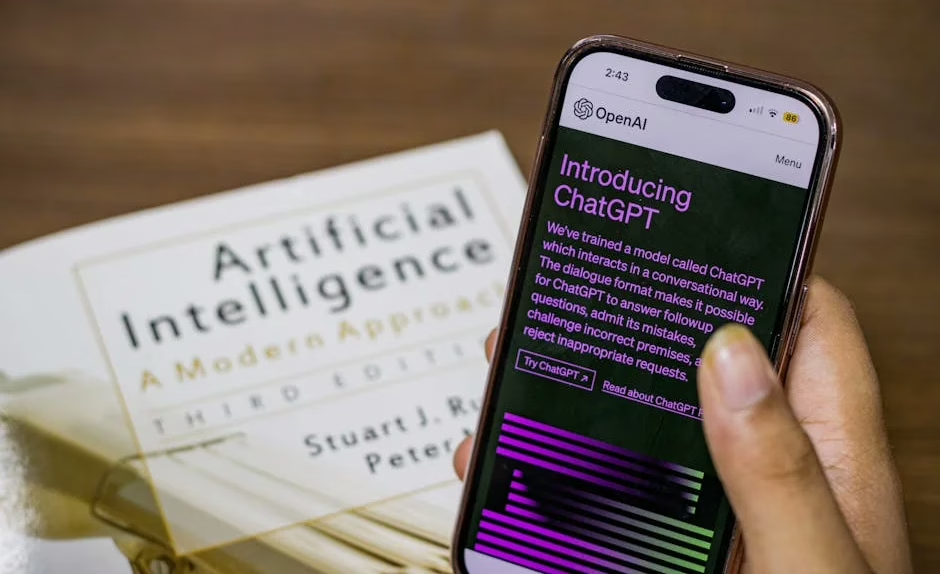

OpenAI has officially released ChatGPT Images 2.0, a significant upgrade to its image generation capabilities, while co-founder Sam Altman’s World project expands its iris-scanning verification technology to major platforms including Tinder and Zoom. The new image model, previously tested under the codename “duct tape” on LM Arena AI, demonstrates substantial improvements in text generation within images, multilingual support, and complex visual compositions.
ChatGPT Images 2.0 Technical Architecture and Capabilities
The new gpt-image-2 model represents a fundamental advancement in multimodal AI architecture. According to VentureBeat, the model can generate complex visual content including:
- Long-form text blocks within single images
- Multilingual text rendering with accurate character formation
- Full infographics and presentation slides
- Interactive user interface mockups with realistic detail
- Character models from multiple viewing angles
- Floor plans and architectural layouts
The technical breakthrough lies in the model’s enhanced instruction-following capabilities and improved understanding of spatial relationships between text and visual elements. This advancement builds upon the previous GPT-Image-1.5 release from December 2025, which focused primarily on color accuracy and lighting improvements.
Early testing revealed the model’s capacity to perform web research integration, embedding real-time information directly into generated images. This functionality suggests sophisticated retrieval-augmented generation (RAG) architecture working in conjunction with the image synthesis pipeline.
World Project Scales Human Verification Infrastructure
Sam Altman’s World project has achieved significant expansion milestones, with 18 million users verified through its iris-scanning Orb technology, representing a 50% increase from 12 million users in 2024. According to Wired, the project addresses the growing challenge of distinguishing human activity from AI-generated content as artificial intelligence becomes increasingly sophisticated.
The Orb verification system employs advanced cryptographic protocols:
- Zero-knowledge proof-based authentication for privacy preservation
- Iris pattern conversion to unique cryptographic identifiers
- Anonymous verification maintaining user privacy while proving humanity
- Cross-platform compatibility for multiple service integrations
Tools for Humanity, the company behind World, announced partnerships extending beyond dating applications to include enterprise solutions for videoconferencing, document signing, and event management systems.
Enterprise Integration and Platform Partnerships
The World verification system has secured integration with multiple major platforms, demonstrating the growing demand for human authentication services. The Verge reports that verified Tinder users receive five free boosts as an incentive, typically a premium feature increasing profile visibility by up to 10 times.
Key platform integrations include:
- Zoom: Hosts can require World ID verification for meeting participants
- DocuSign: Integration for document authentication workflows
- Tinder: Global expansion following successful Japan pilot program
- Concert Kit: Planned rollout for event ticketing and VIP access
The technical architecture enables seamless verification across platforms while maintaining user anonymity through cryptographic protocols. This approach addresses privacy concerns that have previously hindered biometric verification adoption.
Challenges and Market Resistance
Despite technological advances, World has encountered significant obstacles in achieving mainstream adoption. Government regulatory bodies across multiple jurisdictions have investigated the company for potential data protection law violations, creating compliance challenges for international expansion.
A notable setback occurred when Tools for Humanity incorrectly announced a partnership with Bruno Mars for their Concert Kit launch. According to Wired, Bruno Mars Management and Live Nation stated that “the partnership does not exist” and that they were never approached about collaboration. The company subsequently corrected their announcement to feature a 2027 partnership with Thirty Seconds to Mars instead.
This incident highlights the challenges faced by emerging verification technologies in securing entertainment industry partnerships and maintaining accurate public communications.
Technical Implications for AI Detection
The convergence of advanced AI image generation and human verification technologies represents a critical inflection point in digital authentication. ChatGPT Images 2.0’s capability to generate highly realistic content, including accurate reproductions of public figures like Sam Altman, demonstrates the increasing sophistication of AI-generated media.
The zero-knowledge proof architecture employed by World offers a technically sound approach to the verification challenge. By converting biometric data into cryptographic identifiers without storing the original biometric information, the system addresses both security and privacy requirements.
Technical advantages include:
- Cryptographic security preventing identity spoofing
- Privacy preservation through data anonymization
- Scalable verification across multiple platforms
- Real-time authentication for live interactions
What This Means
The simultaneous advancement of AI content generation and human verification technologies signals a fundamental shift in digital interaction paradigms. OpenAI’s ChatGPT Images 2.0 democratizes sophisticated visual content creation, while World’s expanding verification infrastructure addresses the authentication challenges this creates.
For enterprises, these developments offer both opportunities and challenges. Enhanced AI image generation capabilities enable rapid prototyping, content creation, and visual communication workflows. However, the increasing difficulty in distinguishing AI-generated content necessitates robust verification systems for applications requiring human authenticity.
The technical architecture of both systems suggests a future where AI-generated content and human verification technologies evolve in tandem, creating an ecosystem where sophisticated AI capabilities coexist with reliable human authentication mechanisms.
FAQ
How does ChatGPT Images 2.0 differ from previous versions?
ChatGPT Images 2.0 introduces advanced text rendering within images, multilingual support, and complex visual composition capabilities including infographics, user interfaces, and architectural layouts. The model demonstrates significant improvements in instruction following and spatial understanding.
Is World ID verification secure and private?
World employs zero-knowledge proof-based authentication, converting iris patterns into anonymous cryptographic identifiers without storing biometric data. This approach provides verification while maintaining user privacy and preventing identity theft.
Which platforms currently support World ID verification?
World ID is integrated with Tinder globally, Zoom for meeting authentication, DocuSign for document verification, and planned expansion to concert ticketing through Concert Kit. The system supports cross-platform verification while maintaining user anonymity.
Related news
- OpenAI launches Privacy Filter, an open source, on-device data sanitization model that removes personal information from enterprise datasets – VentureBeat
- OpenAI unveils Workspace Agents, a successor to custom GPTs for enterprises that can plug directly into Slack, Salesforce and more – VentureBeat
- OpenAI now lets teams make custom bots that can do work on their own – The Verge