
- Small language models (SLMs) are transformer-based language models with parameter counts low enough to run on a single consumer device — typically 500 million to 10 billion parameters — instead of a data-centre GPU cluster.
- Model families such as Microsoft’s Phi, Google’s Gemma, Meta’s Llama 3.2 1B/3B, Alibaba’s Qwen small variants and Mistral’s small models have closed much of the quality gap with earlier frontier models while shipping under 10B parameters.
- Three compression techniques do most of the work: quantization (fewer bits per weight), pruning (removing weights) and knowledge distillation (training a small student on a large teacher’s outputs).
- On-device inference delivers three concrete benefits: data never leaves the device (privacy), round-trip latency drops from hundreds of milliseconds to tens (responsiveness), and per-query marginal cost approaches zero.
- Frameworks including llama.cpp, MLC LLM and Ollama make it practical to deploy an SLM on a laptop, phone or single-board computer without a cloud account.
What counts as a small language model
There is no sharp boundary. In practice, a small language model is one that can load and generate tokens on commodity hardware — a modern laptop, a recent smartphone, a Raspberry Pi 5, an automotive SoC — without a dedicated accelerator card. The working range is roughly 0.5 billion to 10 billion parameters. Below that, capability degrades for general tasks; above it, memory footprint outgrows most consumer devices once the key-value cache is included.
The shift happened for two reasons. First, scaling laws turned out to be only half the story. Training smaller models on more and better data — the direction Microsoft’s Phi-3 report made explicit with its “textbook-quality” data mix — produced models that punched well above their parameter count. Second, hardware improved: Apple’s Neural Engine, Qualcomm’s Hexagon NPU, AMD’s XDNA and a generation of laptops with 16-32 GB of unified memory made local inference realistic for models that would have been impossible on consumer hardware two years earlier.
How SLMs differ from their large cousins
Architecturally, most SLMs are the same decoder-only transformers as large language models. The differences are quantitative: fewer layers, narrower hidden dimensions, fewer attention heads, smaller vocabularies in some cases. They inherit the same failure modes (hallucination, brittle reasoning on long chains) but are more sensitive to prompt quality because they have less parametric knowledge to fall back on.
The current SLM landscape
A non-exhaustive map of open-weights families as of 2026:
- Phi (Microsoft) — Phi-3-mini (3.8B), Phi-3-small (7B), Phi-3-medium (14B) and the later Phi-3.5 and Phi-4 iterations. Notable for strong reasoning benchmarks relative to size, driven by curated synthetic training data.
- Gemma (Google) — Gemma 2B and 7B, and the Gemma 2 generation at 2B, 9B and 27B. Built from the same research as Gemini. Google publishes the weights under a custom license.
- Llama small variants (Meta) — Llama 3.2 1B and 3B, designed explicitly for on-device use, plus the 11B vision model for multimodal tasks. Llama 3.1 8B remains a common baseline for laptop-class deployment.
- Qwen small (Alibaba) — Qwen2.5 0.5B, 1.5B, 3B and 7B. Strong multilingual coverage, particularly for Chinese, and aggressive release cadence.
- Mistral small — Mistral 7B established the category in 2023; Ministral 3B and 8B followed in late 2024 aimed at edge deployment.
SmolLM from Hugging Face, TinyLlama, Apple’s on-device foundation model shipped with Apple Intelligence, and several Chinese research-lab releases fill out the long tail. Quality varies, and benchmark rankings shift with each generation, so the practical answer to “which SLM should I use” is usually “try two or three on your actual task.”
Compression techniques that make SLMs practical
Quantization
Quantization stores model weights with fewer bits than the 16 or 32 used in training. A 7-billion-parameter model stored in FP16 needs 14 GB; at 4-bit quantization it needs about 3.5 GB plus overhead, which fits into a laptop or a mid-range phone. The dominant formats in the open-weights ecosystem are GGUF (used by llama.cpp), AWQ, GPTQ and the newer integer-and-block-scaling schemes like Q4_K_M. Quality loss at 4 bits is typically small for well-trained models and often imperceptible for 8 bits. Below 4 bits, degradation becomes visible, though research on 2-bit and 1.58-bit quantization (BitNet) keeps pushing the frontier.
Pruning
Pruning removes weights — either individually (unstructured) or in blocks, rows, heads or layers (structured). Unstructured pruning achieves higher compression but requires sparse-matrix hardware support to translate into real speed-ups. Structured pruning is less aggressive but yields dense smaller matrices that run fast on any accelerator. Pruning is usually followed by a brief fine-tuning phase to recover lost quality.
Knowledge distillation
Knowledge distillation, formalised by Hinton, Vinyals and Dean in 2015, trains a small “student” model to match the output distribution of a large “teacher” model. Instead of learning only the correct next token, the student learns the teacher’s full probability distribution, which carries richer information about how the teacher weighs alternatives. Distillation is how several modern SLMs, including parts of the Gemma and Phi families, reach their quality levels: a large frontier model generates the training signal that a much smaller architecture absorbs.
Combining the three
Production pipelines usually apply all three in sequence: train or distill a small base model, prune and fine-tune, then quantize for deployment. Each step trades a small amount of quality for a large amount of memory or speed. The fine tuning that glues these stages together is what turns a generic base model into something that fits a specific product.
Why run inference on-device
Privacy
Data that never leaves the device cannot be intercepted in transit, logged by a provider, or subpoenaed from a cloud vendor. For regulated sectors — healthcare, legal, finance, defence — this changes what is deployable at all. It also removes the class of breach where a provider’s log retention outlives the user’s expectation.
Latency
A cloud round trip is rarely under 100 ms and often much more on mobile networks. On-device inference eliminates that floor. For a local assistant, a voice transcription correction, or an IDE autocomplete, the difference between 300 ms and 30 ms is the difference between “feels laggy” and “feels instant.”
Cost and offline operation
Per-query cloud inference costs money at scale. On-device inference costs electricity and wear. Over the lifetime of a deployed product with millions of users, the difference dominates. On-device models also keep working on a plane, in a tunnel, or during a regional outage.
Where SLMs are showing up
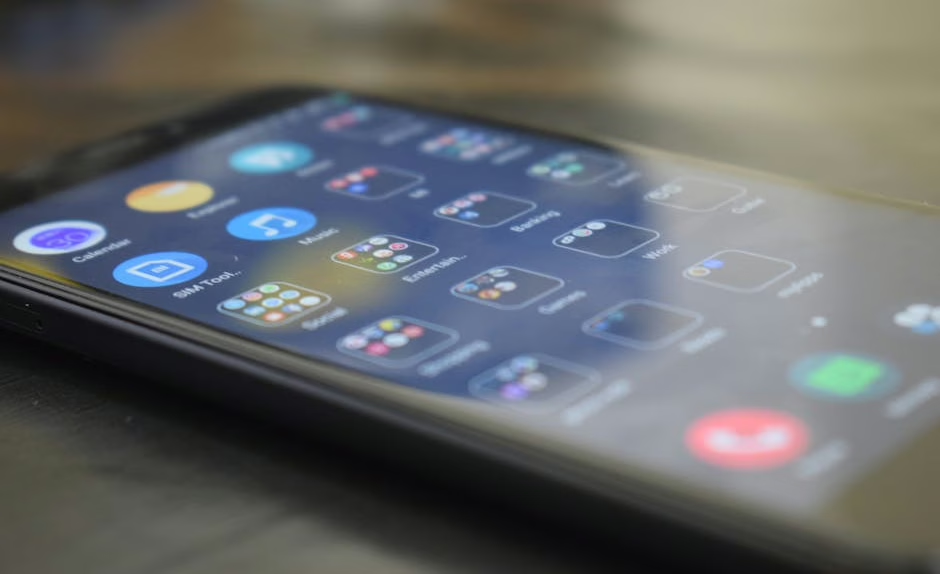
- Mobile — Apple Intelligence ships a ~3B on-device foundation model on iPhone 15 Pro and later. Google’s Gemini Nano runs on Pixel and some Samsung devices. Both handle summarisation, rewriting, and short-form Q&A without network access.
- IoT and embedded — Raspberry Pi 5, NVIDIA Jetson Orin Nano and similar boards can run 1-3B parameter models at usable speeds, enabling natural-language control of sensors and actuators without a cloud dependency.
- Automotive — In-cabin assistants increasingly run locally to meet latency budgets and to continue functioning where cellular coverage is unreliable. Multiple OEMs have announced deployments based on small models fine-tuned for domain vocabulary.
- Laptop-local assistants — Tools like Raycast AI offline modes, GitHub Copilot’s local model experiments, and numerous indie apps built on Ollama put a 7-8B model behind a system-wide keyboard shortcut. For developers, this is often the most immediately useful deployment.
Inference frameworks for local deployment
llama.cpp
llama.cpp, started by Georgi Gerganov in 2023, is a C/C++ inference engine with GGUF-format model support, first-class quantization, and backends for CPU, CUDA, Metal, Vulkan and ROCm. It underpins a large fraction of the local-LLM ecosystem. Bindings exist for Python, Go, Rust and most other mainstream languages.
MLC LLM
MLC LLM compiles models ahead of time to target-specific kernels using Apache TVM. It supports iOS and Android directly, as well as WebGPU for in-browser inference, which is uniquely useful for shipping models to end users without installing anything.
Ollama and LM Studio
Ollama wraps llama.cpp with a simple CLI and REST API, a model registry, and automatic download management. LM Studio provides a desktop GUI for the same underlying stack. Both have become the default starting point for developers evaluating SLMs on their own hardware, and both expose OpenAI-compatible APIs so existing client code ports with minimal changes.
Vendor and platform runtimes
Apple’s Core ML, Google’s AI Edge, Qualcomm’s AI Engine Direct, ONNX Runtime and TensorRT-LLM cover deployment to specific NPUs and GPUs. These typically offer better performance than llama.cpp on their target hardware at the cost of portability.
Trade-offs and limits
SLMs are not a strict replacement for frontier cloud models. On tasks that reward broad world knowledge, long-horizon reasoning, or cross-document synthesis, a 4B model is visibly weaker than a 400B mixture-of-experts one. The useful framing is not small-versus-large but right-sizing: match model capacity to task difficulty. Short-form classification, rewriting, structured extraction, domain-constrained Q&A, and on-rails tool calling are well served by SLMs. Open-ended research tasks are still better served by frontier models accessed over the network.
Context windows are another constraint. Smaller models historically shipped with shorter contexts, though recent releases — Gemma 2, Llama 3.2, Qwen2.5 — offer 128k-token contexts even at sub-10B sizes, at the cost of higher RAM for the key-value cache. The broader ai industry trajectory favours continued SLM capability gains as training recipes and quantization schemes improve.
Frequently asked questions
Can a small language model match a frontier model like GPT-4 or Claude?
Not across the board. On narrow tasks, a well-chosen and fine-tuned SLM in the 7-10B range can approach or match frontier quality for tasks such as summarisation, classification or domain-specific Q&A. On broad, open-ended reasoning with limited context, frontier models remain meaningfully ahead. Benchmarks such as MMLU and MT-Bench show the gap has narrowed sharply since 2023 but has not closed, and benchmark performance does not always translate directly to production quality, so evaluation on the actual target workload is still necessary.
How much hardware do I need to run an SLM locally?
For a 3-billion-parameter model at 4-bit quantization, about 2-3 GB of free RAM and any CPU from the last five years will produce tokens at readable speed. For 7-8B models, 8 GB of free RAM on a machine with a modern integrated GPU or Apple Silicon is comfortable. A discrete consumer GPU (RTX 3060 and up, M-series Macs with 16 GB or more) gives near-interactive latency for 7-13B models. Phones with a dedicated NPU can run 1-3B models; microcontroller-class devices cannot run conventional SLMs and need a different class of model entirely.
Is running an SLM locally actually more private if I fine-tune it on sensitive data?
Local inference keeps input and output data on the device, which is the main privacy win. Fine-tuning on sensitive data introduces a separate risk: the tuned weights themselves can memorise training examples and, under some attacks, leak them back through generation. Techniques such as differential privacy during fine-tuning, limiting training-epoch counts, and deduplicating training data reduce but do not fully eliminate this risk. For highly sensitive data, retrieval-based approaches that keep the data in a separate secured store and feed only relevant fragments into the prompt are often safer than baking the data into the weights.