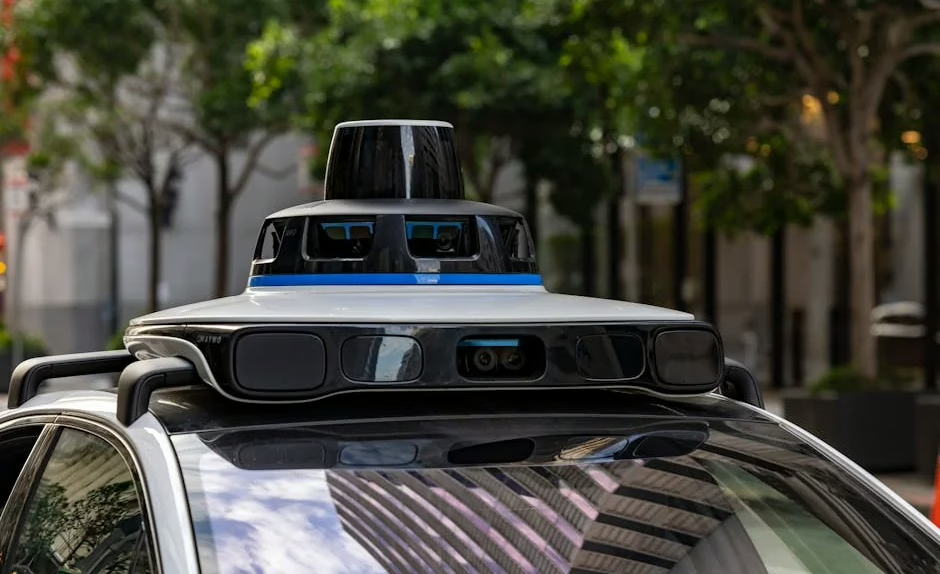

Tesla disclosed details of 17 robotaxi crashes to federal regulators this week, including two incidents in Austin, Texas, where remote human operators — not the autonomous system itself — drove the vehicles into objects at speeds below 10 mph. The disclosures, published in a National Highway Traffic Safety Administration (NHTSA) database, mark the first time Tesla has released narrative descriptions of its robotaxi incidents after months of redacting the data as confidential business information.
Tesla’s Teleoperator Crashes, Explained
According to TechCrunch, the first incident occurred in July 2025, shortly after Tesla launched its robotaxi network in Austin. The car’s automated driving system stopped on a street and would not move forward. A safety monitor in the passenger seat requested help from Tesla’s remote assistance team. The teleoperator took control, turned the vehicle left, drove it up a curb, and struck a metal fence at 8 mph. The safety monitor reported minor injuries but was not hospitalized.
The second crash happened in January 2026. Again, a safety monitor requested navigation assistance from the remote team. The teleoperator drove the vehicle straight into a temporary construction barricade at 9 mph, scraping the front left fender and tire. Tesla reported no injuries in that incident.
In both cases, no passengers were aboard, and safety monitors occupied the vehicles’ passenger seats — not the driver’s seat.
Remote Driving Is Standard, but Tesla Is an Outlier
All U.S. self-driving operators maintain remote monitoring teams, according to Wired, which cited letters submitted to a U.S. senator earlier this year. What distinguishes Tesla is that it more frequently allows those remote workers to directly pilot the vehicles — not just observe or guide them.
Tesla told lawmakers that teleoperators may drive a vehicle remotely as long as they stay under 10 mph. In a statement cited by TechCrunch, Tesla explained the rationale: “This capability enables Tesla to promptly move a vehicle that may be in a compromising position, thereby mitigating the need to wait for a first responder or Tesla field representative to manually recover the vehicle.”
Most competing autonomous vehicle operators use remote assistance primarily for guidance and decision support, not direct vehicle control. That distinction matters because it shifts a category of crash liability from the autonomous system to a human operator — one who may be managing multiple vehicles simultaneously and lacks the physical feedback of in-car driving.
Why Tesla Changed Course on Transparency
For more than a year, Tesla redacted crash descriptions in NHTSA filings, citing confidential business information. That changed this week without public explanation. The newly unredacted data covers all 17 crashes Tesla has recorded since its robotaxi network launched.
Tesla does not have a public relations team and did not respond to Wired’s request for comment on the disclosures or the underlying incidents.
The timing is notable. Regulatory scrutiny of autonomous vehicles has intensified across the industry, and federal requirements to report crashes involving automated driving systems apply to all operators. Tesla’s previous practice of blanket redaction was an outlier among AV companies, most of which provide at least some incident narrative in their NHTSA submissions.
The release does not indicate whether NHTSA requested the change or whether Tesla made the decision unilaterally.
GM’s AI Workforce Swap and the Industry’s Hiring Shift
While Tesla’s robotaxi operations draw scrutiny, General Motors is restructuring its workforce around AI in a move that reflects a broader pattern across the Detroit automakers. According to TechCrunch Mobility, GM laid off more than 10% of its IT department — approximately 600 salaried employees — in a deliberate effort to replace traditional IT roles with AI-focused talent.
The skills GM is actively recruiting for include:
- AI-native development — building systems from the ground up rather than layering AI onto existing tools
- Data engineering and analytics
- Cloud-based engineering
- Agent and model development
- Prompt engineering and AI workflow design
GM’s approach is not a one-to-one replacement. The layoffs are expected to produce a net reduction in headcount even as the company hires for new roles. TechCrunch Mobility noted that Ford, GM, and Stellantis combined have cut more than 20,000 U.S. salaried jobs — roughly 19% of their combined workforces — from recent employment peaks this decade, with technological change, including AI adoption, cited as a primary driver.
Samsara’s Commercial AI Model Points to a Working Template
Not every automotive AI deployment is in flux. Samsara, a fleet management company, offers a concrete example of AI generating measurable commercial value in transportation. According to TechCrunch Mobility, Samsara spent the past decade deploying cameras inside millions of commercial trucks for driver monitoring, theft prevention, and liability documentation.
The company used that accumulated data to train its own AI model capable of detecting road hazards such as potholes — turning a passive monitoring system into a proactive infrastructure intelligence tool. The approach is notable because it follows a pattern that has proven durable in enterprise AI: start with a narrow, high-value data collection problem, accumulate proprietary training data at scale, then build models on top of that data advantage.
For automakers and fleet operators still searching for AI use cases with clear return on investment, Samsara’s trajectory — a decade of data collection before model deployment — illustrates why early infrastructure decisions matter as much as the AI itself.
What This Means
The Tesla robotaxi disclosures reframe a question the autonomous vehicle industry has largely avoided: when a human teleoperator causes a crash in an otherwise autonomous vehicle, who is responsible, and what does that mean for how regulators classify the incident?
Both Austin crashes involved human error by remote workers, not failures of Tesla’s automated driving system. That distinction could be legally and regulatorily significant — but it also raises questions about the reliability of the human backstop layer that the entire AV industry depends on. If teleoperators are piloting vehicles remotely without physical feedback, at what point does the remote-driving model introduce more risk than it mitigates?
Meanwhile, GM’s workforce restructuring signals that the AI skills transition in automotive is no longer theoretical. The company is making real cuts and real hires based on specific capability gaps — AI-native engineering, not AI-adjacent productivity. The gap between automakers that build AI competency internally and those that bolt it on after the fact is likely to widen over the next few years, and the workforce data suggests that transition is already underway.
For the broader industry, Samsara’s model offers a useful counterpoint to the hype cycle: the most defensible AI applications in transportation are built on proprietary data collected over years, not on general-purpose models applied to generic problems.
FAQ
What caused the Tesla robotaxi crashes in Austin?
Both crashes were caused by human teleoperators who remotely took control of the vehicles at the request of on-site safety monitors. In each case, the autonomous driving system had stopped or needed navigation assistance, and the remote driver made contact with a physical obstacle — a metal fence in July 2025 and a construction barricade in January 2026 — at speeds below 10 mph.
Are autonomous vehicle operators required to report crashes to the government?
Yes. Under NHTSA rules, companies operating automated driving systems in the United States must submit detailed crash reports to the federal database. Tesla had previously redacted the narrative descriptions of its incidents, citing confidential business information, but released unredacted descriptions for all 17 recorded crashes this week without publicly explaining the change.
How many jobs has the auto industry cut due to AI and technology changes?
According to TechCrunch Mobility, Ford, GM, and Stellantis have collectively eliminated more than 20,000 U.S. salaried positions — approximately 19% of their combined peak workforces — this decade, with AI-driven restructuring cited as a significant factor. GM alone cut roughly 600 IT roles in a targeted effort to hire workers with AI-native skills in their place.
Related news
Sources
- TechCrunch Mobility: The AI skills arms race is coming for automotive – TechCrunch
- Tesla Reveals New Details About Robotaxi Crashes—and the Humans Involved – Wired
- Tesla reveals two Robotaxi crashes involving teleoperators – TechCrunch
- GM deploys AI tools to speed vehicle design and autonomous vehicle development – Automotive News – Google News – AI Tools
- 20 Leaders Who Built the CISO Era: 2 Decades of Change – Dark Reading