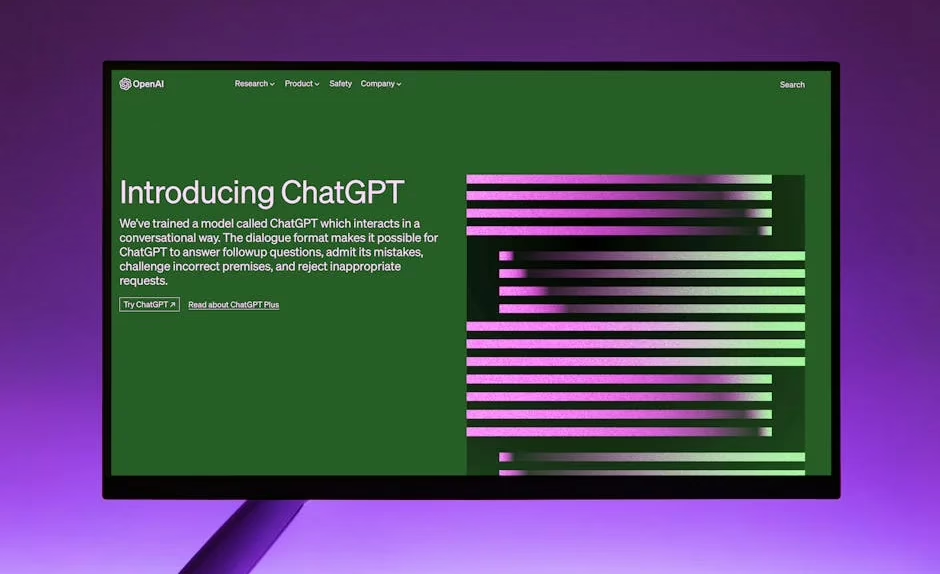

OpenAI and Microsoft on Monday terminated their exclusive partnership agreement, ending revenue-sharing arrangements that have defined the AI industry’s most consequential alliance since 2019. The restructuring allows OpenAI to license its models to any cloud provider, including Microsoft competitors Google and Amazon, while capping OpenAI’s payments to Microsoft at a fixed ceiling.
According to Forbes, Microsoft will retain its 27% stake in OpenAI—valued at approximately $225 billion—but will no longer receive a cut of OpenAI’s AI revenue. In exchange, OpenAI gains freedom to partner with rival cloud providers, ending Microsoft’s exclusive licensing rights to OpenAI’s intellectual property.
Partnership Restructuring Details
The new agreement fundamentally alters the relationship that began with Microsoft’s $1 billion investment in OpenAI’s for-profit arm. Under the previous exclusive arrangement, Microsoft served as the sole distributor of OpenAI’s technology to enterprise customers and provided Azure as OpenAI’s only permitted cloud infrastructure.
CNBC reported that the changes stem from OpenAI’s growing computing demands that exceeded Microsoft’s capacity to supply. The strain became apparent as OpenAI pursued partnerships with Microsoft rivals, notably the $500 billion Stargate data center project with Oracle and SoftBank.
Microsoft shares dropped 1% in early Monday trading following the announcement. The companies issued a joint statement emphasizing their partnership remains “strong and central” despite the structural changes.
Enterprise AI Funding Surge
The OpenAI-Microsoft restructuring coincides with significant enterprise AI funding activity. Netomi, a San Francisco-based customer service AI startup, announced Thursday it raised $110 million in a round led by Accenture Ventures, with participation from Adobe Ventures, WndrCo, Silver Lake Waterman, and NAVER Ventures.
The Netomi round builds on early backing from AI industry leaders including OpenAI co-founder Greg Brockman, Google DeepMind co-founder Demis Hassabis, and Microsoft AI CEO Mustafa Suleyman. Jeffrey Katzenberg, managing partner of WndrCo and DreamWorks co-founder, joined Netomi’s board as part of the investment.
The funding reflects growing enterprise demand for AI systems that operate in “messy, brittle, heavily governed environments where large businesses actually operate,” according to VentureBeat’s analysis. Competitor Sierra, led by former Salesforce co-CEO Bret Taylor, raised $350 million at a $10 billion valuation in September 2025.
SoftBank’s $100 Billion AI Spinout
SoftBank is reportedly planning a $100 billion AI and robotics spinout with a potential U.S. IPO, according to the Financial Times. The new entity would focus on building data centers and deploying robotics to improve AI infrastructure construction efficiency.
The spinout represents founder Masayoshi Son’s escalating AI investments, following tens of billions of dollars committed to the AI sector in recent years. The $100 billion valuation would rank among the largest technology IPOs in history if completed.
SoftBank’s AI ambitions extend beyond traditional venture investments. The spinout would combine data center development with robotics automation, targeting the massive infrastructure buildout required for enterprise AI deployment.
Global AI Investment Patterns
India’s instant services market demonstrates AI-adjacent funding momentum. Snabbit, a Bengaluru-based house-help startup, is reportedly raising $50-55 million at a $400 million valuation led by Susquehanna Venture Capital.
The round would more than double Snabbit’s $180 million October 2025 valuation, reflecting strong investor appetite for on-demand services platforms. Participants include Mirae Asset, FJ Labs, and existing investors Lightspeed Venture Partners and Bertelsmann India Investments.
Snabbit’s growth parallels broader trends in instant services. Competitor Pronto is finalizing funding at approximately $200 million valuation, while Urban Company reported crossing one million bookings for instant home services in March.
Market Implications
The OpenAI-Microsoft restructuring signals maturation in enterprise AI partnerships. Rather than exclusive arrangements, leading AI companies are pursuing multi-cloud strategies to meet enterprise demand and reduce infrastructure dependencies.
For Microsoft, the changes trade exclusive access for reduced financial obligations while maintaining significant equity upside through its OpenAI stake. The software giant can focus Azure resources on competing AI workloads rather than subsidizing OpenAI’s expanding compute requirements.
OpenAI gains strategic flexibility to partner with hyperscale cloud providers based on technical capabilities rather than contractual restrictions. The company can now leverage Google Cloud’s tensor processing units, Amazon’s custom silicon, or Oracle’s high-performance computing infrastructure as needed.
What This Means
The end of OpenAI-Microsoft exclusivity marks a strategic inflection point for enterprise AI. As AI models require increasingly specialized infrastructure, exclusive partnerships become liability rather than advantage. Companies need access to diverse computing resources, from NVIDIA’s latest GPUs to custom silicon optimized for specific workloads.
SoftBank’s $100 billion AI spinout signals institutional capital’s confidence in AI infrastructure investments despite recent market volatility. The combination of data centers and robotics automation addresses two critical enterprise AI bottlenecks: computing capacity and deployment speed.
For investors, the pattern suggests AI value is shifting from model development toward infrastructure and enterprise deployment. Companies demonstrating production-ready AI systems in regulated environments command premium valuations, as evidenced by Netomi’s backing from enterprise-focused investors like Accenture and Adobe.
FAQ
What does the OpenAI-Microsoft partnership change mean for businesses?
Businesses can now access OpenAI’s models through multiple cloud providers including Google Cloud and AWS, rather than being limited to Microsoft Azure. This increases competition and potentially reduces costs for enterprise AI deployments.
Why is SoftBank spinning out AI and robotics into a separate company?
The spinout allows SoftBank to unlock value from its AI investments while focusing the new entity on data center construction and robotics automation. A separate public company could achieve higher valuations than keeping these assets within SoftBank’s conglomerate structure.
How significant is the $110 million Netomi funding round?
The round reflects growing enterprise demand for production-ready AI customer service systems. With backing from Accenture and Adobe, Netomi is positioned to compete with Sierra and other AI agent platforms for large enterprise contracts worth millions annually.
Related news
Sources
- OpenAI shakes up partnership with Microsoft, capping revenue share payments – CNBC Tech
- OpenAI And Microsoft End Exclusive Partnership And Revenue Sharing – Forbes Tech
- Netomi raises $110 million as Accenture and Adobe bet on AI for customer service – VentureBeat
- SoftBank reportedly weighs $100 billion valuation for new AI and robotics spinout in potential U.S. IPO – CNBC Tech