
The artificial intelligence revolution is reshaping the job market at breakneck speed, with companies like Google investing $10 million to train 40,000 manufacturing workers while 43% of AI-generated code requires manual debugging in production environments. As AI models continue improving and adoption accelerates faster than the internet or personal computers, workers, employers, and policymakers are scrambling to adapt to a technology that’s evolving faster than we can manage.
The Current State of AI Adoption in the Workplace
AI adoption is happening at unprecedented speed across industries. According to Stanford’s 2026 AI Index, people are adopting AI faster than they picked up personal computers or the internet. Major tech companies are leading this charge, with Microsoft CEO Satya Nadella and Google CEO Sundar Pichai claiming around 25-30% of their companies’ code is now AI-generated.
However, this rapid adoption comes with significant challenges. The AIOps market—platforms designed to manage AI-driven operations—stands at $18.95 billion in 2026 and is projected to reach $37.79 billion by 2031. Yet infrastructure meant to catch AI-generated mistakes is badly lagging behind AI’s capacity to produce them.
The speed of change is creating a trust gap among engineering leaders. According to Lightrun’s 2026 State of AI-Powered Engineering Report, not a single respondent said their organization could verify an AI-suggested fix with just one redeploy cycle, with 88% needing two to three cycles and 11% requiring four to six.
Training and Reskilling Initiatives
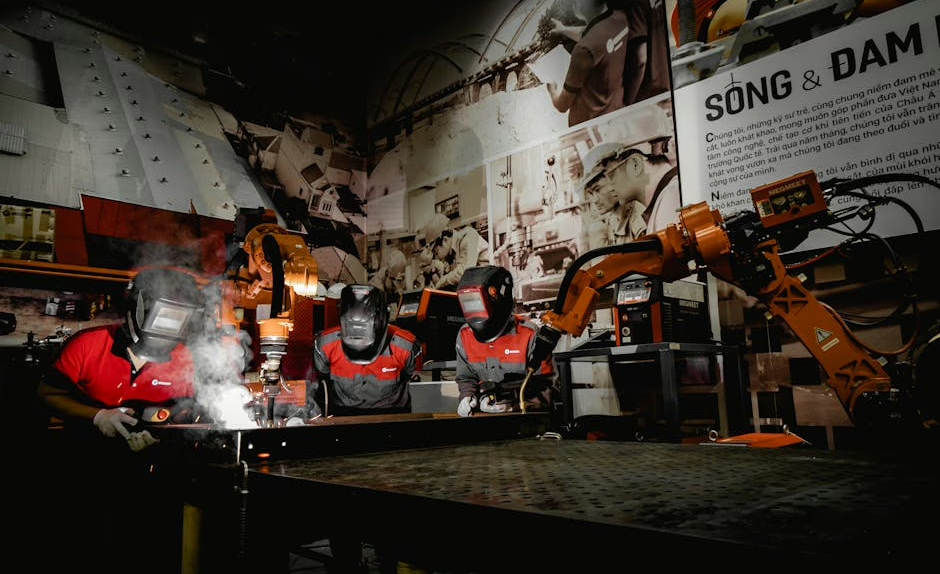
Recognizing the urgent need for workforce preparation, major companies are investing heavily in training programs. Google announced $10 million in funding to the Manufacturing Institute to equip 40,000 current and future manufacturing employees with critical AI skills and expand apprenticeship opportunities to 15 U.S. regions.
The initiative includes two new courses specifically designed for manufacturing workers:
- AI 101 for Manufacturing: Adapting existing AI training to fit manufacturing contexts
- Advanced AI Skills for Technicians: Targeting higher-level technical roles
Beyond manufacturing, Google is also funding healthcare worker training programs and creating apprenticeships in high-demand fields. At their inaugural AI for the Economy Forum, co-hosted with MIT FutureTech, the company emphasized that “neither the benefits nor the risks are automatic or guaranteed” when it comes to AI’s economic impact.
The Hidden Costs of AI Implementation
While AI promises increased productivity, the reality is more complex. The VentureBeat survey of 200 senior site-reliability and DevOps leaders reveals significant hidden costs in AI adoption. 43% of AI-generated code changes require manual debugging in production environments even after passing quality assurance and staging tests.
This debugging burden represents a substantial cost that many organizations haven’t fully accounted for. As Or Maimon, Lightrun’s chief business officer, noted, “The 0% figure signals that engineering is hitting a trust wall with AI adoption,” referring to the fact that zero percent of engineering leaders could verify AI fixes in a single deployment cycle.
The infrastructure challenges extend beyond code quality. AI data centers worldwide now draw 29.6 gigawatts of power—enough to run the entire state of New York at peak demand. Annual water use from running OpenAI’s GPT-4o alone may exceed the drinking water needs of 12 million people.
Political and Regulatory Responses
The AI workforce impact is becoming a political battleground. Former Palantir employee Alex Bores, now a New York Assembly member running for Congress, has become a vocal proponent of rigorous AI regulation. Bores cosponsored New York’s RAISE Act, which became law in 2025 and requires major AI firms to implement and publish safety protocols.
His regulatory stance has made him a target for Big Tech leaders. A super PAC called Leading the Future—bankrolled by OpenAI’s Greg Brockman, Palantir cofounder Joe Lonsdale, and VC firm Andreessen Horowitz—launched an aggressive campaign against his primary run. The group described his approach as “ideological and politically motivated legislation that would handcuff not only New York’s, but the entire country’s, ability to lead on AI jobs and innovation.”
This political tension highlights the broader challenge of regulating a technology that few lawmakers fully understand, despite being responsible for overseeing its impact on workers and the economy.
Global Competition and Supply Chain Vulnerabilities
The AI workforce transformation is happening against a backdrop of intense global competition. According to MIT Technology Review’s analysis of Stanford’s AI Index, the US and China are nearly tied in AI model performance, with the gap between them narrowing significantly throughout 2024.
This competition has created concerning supply chain vulnerabilities. The US hosts most of the world’s AI data centers, while one company in Taiwan—TSMC—fabricates almost every leading AI chip. This concentration of critical infrastructure creates potential bottlenecks that could significantly impact AI deployment and, by extension, workforce transformation efforts.
The fragility of this supply chain becomes particularly concerning when considering the scale of investment involved. AI companies are generating revenue faster than companies in any previous technology boom, but they’re also spending hundreds of billions of dollars on data centers and chips.
What This Means
The AI workforce transformation represents both unprecedented opportunity and significant risk. While companies are investing billions in AI capabilities and training programs, the technology is evolving faster than our ability to manage its implications effectively.
For workers, this means the importance of continuous learning and adaptation cannot be overstated. The most successful employees will be those who can work alongside AI tools while understanding their limitations. For employers, the focus should shift from simply implementing AI to building robust systems for managing AI-generated work and investing in comprehensive training programs.
Policymakers face the challenge of creating regulations that protect workers without stifling innovation. The political battle around figures like Alex Bores suggests this balance won’t be easy to achieve, particularly when tech industry lobbying efforts are actively working against regulatory approaches.
FAQ
How much of today’s code is written by AI?
Major tech companies report that 25-30% of their code is now AI-generated, with Microsoft and Google leading this adoption.
What percentage of AI-generated code needs fixing?
According to industry surveys, 43% of AI-generated code changes require manual debugging in production environments, even after passing initial testing.
How much is being invested in AI workforce training?
Google alone has committed $10 million to train 40,000 manufacturing workers, while the broader AIOps market is projected to grow from $18.95 billion to $37.79 billion by 2031.
For the broader 2026 landscape across research, industry, and policy, see our State of AI 2026 reference.