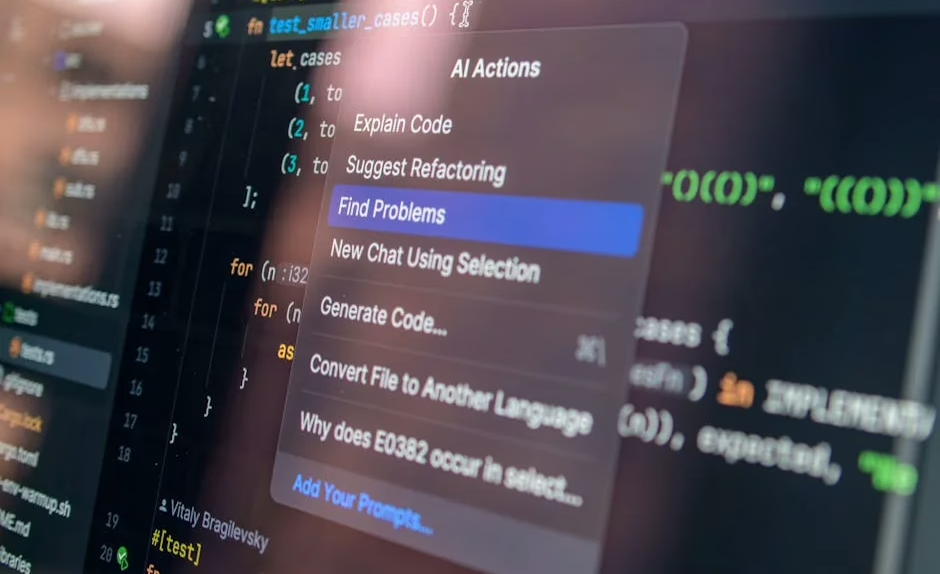

The artificial intelligence revolution is reshaping how we work, but new data reveals significant challenges alongside promising opportunities. According to Lightrun’s 2026 State of AI-Powered Engineering Report, 43% of AI-generated code changes require manual debugging in production environments, while Google announces $10 million in funding to train 40,000 manufacturing workers in AI skills.
These developments highlight the complex reality of AI adoption in the workplace. While companies like Microsoft and Google report that around 25% of their code is now AI-generated, the infrastructure to manage AI-driven operations is struggling to keep pace with rapid deployment.
Code Quality Challenges Create New Job Demands
The promise of AI-powered coding comes with unexpected complications that are creating new types of work rather than eliminating jobs entirely. Zero percent of engineering leaders surveyed by Lightrun said their organizations could verify an AI-suggested fix with just one redeploy cycle.
This debugging bottleneck is creating demand for specialized roles in AI code review and quality assurance. According to the VentureBeat report, 88% of organizations need two to three redeploy cycles to verify AI fixes, while 11% require four to six cycles.
The AIOps market, which manages these AI-driven operations, has grown to $18.95 billion in 2026 and is projected to reach $37.79 billion by 2031. This growth represents thousands of new jobs in monitoring, debugging, and optimizing AI-generated code.
“The 0% figure signals that engineering is hitting a trust wall with AI adoption,” said Or Maimon, Lightrun’s chief business officer, highlighting how quality concerns are actually increasing demand for human oversight.
Manufacturing Workers Get AI Skills Training
While some sectors struggle with AI implementation, others are proactively preparing their workforce for an AI-enhanced future. Google announced $10 million in funding through Google.org to support the Manufacturing Institute in training 40,000 current and future manufacturing employees.
The initiative includes two new courses specifically designed for shop floor workers:
- AI 101 for Manufacturing: Adapting existing AI training to fit manufacturing environments
- Advanced AI Applications: For technicians working with sophisticated manufacturing systems
This training program will expand apprenticeship opportunities to 15 U.S. regions, addressing the skills gap that many employers face when implementing AI tools. Rather than replacing workers, these programs focus on augmenting human capabilities with AI assistance.
The manufacturing sector represents a significant opportunity for AI integration without mass job displacement. Workers trained in AI applications can operate more efficiently, troubleshoot complex systems, and adapt to new technologies as they emerge.
Political Battles Over AI Regulation Intensify
The workforce impact of AI has become a political battleground, with former tech workers now advocating for stronger oversight. Alex Bores, a Democrat running for Congress who previously worked at Palantir, has become a vocal proponent of rigorous AI regulation.
Bores cosponsored New York’s RAISE Act, which became law in 2025 and requires major AI firms to implement and publish safety protocols for their models. His regulatory stance has attracted opposition from a super PAC called Leading the Future, funded by OpenAI’s Greg Brockman, Palantir cofounder Joe Lonsdale, and VC firm Andreessen Horowitz.
According to Wired’s coverage, the tech-funded group described Bores’ approach as “ideological and politically motivated legislation that would handcuff not only New York’s, but the entire country’s, ability to lead on AI jobs and innovation.”
This political tension reflects broader disagreements about how to balance AI innovation with worker protection and job security.
Global Competition Drives Workforce Development
The Stanford AI Index 2026 reveals that AI development continues accelerating despite predictions of hitting a wall. The US and China are nearly tied in AI model performance, creating pressure for workforce development initiatives.
Key findings from the report include:
- People are adopting AI faster than they adopted personal computers or the internet
- AI companies generate revenue faster than any previous technology boom
- Hundreds of billions are being spent on data centers and chips
- Job market benchmarks struggle to keep up with AI capabilities
This rapid pace means traditional job categories are evolving faster than educational institutions and training programs can adapt. Workers need continuous learning opportunities to remain relevant in an AI-enhanced economy.
The energy demands are also creating new job categories. AI data centers worldwide now draw 29.6 gigawatts of power—enough to run the entire state of New York at peak demand—requiring specialized technicians and engineers.
Skills-Based Hiring Transforms Recruitment
Companies are shifting from degree-based to skills-based hiring as AI changes job requirements. Google’s AI for the Economy Forum, co-hosted with MIT FutureTech, brought together economists, industry leaders, and policymakers to address these workforce transitions.
The forum emphasized that AI’s impact on jobs isn’t predetermined. How artificial intelligence affects employment depends on deliberate choices made by companies, workers, governments, and educational institutions.
Google committed to funding research that helps governments and organizations make informed decisions about AI workforce policies. This includes studying which jobs are most likely to be augmented versus replaced, and identifying the skills workers need to thrive alongside AI systems.
Employers are increasingly looking for candidates who can work effectively with AI tools, regardless of their formal educational background. This shift creates opportunities for workers to transition into new roles through targeted training programs.
What This Means
The AI workforce revolution isn’t following the simple narrative of mass job displacement that many predicted. Instead, it’s creating a complex landscape where some roles disappear, others transform significantly, and entirely new job categories emerge.
The debugging challenges in AI-generated code demonstrate that human expertise remains crucial, even as AI handles more routine tasks. Manufacturing training initiatives show how proactive workforce development can help workers adapt rather than being left behind.
Political battles over AI regulation will likely intensify as the technology’s workforce impact becomes more apparent. The key question isn’t whether AI will change jobs—it already is—but whether society will invest in helping workers navigate these changes successfully.
Companies that invest in retraining existing employees and developing human-AI collaboration skills will likely see better outcomes than those that simply replace workers with automation. The most successful AI implementations appear to be those that enhance human capabilities rather than eliminate them entirely.
FAQ
Q: Will AI really eliminate most jobs?
A: Current data suggests AI is more likely to transform jobs than eliminate them entirely. While some roles may disappear, new positions in AI management, debugging, and human-AI collaboration are emerging.
Q: What skills should workers focus on to remain relevant?
A: Skills in AI tool usage, critical thinking, complex problem-solving, and human-AI collaboration are becoming increasingly valuable. Technical debugging and quality assurance skills are also in high demand.
Q: How can companies prepare their workforce for AI changes?
A: Successful companies are investing in retraining programs, partnering with educational institutions, and focusing on augmenting human capabilities rather than replacing workers entirely.
For the broader 2026 landscape across research, industry, and policy, see our State of AI 2026 reference.