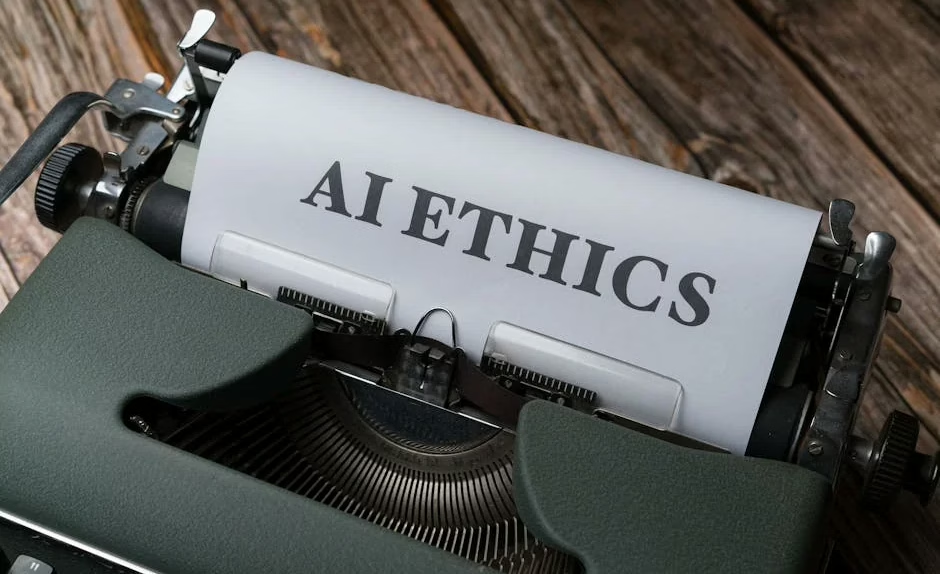

Major AI companies are taking opposing stances on liability legislation as regulatory frameworks struggle to keep pace with rapid technological advancement. Anthropic has come out against a proposed Illinois law backed by OpenAI that would shield AI labs from liability for large-scale harm, while lawmakers across the country grapple with surveillance laws and facial recognition security breaches that highlight the urgent need for comprehensive AI governance.
The regulatory landscape is becoming increasingly complex as Silicon Valley spends millions to influence political outcomes, with tech leaders funding super PACs to oppose candidates who support rigorous AI regulation. Meanwhile, cyberscammers are exploiting banking security systems through tools sold on Telegram, demonstrating the real-world consequences of inadequate oversight.
Tech Industry Splits on Liability Framework
The battle over Illinois Senate Bill 3444 has exposed significant divisions within the AI industry regarding accountability and liability standards. OpenAI supports the legislation, which would protect AI companies from liability in cases involving mass casualties or property damage exceeding $1 billion. However, Anthropic strongly opposes the measure, arguing it creates a “get-out-of-jail-free card” for AI developers.
Cesar Fernandez, Anthropic’s head of US state and local government relations, emphasized that “good transparency legislation needs to ensure public safety and accountability for the companies developing this powerful technology.” The company has been actively lobbying Illinois lawmakers to either significantly modify or kill the bill entirely.
This disagreement reflects broader philosophical differences about how the industry should approach risk management and public safety. While some companies seek protection from potential lawsuits, others advocate for maintaining accountability mechanisms that could drive more responsible development practices.
Political Resistance to Tech Regulation Grows
Tech industry influence in politics has reached new heights, with wealthy Silicon Valley figures funding campaigns against pro-regulation candidates. The super PAC “Leading the Future,” backed by OpenAI’s Greg Brockman, Palantir cofounder Joe Lonsdale, and Andreessen Horowitz, has launched aggressive campaigns against candidates supporting AI regulation.
Alex Bores, a former Palantir employee turned New York assemblyman, has become a primary target for his support of rigorous AI oversight. Bores cosponsored New York’s RAISE Act, which requires major AI firms to implement and publish safety protocols for their models. The tech-funded opposition describes such measures as “ideological and politically motivated legislation that would handcuff the country’s ability to lead on AI jobs and innovation.”
This dynamic raises critical questions about democratic governance and corporate influence. When former industry insiders advocate for regulation based on their technical expertise, their own former employers and industry peers mobilize significant financial resources to oppose them.
Surveillance Laws Face Renewal Deadlock
Concurrently, lawmakers are deadlocked over Section 702 of the Foreign Intelligence Surveillance Act (FISA), which allows intelligence agencies to collect overseas communications without individualized warrants. The law’s broad scope inevitably captures communications of Americans interacting with overseas contacts, raising constitutional concerns about privacy protection.
Bipartisan privacy advocates are pushing for significant reforms to protect American citizens from warrantless surveillance, while others seek simple reauthorization. The Government Surveillance Reform Act represents a compromise approach that would maintain intelligence capabilities while strengthening privacy protections.
The FISA debate intersects with AI regulation in important ways. As AI systems become more sophisticated at analyzing communications data, the potential for surveillance overreach grows exponentially. Without proper safeguards, AI-enhanced surveillance could fundamentally alter the balance between security and privacy in democratic societies.
Security Vulnerabilities Expose Regulatory Gaps
The emergence of sophisticated tools for bypassing banking security measures demonstrates how quickly bad actors adapt to exploit technological vulnerabilities. Criminals are using virtual camera tools and deepfake technology to circumvent “Know Your Customer” facial recognition systems, enabling money laundering and account fraud.
Twenty-two public Telegram channels were identified selling bypass kits and stolen biometric data, highlighting the scale of this underground economy. These tools allow scammers to replace live camera feeds with static images or deepfake videos, defeating liveness checks designed to verify user identity.
This cat-and-mouse game between criminals and financial institutions illustrates why reactive regulation often fails. By the time lawmakers understand and address one set of vulnerabilities, bad actors have already moved on to exploit new weaknesses. Proactive regulatory frameworks that anticipate technological evolution become essential for maintaining security and public trust.
Global AI Development Accelerates Despite Governance Challenges
According to Stanford’s 2026 AI Index, AI development continues accelerating despite regulatory uncertainty. The US and China remain nearly tied in AI model performance, while adoption rates exceed those of previous technological revolutions like personal computers and the internet.
AI companies are generating revenue faster than any previous technology boom, but they’re also spending hundreds of billions on infrastructure. AI data centers now consume 29.6 gigawatts of power globally—enough to run New York state at peak demand. Water usage from OpenAI’s GPT-4o alone may exceed the drinking water needs of 12 million people annually.
These resource requirements highlight the environmental and infrastructure implications of AI development that current regulatory frameworks barely address. The concentration of chip manufacturing in Taiwan and data centers in the US creates additional geopolitical and economic vulnerabilities that policymakers are only beginning to recognize.
What This Means
The current regulatory landscape reveals a fundamental mismatch between the pace of AI development and governance capabilities. While tech companies debate liability frameworks and spend millions influencing political outcomes, real-world harms from inadequate oversight continue mounting. The banking security breaches, surveillance overreach, and environmental impacts demonstrate that waiting for perfect regulation may be more dangerous than implementing imperfect but adaptive frameworks.
The split between Anthropic and OpenAI on liability legislation suggests that the industry itself recognizes the need for accountability mechanisms, even as companies disagree on implementation. This internal division could provide opportunities for policymakers to craft more nuanced approaches that balance innovation with responsibility.
Most critically, the current moment demands democratic institutions that can govern effectively despite corporate influence campaigns. The technical complexity of AI systems requires lawmakers with genuine expertise, but the political dynamics around figures like Alex Bores show how industry opposition can undermine evidence-based policymaking.
FAQ
What is the main disagreement between Anthropic and OpenAI on AI regulation?
Anthropic opposes Illinois SB 3444, which would shield AI companies from liability for large-scale harm, while OpenAI supports it. Anthropic argues the bill creates a “get-out-of-jail-free card” rather than ensuring accountability for AI developers.
How are criminals bypassing banking facial recognition systems?
Scammers use virtual camera tools sold on Telegram to replace live camera feeds with static images or deepfake videos during “liveness” checks, allowing them to access accounts using stolen identity information and circumvent Know Your Customer security measures.
Why are tech companies spending millions to oppose pro-regulation political candidates?
Tech leaders view strict AI regulation as potentially limiting innovation and competitiveness. They’re funding super PACs to oppose candidates like Alex Bores who support measures requiring AI companies to implement and publish safety protocols, which they consider “ideological” restrictions on industry growth.
Related news
Sources
For the broader 2026 landscape across research, industry, and policy, see our State of AI 2026 reference.