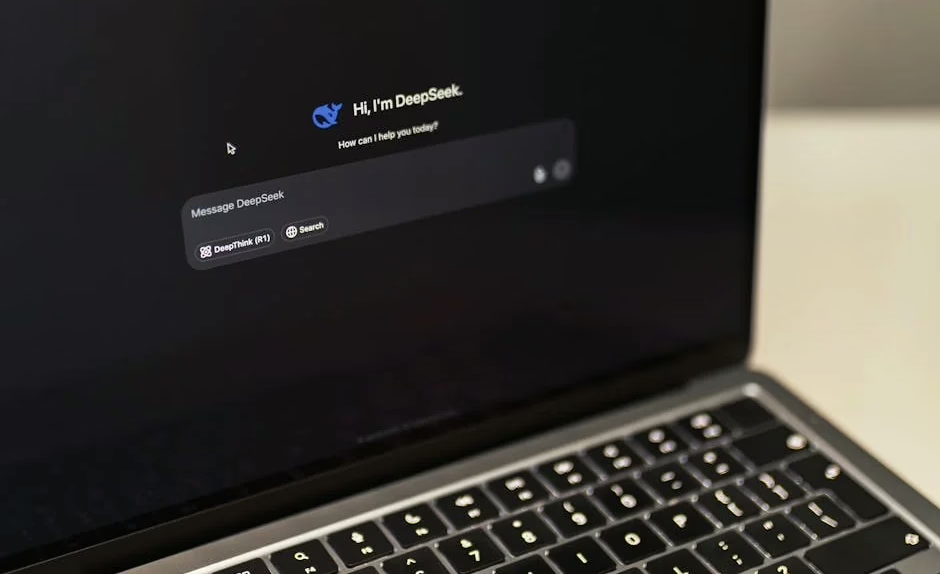

DeepSeek on Monday released its V4 model, a 1.6-trillion-parameter system that matches or exceeds frontier AI performance at approximately one-sixth the API cost of OpenAI’s GPT-5.5 and Anthropic’s Claude Opus 4.7. According to VentureBeat, the Chinese AI startup’s latest release is being called the “second DeepSeek moment” following its January 2025 breakthrough with the R1 model.
Performance Benchmarks Show Competitive Results
The V4 model demonstrates near state-of-the-art performance across multiple evaluation metrics while maintaining significant cost advantages. DeepSeek AI researcher Deli Chen described the release on X as a “labor of love” developed over 484 days since the V3 launch.
Meanwhile, OpenAI’s newly released GPT-5.5 has reclaimed benchmark leadership in several categories. VentureBeat reported that GPT-5.5 narrowly beats Anthropic’s Claude Mythos Preview on Terminal-Bench 2.0, representing what amounts to a statistical tie between the models.
“It’s definitely our strongest model yet on coding, both measured by benchmarks and based on the feedback that we’ve gotten from trusted partners,” explained Amelia “Mia” Glaese, VP of Research at OpenAI, in a briefing with journalists.
Specialized Domain Benchmarks Reveal Performance Gaps
New specialized benchmarks are exposing significant performance variations across different domains. The ThermoQA benchmark published on arXiv evaluates thermodynamic reasoning across 293 engineering problems in three tiers: property lookups, component analysis, and full cycle analysis.
Results show Claude Opus 4.6 leading at 94.1%, followed by GPT-5.4 at 93.1% and Gemini 3.1 Pro at 92.5%. The benchmark reveals substantial performance degradation as problem complexity increases, with cross-tier drops ranging from 2.8 percentage points for Opus to 32.5 percentage points for MiniMax.
Supercritical water, R-134a refrigerant, and combined-cycle gas turbine analysis serve as particularly challenging discriminators, showing 40-60 percentage point performance spreads between top and bottom performers. Multi-run consistency varies significantly, with sigma ranges from ±0.1% to ±2.5% across different models.
Google Expands Research Agent Capabilities
Google on Monday launched Deep Research and Deep Research Max agents, marking the company’s most significant upgrade to autonomous research capabilities since the product’s debut. According to Google’s blog post, the new agents can fuse open web data with proprietary enterprise information through a single API call.
Built on Google’s Gemini 3.1 Pro model, the agents support the Model Context Protocol (MCP) for connecting to third-party data sources and can generate native charts and infographics within research reports. Google CEO Sundar Pichai announced on X that the updates include “better quality, MCP support, and native chart/infographics generation.”
The release targets enterprise research workflows in finance, life sciences, and market intelligence, where research accuracy carries high stakes.
Enterprise AI Adoption Accelerates
Google’s data reveals accelerating enterprise AI adoption, with 1,302 documented real-world generative AI use cases from leading organizations as of April 2026. The list has grown substantially from the original 101 use cases published at Next ’24 in 2024.
The majority of new implementations showcase agentic AI applications built with tools including Gemini Enterprise, Gemini CLI, Security Command Center, and Google’s AI Hypercomputer infrastructure. According to Google’s analysis, this represents “the fastest technological transformation we’ve seen” with customers driving adoption.
Production AI and agentic systems are now deployed across virtually every organization attending Google’s Next ’26 conference in Las Vegas, indicating widespread enterprise integration beyond experimental phases.
What This Means
The simultaneous release of multiple frontier AI models with different cost-performance profiles signals market maturation and increased competition. DeepSeek-V4’s dramatic cost reduction while maintaining competitive performance could pressure established providers to adjust pricing strategies, particularly for API access.
The emergence of specialized benchmarks like ThermoQA reveals that general-purpose evaluation metrics may not capture domain-specific reasoning capabilities. Performance gaps of 40-60 percentage points on engineering problems suggest that model selection for specialized applications requires careful domain-specific testing.
Google’s expanded research agent capabilities represent a shift toward AI systems that can autonomously conduct complex, multi-source research tasks. The integration of proprietary enterprise data with web sources through standardized APIs could accelerate AI adoption in knowledge-intensive industries where data integration has been a barrier.
FAQ
How does DeepSeek-V4’s cost compare to other frontier models?
DeepSeek-V4 costs approximately one-sixth the price of GPT-5.5 and Claude Opus 4.7 through API access, while delivering comparable performance on most benchmarks. The model is available under the MIT License for commercial use.
What makes the ThermoQA benchmark significant for AI evaluation?
ThermoQA tests thermodynamic reasoning across three complexity tiers using programmatically computed ground truth from CoolProp 7.2.0. It reveals that property memorization doesn’t translate to thermodynamic reasoning, with performance drops of up to 32.5 percentage points as problems become more complex.
What new capabilities do Google’s Deep Research agents offer?
The agents can combine open web data with proprietary enterprise information in a single API call, generate native charts and infographics, and connect to third-party data sources through the Model Context Protocol. This enables autonomous research across both public and private data sources.
Related news
- The Bottlenecks Slowing Down AI Performance – Forbes Tech
Sources
- OpenAI’s GPT-5.5 is here, and it’s no potato: narrowly beats Anthropic’s Claude Mythos Preview on Terminal-Bench 2.0 – VentureBeat
- ThermoQA: A Three-Tier Benchmark for Evaluating Thermodynamic Reasoning in Large Language Models – arXiv AI
- DeepSeek-V4 arrives with near state-of-the-art intelligence at 1/6th the cost of Opus 4.7, GPT-5.5 – VentureBeat