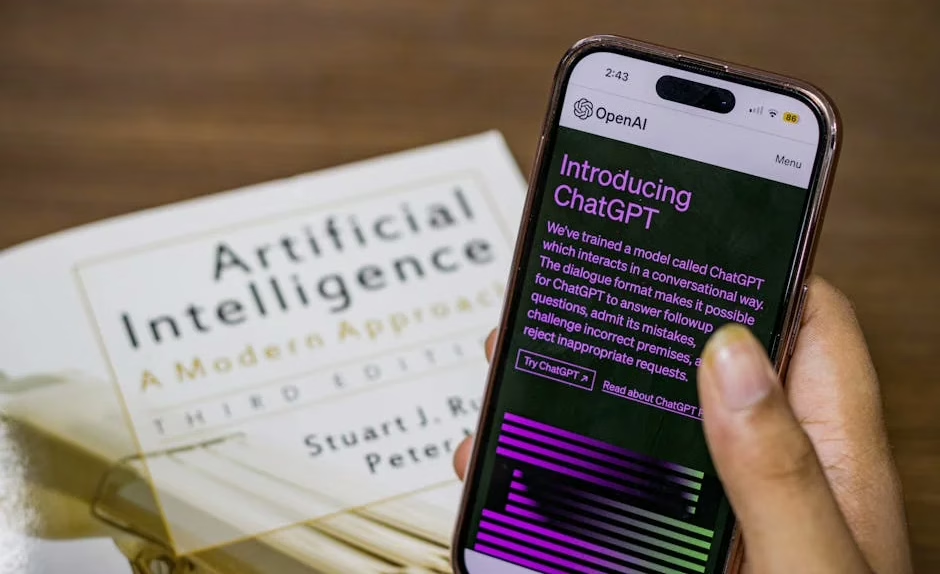

OpenAI launched ChatGPT Images 2.0 on Tuesday, marking a significant escalation in the AI image generation market that could reshape competitive dynamics between major players including Stability AI’s Stable Diffusion and Midjourney. The new model generates multiple images from single prompts and includes text rendering capabilities in non-English languages including Chinese and Hindi, features that position it as a direct competitor to established platforms.
The timing of this release comes as the AI image generation market experiences unprecedented growth, with enterprise adoption accelerating across industries. According to Google’s latest analysis, over 1,302 organizations are now deploying generative AI solutions in production environments, representing what Google calls “the fastest technological transformation we’ve seen.”
Market Positioning and Competitive Response
ChatGPT Images 2.0’s launch represents OpenAI’s strategic push to capture market share in the rapidly expanding AI image generation sector. The model’s integration with ChatGPT’s reasoning capabilities allows it to search the internet for recent information and generate contextually relevant visual content, a feature that differentiates it from competitors.
The business implications are substantial. Unlike standalone image generators, OpenAI’s approach leverages its existing ChatGPT user base, estimated at over 100 million weekly active users. This distribution advantage could significantly impact revenue streams for competitors like Midjourney, which operates on a subscription model ranging from $10 to $120 monthly.
Key competitive advantages include:
- Integration with existing ChatGPT infrastructure
- Multi-modal capabilities combining text and image generation
- Real-time internet connectivity for current information
- Support for multiple aspect ratios and customization options
The model’s December 2025 knowledge cutoff date also provides a competitive edge over models with earlier training data, enabling more current and relevant image generation for business applications.
Technical Advancements Drive Business Value
The most significant technical breakthrough in ChatGPT Images 2.0 lies in its text rendering capabilities. According to TechCrunch’s analysis, the model can now generate accurate text within images, solving a persistent problem that has limited commercial applications of AI-generated imagery.
This advancement has immediate revenue implications for businesses requiring marketing materials, signage, and branded content. Previously, companies needed human intervention to correct text errors in AI-generated images, adding costs and production time. The ability to generate restaurant menus, business cards, and promotional materials without text errors represents a significant cost reduction for enterprises.
Business applications include:
- Marketing collateral generation
- Multilingual content creation
- Rapid prototyping for design teams
- Educational material development
The model’s autoregressive architecture, while unconfirmed by OpenAI, suggests a fundamental shift from traditional diffusion models used by competitors. This architectural change could provide sustained competitive advantages in text rendering and multi-image generation capabilities.
Revenue Model Innovation and Market Impact
OpenAI’s pricing strategy for ChatGPT Images 2.0 follows a tiered approach, with basic functionality available to free users and enhanced features reserved for paying subscribers. This freemium model contrasts with Midjourney’s subscription-only approach and could accelerate market penetration.
The integration with existing ChatGPT subscriptions creates additional value for current customers while potentially reducing churn rates. For businesses already paying for ChatGPT Plus or Enterprise subscriptions, image generation becomes an added benefit rather than a separate cost center.
Market implications include:
- Pressure on standalone image generators to justify separate subscriptions
- Potential consolidation as users prefer integrated solutions
- Increased enterprise adoption due to simplified procurement processes
- Revenue diversification for OpenAI beyond text-based AI services
Google’s simultaneous announcement of eighth-generation TPUs specifically designed for “agentic AI” applications signals infrastructure investments supporting this market expansion. The TPU 8t and TPU 8i chips are engineered for the complex, iterative demands of AI agents, indicating enterprise-level commitment to visual AI applications.
Enterprise Adoption and Investment Trends
The enterprise market for AI image generation is experiencing rapid expansion, driven by cost reduction opportunities and creative workflow enhancement. Organizations are deploying these tools across marketing, product development, and customer engagement initiatives.
Investor sentiment remains bullish on visual AI applications, with venture capital flowing toward companies developing specialized use cases. The integration of image generation with existing business workflows represents a key value proposition driving adoption rates.
Investment drivers include:
- Reduced creative production costs
- Faster time-to-market for visual content
- Scalable content creation for global markets
- Integration with existing enterprise software systems
The success of previous AI image trends, such as Google’s “Nano Banana model” generating viral social media adoption, demonstrates the potential for rapid user acquisition and engagement. These viral moments translate into increased platform usage and subscription conversions, creating significant business value.
Strategic Implications for Industry Players
ChatGPT Images 2.0’s launch forces competitors to reassess their market positioning and feature development priorities. Midjourney’s focus on artistic quality may need to expand toward business utility, while Stable Diffusion’s open-source approach faces pressure from integrated commercial solutions.
The convergence of text and image generation capabilities suggests a broader trend toward multi-modal AI platforms. Companies offering single-function AI tools may struggle to compete against integrated solutions providing comprehensive creative workflows.
Strategic responses likely include:
- Enhanced integration capabilities from standalone providers
- Specialized vertical solutions targeting specific industries
- Partnership strategies with established software platforms
- Open-source alternatives to counter proprietary advantages
What This Means
OpenAI’s ChatGPT Images 2.0 represents more than a product update—it signals a strategic shift toward integrated AI platforms that could reshape the competitive landscape. The combination of technical improvements in text rendering, multi-image generation, and internet connectivity creates substantial business value for enterprise customers.
For investors, this development highlights the importance of platform integration over standalone AI tools. Companies that can successfully combine multiple AI capabilities within existing user workflows are positioned for stronger market performance and customer retention.
The broader implications extend to the entire creative technology sector, where traditional design software companies must now compete with AI-native solutions offering faster, more cost-effective content creation. This technological disruption creates both opportunities for new market entrants and challenges for established players.
FAQ
What makes ChatGPT Images 2.0 different from DALL-E and Midjourney?
ChatGPT Images 2.0 integrates directly with ChatGPT’s reasoning capabilities, enabling internet searches and multi-image generation from single prompts. Unlike standalone tools, it leverages existing user relationships and subscription models.
How does the text rendering improvement impact business applications?
Accurate text rendering eliminates the need for manual corrections in business materials like menus, signage, and marketing collateral. This reduces production costs and enables immediate use of generated content without additional design work.
What are the competitive implications for existing AI image companies?
Integrated platforms like ChatGPT Images 2.0 create pressure on standalone providers to justify separate subscriptions. Companies may need to focus on specialized use cases or seek integration partnerships to maintain market position.
Related news
- OpenAI teases GPT-5.5 model upgrade for ChatGPT in cryptic message – 9to5Mac
- OpenAI opens Codex-powered workspace agents to ChatGPT Edu and Teachers plans – EdTech Innovation Hub – Google News – Tech Innovation