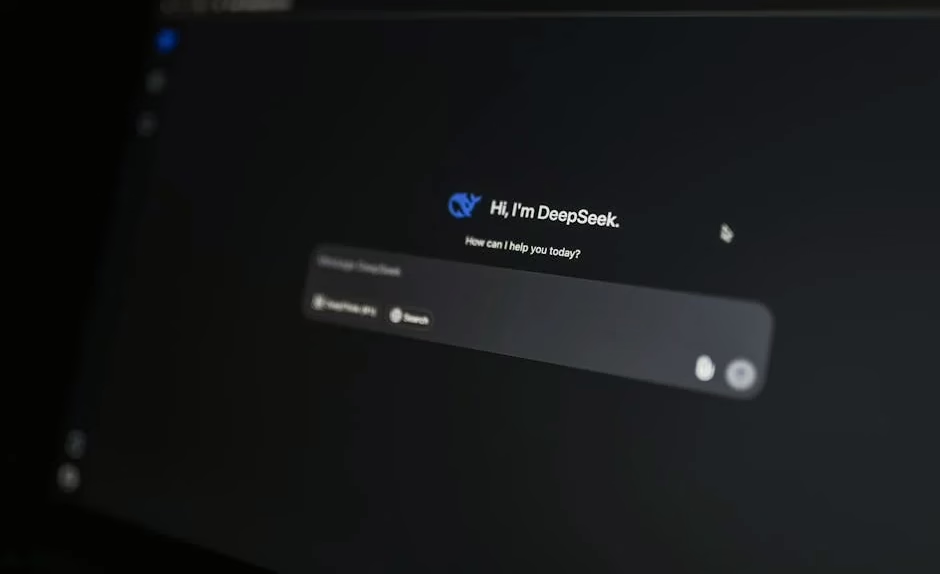

Chinese AI firm DeepSeek on Friday released V4, its flagship model that matches performance of leading closed-source rivals from Anthropic, OpenAI, and Google while remaining open source. The release coincides with Google’s launch of two new autonomous research agents and a former Google DeepMind researcher securing a record $1.1 billion in seed funding for his AI startup.
According to MIT Technology Review, DeepSeek V4 can process significantly longer prompts than previous generations through a new design that handles large text volumes more efficiently. The model represents DeepSeek’s first release optimized for Huawei’s Ascend chips, marking a crucial test of China’s ability to reduce dependence on NVIDIA hardware.
Google Launches Deep Research Agents with Enterprise Integration
Google on Monday unveiled Deep Research and Deep Research Max, two autonomous research agents that represent the most significant upgrade to the company’s research capabilities since the product’s debut. According to VentureBeat, these agents can fuse open web data with proprietary enterprise information through a single API call for the first time.
The agents, built on Google’s Gemini 3.1 Pro model, can produce native charts and infographics inside research reports and connect to third-party data sources through the Model Context Protocol (MCP). Google CEO Sundar Pichai announced the launch on X, highlighting the agents’ improved quality and new capabilities.
The release targets enterprise research workflows in finance, life sciences, and market intelligence — industries where information accuracy carries high stakes. Google positions this as infrastructure for autonomous research that traditionally required hours or days of human analyst time.
API-Only Availability Draws User Criticism
The new research agents are available exclusively through Google’s API, not in the consumer Gemini app. Several users on X noted this limitation, with some arguing it punishes Gemini App Pro subscribers. Others raised concerns about potentially misleading benchmark result presentations in Google’s promotional materials.
Former DeepMind Researcher Raises Record $1.1B Seed Round
A former Google DeepMind researcher announced Monday a record-breaking $1.1 billion seed funding round for his new AI lab, Ineffable Intelligence. CNBC reported that the startup emerged from stealth with a $5.1 billion valuation, backed by Sequoia, Lightspeed, NVIDIA, and Google.
The funding represents one of the largest seed rounds in AI history and continues a trend of top researchers leaving Big Tech companies to launch independent AI labs. The startup’s focus on superintelligence development reflects growing investor confidence in AGI research despite uncertain timelines for breakthrough achievements.
Medical Imaging Pioneer Enters National Inventors Hall of Fame
David Huang, inventor of optical coherence tomography (OCT), earned induction into the National Inventors Hall of Fame in 2025 for creating technology now used in 40 million medical procedures annually. MIT Technology Review reported that Huang developed OCT as an MD-PhD student, combining ultrafast lasers with interferometry to achieve micrometer-resolution tissue imaging.
OCT provides three-dimensional, high-resolution images of biological tissues like the retina and coronary artery plaques using barely visible infrared light. The technology emerged from Huang’s work under James Fujimoto at MIT, initially focused on improving ophthalmological measurements.
From Engineering Student to Medical Revolutionary
Huang didn’t expect to revolutionize eye imaging when he began studying electrical engineering at MIT. His goal was applying an engineering mindset to medical advancements, following his father’s path as a family practitioner. The discovery earned him the Lasker Award and National Medal of Technology and Innovation in 2023.
Enterprise AI Adoption Reaches 1,302 Documented Use Cases
Google documented 1,302 real-world generative AI use cases from leading organizations, marking explosive growth from the original 101 cases published two years ago. Google’s blog post indicates production AI and agentic systems are now deployed across virtually every organization attending the Next ’26 conference in Las Vegas.
The vast majority showcase agentic AI applications built with tools like Gemini Enterprise, Gemini CLI, Security Command Center, and Google’s AI Hypercomputer infrastructure stack. Google used its own Gemini Enterprise to analyze the complete dataset and surface notable trends across the implementations.
What This Means
These developments signal accelerating competition in AI research and deployment. DeepSeek V4‘s performance parity with closed-source models while remaining open source challenges the assumption that proprietary development provides significant advantages. The model’s optimization for Huawei chips also tests China’s semiconductor independence strategy.
Google’s research agents represent a shift toward autonomous information gathering that could reshape knowledge work across industries. The enterprise focus suggests Google sees B2B applications as more immediately profitable than consumer features, despite user frustration with API-only availability.
The record funding for Ineffable Intelligence reflects continued investor appetite for AGI research, even as technical breakthroughs remain uncertain. The trend of researchers leaving established labs for startups could accelerate innovation through increased competition and specialized focus areas.
FAQ
How does DeepSeek V4 compare to GPT-4 and Claude?
DeepSeek V4 matches the performance of leading closed-source models from OpenAI, Anthropic, and Google while remaining open source. It can process longer prompts more efficiently and runs on Huawei’s Ascend chips rather than NVIDIA hardware.
What makes Google’s Deep Research agents different from existing AI tools?
These agents can combine open web data with private enterprise information through a single API call, generate native charts and infographics, and connect to third-party data sources. They’re designed for autonomous research workflows that traditionally required extensive human time.
Why are top AI researchers leaving big tech companies for startups?
Researchers are seeking greater autonomy, equity upside, and the ability to pursue specialized research directions. Record funding rounds like Ineffable Intelligence’s $1.1 billion seed round provide resources comparable to big tech labs while offering more focused missions.
Related news
- Google is testing AI chatbot search for YouTube – The Verge
- ChatGPT lands in Google Sheets and Excel in beta for Edu and enterprise users | ETIH EdTech News – EdTech Innovation Hub – Google News – Tech Innovation
- Google Photos Changes Again: Leaked Update Redesigns Your Library – Forbes Tech
Sources
- Google’s new Deep Research and Deep Research Max agents can search the web and your private data – VentureBeat
- Former Google DeepMind researcher’s AI startup raises record $1.1 billion seed funding to pursue superintelligence – CNBC Tech
- The Download: DeepSeek’s latest AI breakthrough, and the race to build world models – MIT Technology Review