
Two major AI companies released flagship models this week, with China’s DeepSeek unveiling its V4 preview on Friday and OpenAI launching GPT-5.5 on Thursday. DeepSeek’s V4 marks the company’s most significant release since its market-disrupting R1 model in January 2025, while OpenAI’s GPT-5.5 brings the company closer to its “super app” vision.
DeepSeek V4 Expands Open-Source AI Capabilities
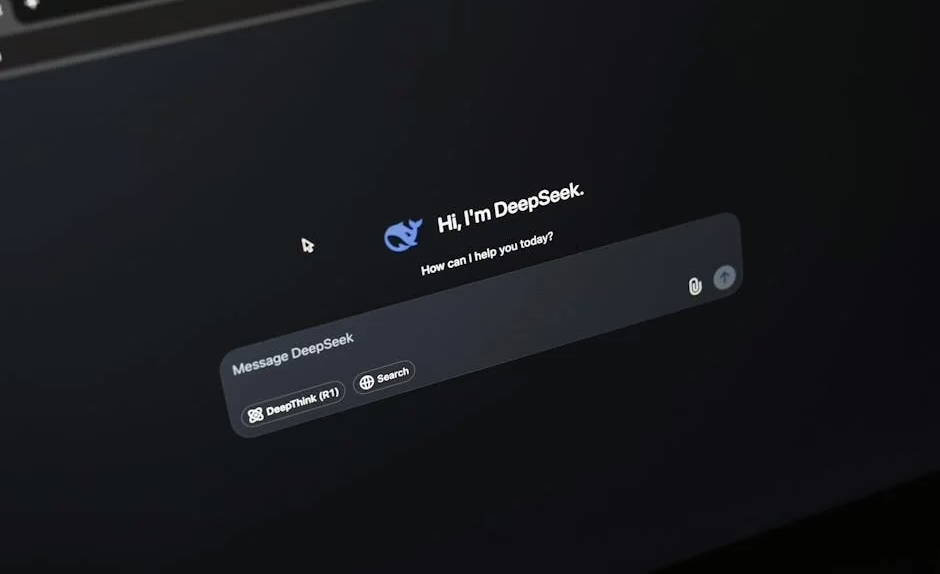
DeepSeek released a preview of its V4 model on Friday, expanding its open-source AI lineup with significantly improved text processing capabilities. According to MIT Technology Review, the model can process much longer prompts than its previous generation through a new design that handles large amounts of text more efficiently.
Like DeepSeek’s previous models, V4 is open source and available for anyone to download, use, and modify. The release comes after months of speculation following the company’s addition of “expert” and “flash” modes to its online interface earlier this month.
DeepSeek’s previous R1 model, launched in January 2025, stunned the global AI industry with strong performance despite being trained on limited computing resources. The success transformed DeepSeek from a little-known research team into China’s best-known AI company and triggered a wave of open-weight model releases from other Chinese AI firms.
OpenAI GPT-5.5 Advances “Super App” Strategy
OpenAI launched GPT-5.5 on Thursday, calling it the company’s “smartest and most intuitive to use model” yet. According to TechCrunch, OpenAI co-founder and president Greg Brockman described the model as a significant advancement “towards more agentic and intuitive computing.”
“This model is a real step forward towards the kind of computing that we expect in the future — but it is one step, and we expect to see many in the future,” Brockman told journalists. “It’s a faster, sharper thinker for fewer tokens compared to something like 5.4.”
The release brings OpenAI closer to launching a “super app” that would combine ChatGPT, Codex, and AI browser into one unified service for enterprise customers. This concept directly competes with similar ambitions from Elon Musk, who wants to transform X into a super app platform.
Accelerated Release Schedule
OpenAI has maintained an aggressive release schedule, with GPT-5.5 following models released in March, December, and November. Chief scientist Jakub Pachocki indicated this pace will continue, stating the company sees “pretty significant improvements in the short term, extremely significant improvements in the medium term.”
“In fact, I would say, like, I think the last two years have been surprisingly slow,” Pachocki added, suggesting even faster development cycles ahead.
OpenAI Expands Open-Source Portfolio with Privacy Filter
Alongside GPT-5.5, OpenAI released Privacy Filter, an open-source model designed to detect and redact personally identifiable information before data reaches cloud servers. VentureBeat reported the 1.5-billion-parameter model launched on Hugging Face under an Apache 2.0 license.
The tool represents a “privacy-by-design” approach, functioning as a context-aware data sanitization system that runs on standard laptops or directly in web browsers. Privacy Filter is built on OpenAI’s gpt-oss family but uses bidirectional token classification rather than standard autoregressive prediction.
This release continues OpenAI’s return to open-source development after shifting to primarily proprietary models during the ChatGPT era. The company previously released the gpt-oss family and recently open-sourced agentic orchestration tools.
Enterprise AI Adoption Accelerates
The model releases coincide with growing enterprise AI deployment. Google Cloud reported 1,302 real-world generative AI use cases from leading organizations, demonstrating what the company calls “the era of the agentic enterprise.”
Google’s blog post noted this represents “almost certainly the fastest technological transformation we’ve seen,” with production AI and agentic systems now deployed across thousands of organizations. The use cases showcase applications built with tools like Gemini Enterprise, Gemini CLI, and AI Hypercomputer infrastructure.
The rapid adoption reflects increasing confidence in AI capabilities as models become more sophisticated and reliable for enterprise workloads.
What This Means
This week’s releases highlight the intensifying competition between Chinese and American AI companies, with DeepSeek’s open-source approach contrasting sharply with OpenAI’s mixed proprietary-open strategy. DeepSeek’s continued success with resource-efficient models challenges assumptions about the relationship between computing power and AI performance.
OpenAI’s accelerated release schedule and super app ambitions suggest the company is positioning for a platform play beyond individual models. The Privacy Filter release indicates recognition that enterprise adoption requires robust privacy infrastructure, particularly for on-device processing.
The timing of these releases, combined with Google’s enterprise adoption data, suggests the AI industry is transitioning from research-focused development to production-ready deployment at scale. This shift favors companies that can deliver both cutting-edge capabilities and practical enterprise features.
FAQ
How does DeepSeek V4 compare to previous models?
V4 can process much longer prompts than previous generations through improved text handling architecture. Like all DeepSeek models, it remains open source and available for modification, continuing the company’s approach that began with the successful R1 model.
What is OpenAI’s “super app” strategy?
OpenAI plans to combine ChatGPT, Codex, and AI browser capabilities into one unified service targeting enterprise customers. This would create a multi-purpose platform similar to what Elon Musk envisions for X, consolidating multiple AI tools into a single interface.
Why did OpenAI release an open-source privacy tool?
Privacy Filter addresses enterprise concerns about sensitive data exposure during AI processing. By providing on-device PII detection and redaction, OpenAI enables companies to use AI tools while maintaining data privacy, supporting broader enterprise adoption of AI systems.
Related news
- Court sides with iyO in trademark fight against OpenAI and Jony Ive – 9to5Mac
- AI talent war: Software industry is a new target as top executives jump ship to OpenAI – CNBC Tech
- Build with DeepSeek V4 Using NVIDIA Blackwell and GPU-Accelerated Endpoints | NVIDIA Technical Blog – NVIDIA Developer – Google News – NVIDIA
Sources
- China’s DeepSeek releases preview of long-awaited V4 model as AI race intensifies – CNBC Tech
- Three reasons why DeepSeek’s new model matters – MIT Technology Review
- OpenAI releases GPT-5.5, bringing company one step closer to an AI ‘super app’ – TechCrunch
- OpenAI launches Privacy Filter, an open source, on-device data sanitization model that removes personal information from enterprise datasets – VentureBeat