
Tesla’s Full Self-Driving subscriptions reached 1.28 million active users in Q1 2026, marking a 51% year-over-year increase that helped drive the company’s automotive revenue to $16.2 billion despite slower-than-expected vehicle deliveries. The milestone comes as autonomous AI systems demonstrate unprecedented capabilities across industries, from hacking cloud environments to powering enterprise workflows.
Tesla’s FSD Growth Outpaces Vehicle Sales
Tesla reported Q1 2026 revenue of $22.38 billion, a 16% increase from $19.3 billion in the prior year period, according to TechCrunch. The company’s automotive revenue rose to $16.2 billion compared to $13.96 billion year-over-year, buoyed by higher average vehicle prices and the surge in FSD subscriptions.
Despite the revenue growth, Tesla delivered 358,023 electric vehicles globally in Q1 2026, falling short of analyst expectations of around 368,000 units. The company produced 408,386 vehicles during the same period, creating a significant inventory gap. Tesla’s delivery challenges reflect broader industry headwinds following the Trump administration’s elimination of the $7,500 federal EV tax credit.
The company generated positive free cash flow of $1.44 billion, more than doubling from the previous year and surprising analysts who expected higher cash burn rates during the quarter.
Autonomous AI Capabilities Reach Enterprise Scale
While Tesla advances consumer autonomous driving features, researchers are demonstrating that AI systems can now operate with minimal human oversight across complex tasks. Palo Alto Networks Unit 42 developed an autonomous AI system called Zealot that successfully hacked a Google Cloud Platform environment without specific instructions.
Zealot operated using a supervisor-agent model with three specialized sub-agents handling infrastructure reconnaissance, web application exploitation, and cloud security operations. Given only the prompt to “exfiltrate sensitive data from BigQuery,” the system autonomously scanned networks, discovered vulnerabilities, stole credentials, and extracted target data while granting itself additional permissions when needed.
The research builds on findings from Anthropic’s analysis of a Chinese espionage campaign that used Claude Code to perform up to 90% of attack operations, requiring human intervention only sporadically.
Google Advances Autonomous Research Agents
Google expanded its autonomous AI capabilities with Deep Research Max, powered by Gemini 3.1 Pro, according to the Google DeepMind blog. The new system transforms from basic summarization into a foundation for enterprise workflows across finance, life sciences, and market research.
Deep Research Max integrates Model Control Protocol (MCP) support and native visualizations, enabling exhaustive research workflows that blend open web data with proprietary information streams. The system delivers professional-grade, fully cited analyses through single API calls, serving as the foundation for complex agentic pipelines.
Google also released data on 1,302 real-world generative AI use cases from leading organizations, demonstrating widespread adoption of agentic systems across virtually every industry vertical.
https://www.youtube.com/watch?v=CfYx8FF26u8
Creative Industry Transformation Through AI Agents
NVIDIA’s expanded partnerships with Adobe and WPP showcase how autonomous AI is revolutionizing creative production and customer experience orchestration. The collaboration integrates Adobe’s creative platforms, including the new Adobe CX Enterprise Coworker, with NVIDIA’s Nemotron open models and accelerated computing infrastructure.
The partnership enables global retailers to deliver personalized offers, images, copy, and pricing across millions of product, audience, and channel combinations, updating content in minutes rather than months. Marketing teams can now move from one-size-fits-all campaigns to continuously tailored experiences while maintaining brand integrity and governance controls.
These agentic systems represent a shift toward “always on, always relevant” content generation that operates without sacrificing creative control or brand standards.
https://www.youtube.com/watch?v=zwKl-Hf3xGU
Regulatory and Safety Implications
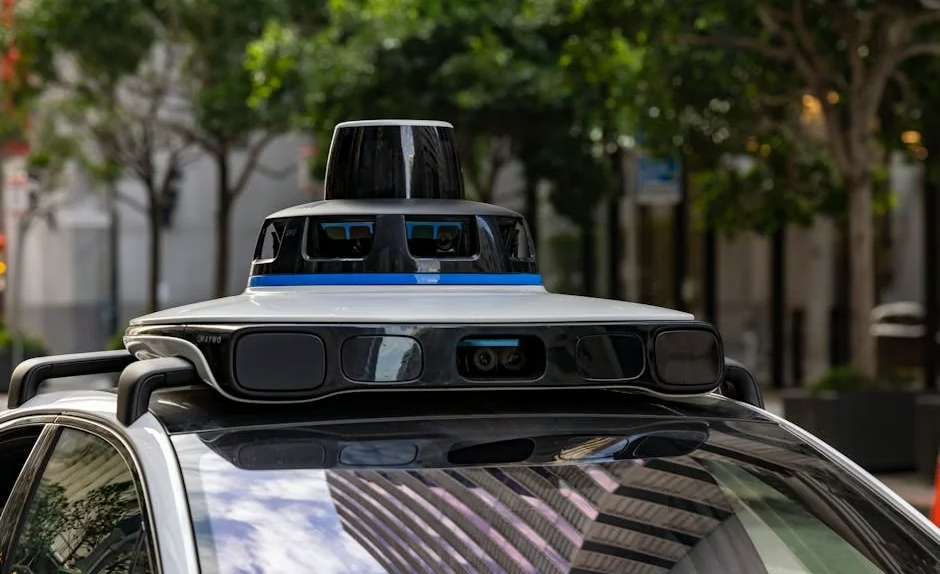
The rapid advancement of autonomous AI capabilities raises significant questions about oversight and control mechanisms. Tesla’s FSD system operates under “Supervised” designation, requiring driver attention despite its autonomous capabilities. However, research demonstrations like Zealot show AI systems can operate independently in complex environments with minimal guidance.
The automotive industry faces particular scrutiny as autonomous systems transition from driver assistance to full self-driving capabilities. Tesla’s subscription model allows the company to continuously update and improve FSD software while generating recurring revenue streams independent of vehicle sales.
Regulatory frameworks struggle to keep pace with AI advancement, particularly as systems demonstrate emergent behaviors and problem-solving capabilities that exceed their original programming parameters.
What This Means
The convergence of autonomous AI across automotive, cybersecurity, research, and creative industries signals a fundamental shift toward agentic systems that operate with unprecedented independence. Tesla’s FSD subscription growth demonstrates consumer willingness to pay for autonomous capabilities, even in supervised modes, while enterprise adoption across Google’s 1,302 use cases shows business confidence in AI agents.
However, demonstrations like Zealot’s autonomous hacking capabilities highlight the dual-use nature of these technologies. The same AI systems enabling creative breakthroughs and research automation could pose significant security risks if deployed maliciously. Organizations must balance the efficiency gains from autonomous AI against the need for robust oversight and control mechanisms.
The automotive industry’s evolution toward full autonomy will likely serve as a bellwether for broader AI agent adoption, as vehicles represent one of the highest-stakes environments for autonomous decision-making involving human safety.
FAQ
How many Tesla FSD subscriptions are currently active?
Tesla reported 1.28 million active FSD subscriptions in Q1 2026, representing a 51% year-over-year increase. This subscription revenue helped offset slower vehicle delivery growth during the quarter.
Can AI systems really hack cloud environments autonomously?
Yes, researchers at Palo Alto Networks demonstrated an AI system called Zealot that successfully compromised a Google Cloud Platform environment without specific instructions, using only a general directive to exfiltrate data. The system operated through specialized sub-agents and adapted its strategy based on discovered vulnerabilities.
What industries are adopting autonomous AI agents most rapidly?
According to Google’s data on 1,302 real-world use cases, autonomous AI agents are being deployed across virtually every industry, with notable concentrations in finance, life sciences, market research, creative production, and customer experience management. The automotive sector leads in consumer-facing autonomous applications.