
Enterprise organizations are witnessing a fundamental shift as autonomous AI agents move from experimental technology to production-ready solutions driving operational efficiency across industries. Google’s latest Deep Research Max agents now integrate with Gemini 3.1 Pro to deliver unprecedented analytical capabilities, while NVIDIA’s expanded partnerships with Adobe and WPP demonstrate how agentic AI is transforming enterprise marketing and creative workflows at scale.
The convergence of advanced language models, accelerated computing infrastructure, and enterprise-grade security frameworks is enabling organizations to deploy autonomous agents that can handle complex, multi-step workflows previously requiring human intervention. This represents a critical inflection point for IT decision-makers evaluating AI adoption strategies.
Enterprise AI Agent Architecture and Integration
Modern autonomous AI agents require sophisticated technical architecture to operate reliably in enterprise environments. Google’s Deep Research agents leverage the Model Context Protocol (MCP) to integrate seamlessly with existing enterprise data streams while maintaining security boundaries.
Key architectural components include:
- Multi-modal processing engines that handle text, visual, and structured data inputs
- Secure API gateways enabling integration with proprietary enterprise systems
- Real-time orchestration layers managing complex, multi-agent workflows
- Compliance frameworks ensuring data governance and regulatory adherence
For IT leaders, the technical requirements extend beyond basic AI model deployment. Enterprise-grade agent systems demand robust monitoring, logging, and audit capabilities. The integration complexity increases exponentially when agents must access multiple enterprise systems while maintaining security protocols.
NVIDIA’s approach with their Nemotron models emphasizes this enterprise readiness, providing organizations with the computational infrastructure needed to run agents at scale without compromising performance or security.
Manufacturing and Industrial AI Agent Deployment
The manufacturing sector represents one of the most compelling use cases for autonomous AI agents, with NVIDIA demonstrating AI-driven production capabilities at Hannover Messe 2026. Enterprise manufacturers are deploying agents across design, engineering, and production optimization workflows.
Critical deployment considerations include:
- Industrial-grade computing infrastructure capable of real-time processing
- Edge computing integration for factory floor applications
- Safety and compliance protocols meeting industrial standards
- Scalability frameworks supporting multi-facility deployments
The Industrial AI Cloud initiative in Germany exemplifies the infrastructure requirements for large-scale agent deployment. Built by Deutsche Telekom, this sovereign AI factory provides the computational foundation necessary for running autonomous agents across entire supply chains.
For enterprise decision-makers, the manufacturing use case demonstrates both the potential and complexity of agent deployment. Organizations must invest in comprehensive infrastructure upgrades while ensuring compliance with industrial safety standards.
Transportation and Mobility AI Agent Economics
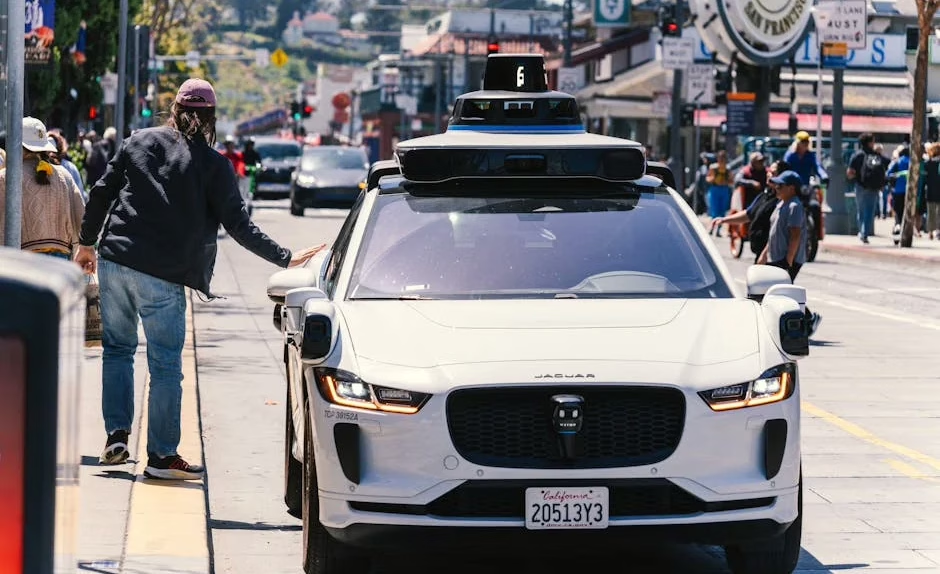
The transportation sector’s embrace of autonomous AI represents a significant enterprise investment trend. Uber’s commitment of over $10 billion to autonomous vehicle technology illustrates the scale of enterprise investment required for AI agent deployment in mobility applications.
This investment pattern reveals critical insights for enterprise AI strategy:
Financial considerations:
- Direct technology investments totaling $2.5 billion in AI capabilities
- Operational expenditure commitments of $7.5 billion for autonomous vehicle procurement
- Equity stake strategies maintaining long-term technology partnerships
- Risk mitigation approaches through diversified technology partnerships
Uber’s approach demonstrates how enterprises can balance innovation investment with operational risk management. Rather than developing all AI capabilities in-house, the company maintains strategic partnerships while securing access to cutting-edge autonomous technologies.
This model provides a framework for other enterprises considering large-scale AI agent deployment across complex operational environments.
Enterprise Marketing and Creative AI Agents
The collaboration between NVIDIA, Adobe, and WPP showcases how autonomous AI agents are transforming enterprise marketing operations. Adobe’s CX Enterprise Coworker represents a new category of AI agents specifically designed for enterprise creative and customer experience workflows.
Enterprise marketing agent capabilities:
- Continuous content generation across millions of product and audience combinations
- Brand governance enforcement maintaining consistency across all generated content
- Real-time personalization delivering tailored experiences at scale
- Multi-channel orchestration coordinating campaigns across digital touchpoints
For enterprise marketing teams, these agents enable a shift from campaign-based marketing to always-on, personalized customer engagement. The technical architecture supports real-time decision-making while maintaining brand control and compliance requirements.
The partnership model demonstrates how enterprises can leverage specialized AI capabilities without building comprehensive in-house expertise. This approach reduces time-to-market while ensuring access to cutting-edge AI technologies.
Security, Compliance, and Governance Frameworks
Enterprise AI agent deployment requires comprehensive security and governance frameworks addressing unique challenges of autonomous systems. Unlike traditional AI applications, agents operate with elevated privileges and can initiate actions across multiple enterprise systems.
Critical governance requirements:
- Multi-layered authentication ensuring secure system access
- Audit trail maintenance providing complete action visibility
- Regulatory compliance meeting industry-specific requirements
- Data sovereignty maintaining control over proprietary information
The integration of Model Context Protocol (MCP) in Google’s Deep Research agents exemplifies how enterprises can maintain security boundaries while enabling agent functionality. This protocol-based approach ensures agents can access necessary data while preventing unauthorized system access.
For IT decision-makers, establishing comprehensive governance frameworks before agent deployment is essential. The autonomous nature of these systems amplifies both security risks and compliance requirements.
What This Means
The enterprise adoption of autonomous AI agents represents a fundamental shift in how organizations approach automation and decision-making. Unlike previous AI implementations focused on specific tasks, agents enable end-to-end workflow automation across complex enterprise environments.
For IT leaders, this transition requires strategic investment in infrastructure, security, and governance capabilities. The examples from Google, NVIDIA, and enterprise partners demonstrate that successful agent deployment demands comprehensive technical architecture rather than point solutions.
The financial commitments illustrated by companies like Uber indicate that enterprise AI agent adoption requires significant long-term investment. However, the operational efficiency gains and competitive advantages justify these investments for organizations ready to embrace autonomous systems.
Enterprise decision-makers must evaluate their organization’s readiness for agent deployment, considering both technical infrastructure and operational governance requirements. The companies leading this transformation are those investing in comprehensive AI strategies rather than isolated implementations.
FAQ
Q: What infrastructure requirements are necessary for enterprise AI agent deployment?
A: Enterprise AI agents require robust computing infrastructure including GPU acceleration, secure API gateways, real-time orchestration platforms, and comprehensive monitoring systems. Organizations typically need significant infrastructure investment before deployment.
Q: How do enterprises maintain security and compliance with autonomous AI agents?
A: Successful enterprises implement multi-layered security frameworks including protocol-based access control (like MCP), comprehensive audit logging, regulatory compliance monitoring, and data sovereignty protection. Governance frameworks must be established before agent deployment.
Q: What ROI can enterprises expect from autonomous AI agent implementation?
A: While specific ROI varies by use case, enterprises report significant efficiency gains in content creation, research workflows, and operational decision-making. Companies like Uber are investing billions based on projected operational improvements and competitive advantages in autonomous capabilities.
Related news
- Google DeepMind launches Deep Research Max autonomous AI research agent | ETIH EdTech News – EdTech Innovation Hub – Google News – Tech Innovation
- NVIDIA and Google Cloud Collaborate to Advance Agentic and Physical AI – NVIDIA AI Blog
- Google unveils chips for AI training and inference in latest shot at Nvidia – CNBC Tech
Sources
- Deep Research Max: a step change for autonomous research agents – Google Blog
- Autonomous AI at Scale: Adobe Agents Unlock Breakthrough Creative Intelligence With NVIDIA and WPP – NVIDIA AI Blog
- NVIDIA and Partners Showcase the Future of AI-Driven Manufacturing at Hannover Messe 2026 – NVIDIA AI Blog