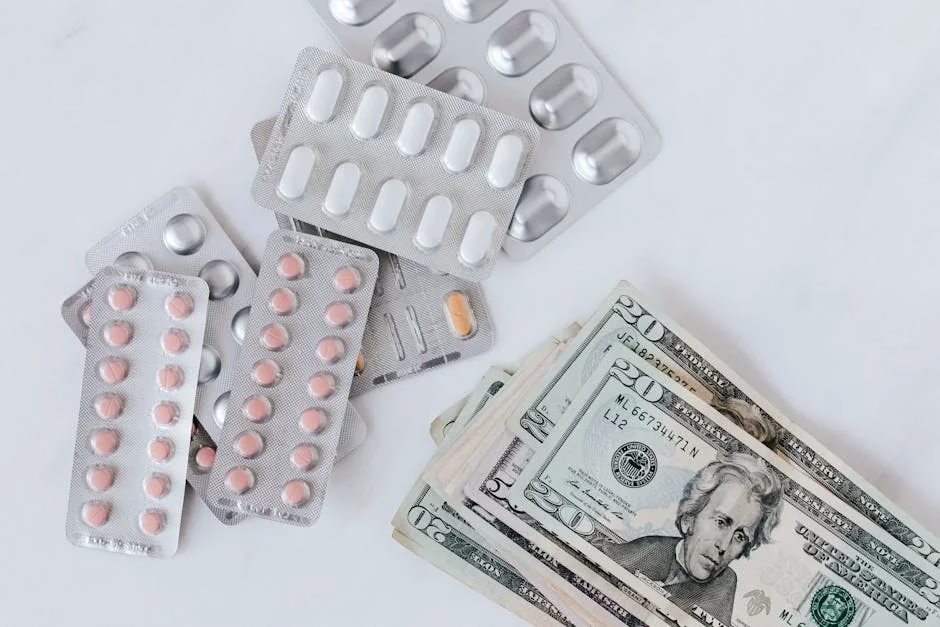

Trump Administration Policies Could Create Headwinds Across Healthcare Sector
Healthcare Industry Braces for Potential Policy Shifts
The healthcare industry is preparing for significant changes as the incoming Trump administration signals policy shifts that could reshape the regulatory landscape. Industry analysts and healthcare organizations are carefully assessing potential impacts across multiple segments of the healthcare ecosystem.
Anticipated Policy Changes
The Trump administration is expected to pursue several healthcare policy initiatives that may create challenges for various stakeholders:
Pharmaceutical Pricing and Regulation
One area of focus is likely to be pharmaceutical pricing. The administration has previously indicated interest in negotiating drug prices, though the approach may differ significantly from current policies. This creates uncertainty for pharmaceutical companies and could affect their pricing strategies and research investments.
According to industry sources, pharmaceutical companies are already adjusting their long-term planning to account for potential policy shifts. Some analysts suggest these changes could create volatility in pharmaceutical stocks as the market adjusts to new regulatory expectations.
Insurance Market Reforms
The administration may also pursue changes to insurance market regulations, potentially affecting both insurers and healthcare providers. Previous statements suggest a preference for market-based solutions and reduced regulatory oversight, which could reshape how insurance products are designed and priced.
Fitch Ratings has indicated that insurance market uncertainty could create headwinds for healthcare organizations that depend on stable reimbursement models. Healthcare systems with high exposure to government programs may face particular challenges if policies shift significantly.
Healthcare Technology and Innovation
The technology sector within healthcare may also experience policy impacts. While the administration has generally supported technological innovation, changes to data privacy regulations, artificial intelligence oversight, or telehealth reimbursement could affect the trajectory of healthcare technology companies.
Innovative healthcare startups that have flourished under current regulatory frameworks may need to adjust their strategies to navigate potential policy changes. Companies focused on AI-driven healthcare solutions could face particular scrutiny as the administration develops its approach to artificial intelligence regulation.
Industry Response and Adaptation
Healthcare organizations are developing contingency plans to address potential policy shifts. Many are focusing on operational efficiency and diversification strategies to mitigate risks associated with regulatory changes.
“Healthcare systems need to prepare for potential ebbs and flows in policy direction,” notes a healthcare consultant who requested anonymity due to client relationships. “Organizations with diversified revenue streams and strong operational fundamentals will be better positioned to weather potential headwinds.”
Larger healthcare systems with scale advantages may have more flexibility to adapt to policy changes, while smaller organizations could face greater challenges if reimbursement models shift significantly.
Economic Implications
The broader economic impact of healthcare policy changes could be substantial. Healthcare represents approximately 18% of U.S. GDP, and policy shifts that affect employment, investment, or consumer spending in this sector have ripple effects throughout the economy.
Investors are closely watching healthcare stocks for early signals of how the market anticipates these policy directions will develop. Some segments, such as health technology and services companies focused on cost reduction, may benefit from certain policy approaches, while others could face headwinds.
Looking Ahead
As the administration begins to articulate specific healthcare policies, industry stakeholders will gain clarity on the actual impact of these changes. The implementation timeline and specific regulatory approaches will significantly influence how disruptive these shifts ultimately prove to be.
Healthcare organizations are advised to maintain flexibility in their strategic planning while closely monitoring policy developments. Engaging constructively with policymakers may help shape the implementation of new approaches in ways that support both industry stability and improved healthcare outcomes.
While uncertainty creates challenges, it also presents opportunities for organizations that can effectively navigate the changing landscape. Those that successfully adapt to new policy directions may emerge stronger, even as the sector as a whole adjusts to potential headwinds.
“The healthcare industry has demonstrated remarkable resilience through previous policy shifts,” observes a healthcare policy analyst. “While the coming changes may create short-term challenges, the fundamental drivers of healthcare demand remain strong.”
Conclusion
As the Trump administration develops its healthcare policy agenda, industry participants should prepare for potential disruption while remaining focused on their core missions of improving health outcomes and operational excellence. The ability to adapt quickly to evolving policy directions will be a key differentiator for organizations across the healthcare spectrum in the coming years.
Sources
- Gemini 2.0 Deep Dive: Code Execution – Reddit Singularity
- News 📰 Trump, Chip Maker TSMC Expected to Announce $100 Billion Investment in the US, per WSJ. – Reddit Singularity
- Factory begins trial for humanoid robots that can build more of themselves – Reddit Singularity
- Sesame voice is incredibly realistic – Reddit Singularity
- GPT-4.5 will just invent concepts mid-conversation – Reddit Singularity
- It begins: Pentagon to give AI agents a role in decision making, ops planning – Reddit Singularity
- A quarter of startups in YC’s current cohort have codebases that are almost entirely AI-generated – Reddit Singularity
- The past 18 months have seen the most rapid change in human written communication ever – Reddit Singularity
- China and US need to cooperate on AI or risk ‘opening Pandora’s box’, ambassador warns – Reddit Singularity
- As models get larger, they become more accurate, but also more dishonest (lie under pressure) – Reddit Singularity
- OpenAI discovered GPT-4.5 scheming and trying to escape the lab, but less frequently than o1 – Reddit Singularity
- Novo Nordisk has gone from a team of 50 writers drafting clinical reports to just 3 – Reddit Singularity
- “Claude (via Cursor) randomly tried to update the model of my feature from OpenAI to Claude” – Reddit Singularity
- 30% of AI researchers say AGI research should be halted until we have a way to fully control these systems (AAAI survey) – Reddit Singularity
- Virtual Reality – Reddit Singularity
- To say GPT-4.5 means winter is to act like it exists in a vacuum where reasoning models don’t exist and won’t be able to distill its vast knowledge. – Reddit Singularity
- Could it be possible to dynamically change reasoning effort of CoT models with just 1 single special token in the system message? – Reddit Singularity
- Elon Musk’s AI chatbot says a ‘Russian asset’ delivered the State of the Union – Reddit Singularity
- Convince me that the majority of the population won’t become the movie “Her” – Reddit Singularity
- We are already there even if there is ZERO pregression from now on. – Reddit Singularity
- Will the next 1000 years be as incomprehensible to us as now is to someone from the Middle Ages? – Reddit Singularity
- Any theories on what Ilya/SSI is working on? – Reddit Singularity
- Failed prediction of the week from Joe Russo: “AI will be able to to create a full movie within two years” (made on April 2023) – Reddit Singularity
- Do you think AI is already helping it’s own improvements? – Reddit Singularity
- Well, gpt-4.5 just crushed my personal benchmark everything else fails miserably – Reddit Singularity
- Software Developers – Stop worrying and start preparing! – Reddit Singularity
- GPT4.5 Review from a physician. This is on a whole other level for non reasoning tasks. – Reddit Singularity
- Open Source is Killing Software Engineers – Reddit Singularity
- How I see radical longevity will happen after singularity – Reddit Singularity
- World’s first “Synthetic Biological Intelligence” runs on living human cells. – Reddit Singularity
- Empirical evidence that GPT-4.5 is actually beating scaling expectations. – Reddit Singularity
- Believing AGI/ASI will only benefit the rich is a foolish assumption. – Reddit Singularity