
Artificial intelligence research continues to accelerate across multiple domains, delivering breakthrough applications that promise to transform healthcare, scientific discovery, and our understanding of AI capabilities themselves.
Machine Learning Transforms Drug Discovery
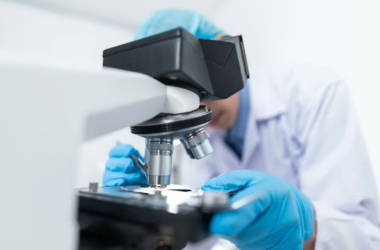
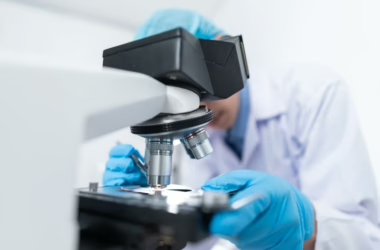
A significant advancement in pharmaceutical research has emerged through machine learning models capable of predicting chemical reactions. This breakthrough technology represents a major step forward in accelerating drug discovery processes, potentially reducing the time and cost associated with developing new medications. The predictive capabilities of these AI systems could revolutionize how researchers approach chemical synthesis and pharmaceutical development.
Medical Applications Reach Clinical Reality
In a historic milestone, Japan has approved the world’s first treatment made with reprogrammed human cells, marking exactly 20 years since the creation of mouse induced pluripotent stem (iPS) cells. The Japanese Ministry of Health, Labor and Welfare granted conditional marketing authorization to two regenerative medical products derived from reprogrammed iPS cells.
Shinya Yamanaka, director emeritus of the iPS Cell Research Institute at Kyoto University, expressed satisfaction with this achievement: “We are very pleased to have taken a major step toward social application on the 20th anniversary of the announcement of mouse iPS cells.” This represents the world’s first practical application of iPS cell-derived products in clinical treatment.
Understanding AI Research Terminology
As AI research advances rapidly, understanding the technical vocabulary becomes increasingly important. The field relies heavily on specialized terminology, from concepts like Artificial General Intelligence (AGI) to emerging phenomena such as hallucinations in large language models (LLMs).
AGI, or artificial general intelligence, represents AI systems that could potentially match or exceed human capabilities across a broad range of tasks. This remains a significant research goal, with scientists continuously developing novel methods to push the boundaries of artificial intelligence while simultaneously identifying emerging safety risks.
Research Publication and Dissemination
The AI research community relies on platforms like arXiv for rapid dissemination of findings, enabling researchers worldwide to access the latest studies and benchmarks. This open approach to knowledge sharing accelerates the pace of discovery and allows for collaborative advancement across institutions and borders.
As researchers continue to uncover new methodologies and identify both opportunities and risks in AI development, the field maintains its dynamic evolution. These recent breakthroughs in drug discovery and regenerative medicine demonstrate AI’s growing impact on practical applications that could benefit humanity.
The convergence of computational power, advanced algorithms, and scientific expertise continues to yield remarkable results, positioning AI research at the forefront of technological and medical innovation.
Sources
For the broader 2026 landscape across research, industry, and policy, see our State of AI 2026 reference.