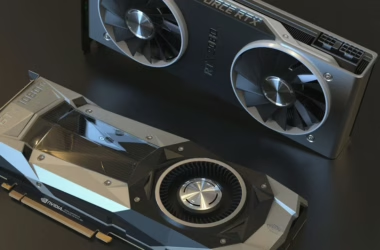

AI infrastructure startup Fluidstack is reportedly in talks to raise $1 billion at an $18 billion valuation, more than doubling its worth from $7.5 billion just months earlier, according to Bloomberg. Meanwhile, procurement automation company Traza closed a $2.1 million pre-seed round led by Base10 Partners, while Caterpillar acquired struggling autonomous tractor maker Monarch Tractor’s assets after the company raised over $200 million since 2018.
Fluidstack’s Meteoric Valuation Rise Reflects AI Infrastructure Demand
Fluidstack’s potential $18 billion valuation represents one of the most dramatic value increases in recent AI company history. The startup, which builds specialized data centers exclusively for AI workloads, has caught investor attention following its $50 billion contract with Anthropic to construct custom facilities in Texas and New York.
The company’s rapid ascent mirrors broader market dynamics where AI infrastructure providers command premium valuations. Unlike traditional cloud providers serving diverse computing needs, Fluidstack’s AI-specific architecture offers dedicated hardware optimized for machine learning workloads, positioning it as critical infrastructure for the AI boom.
Jane Street is reportedly leading the current funding round, though talks remain ongoing. The deal would provide Fluidstack with substantial capital to expand its data center footprint as AI companies increasingly seek alternatives to hyperscale cloud providers for specialized computing requirements.
Procurement AI Startup Traza Targets $8B Market Opportunity
Traza’s $2.1 million pre-seed funding may appear modest compared to Fluidstack’s billion-dollar round, but the New York-based startup is targeting a massive market opportunity. The procurement software sector exceeds $8 billion annually, yet remains largely dominated by manual processes including email, spreadsheets, and phone calls.
Base10 Partners led the round with participation from Kfund, a16z scouts, Clara Ventures, and Masia Ventures. Notable angel investors include Pepe Agell, who scaled Chartboost to 700 million monthly users before its acquisition by Zynga.
Traza’s value proposition centers on autonomous AI agents that execute procurement tasks without continuous human supervision. These agents handle vendor outreach, request-for-quote generation, order tracking, supplier communications, and invoice processing—functions that traditionally require significant manual oversight.
Revenue Model and Market Positioning
The startup’s approach differs from traditional procurement software by focusing on execution rather than recommendations. CEO Silvestre Jara Montes positions this as “rebuilding how procurement works” rather than simply digitizing existing processes.
For enterprise customers, particularly in manufacturing and construction, procurement inefficiencies can result in millions in lost value after contracts are signed. Traza’s autonomous approach promises to capture these savings through continuous optimization and real-time vendor management.
Monarch Tractor’s Acquisition Highlights Execution Challenges
Caterpillar’s acquisition of Monarch Tractor’s assets illustrates the challenges facing hardware-focused AI startups. Despite raising over $200 million since 2018, Monarch struggled to scale its “driver optional” electric tractors for agricultural applications.
The company faced multiple operational setbacks including dealer lawsuits, manufacturing partner loss when Foxconn sold its Lordstown facility, and internal disagreements over strategic direction. Co-founder Carlo Mondavi was reportedly “pushed out” after disagreeing with CEO Praveen Penmetsa’s pivot toward software services.
Strategic Value for Caterpillar
For Caterpillar, the acquisition provides access to autonomous vehicle technology and electric drivetrain expertise relevant to its construction and mining equipment portfolio. The deal represents a relatively low-cost entry into agricultural automation, complementing Caterpillar’s existing heavy machinery business.
Monarch’s technology stack, including computer vision systems and autonomous navigation capabilities, could enhance Caterpillar’s digital transformation initiatives across its equipment lines.
Airwallex’s $1.2B Rejection Proves Prescient
Airwallex CEO Jack Zhang’s decision to reject Stripe’s $1.2 billion acquisition offer in 2018 now appears remarkably prescient. According to TechCrunch, the Melbourne-based fintech company now claims over $1.3 billion in annualized revenue with 85% year-over-year growth, processing nearly $300 billion in annual transaction volume.
At the time of Stripe’s offer, Airwallex generated approximately $2 million in annualized revenue, representing a 600x revenue multiple. Zhang’s rejection came after extensive deliberation, including input from co-founders and personal reflection on his entrepreneurial vision.
Market Validation and Competitive Positioning
Airwallex’s growth trajectory validates Zhang’s belief in building “financial infrastructure that lets any business operate anywhere in the world as if it were a local company.” The company’s success demonstrates the market opportunity for cross-border payment solutions serving global commerce.
The decision also highlights the strategic value of maintaining independence during rapid growth phases. Airwallex’s current valuation likely exceeds Stripe’s 2018 offer by multiple orders of magnitude, justifying Zhang’s conviction in the company’s long-term potential.
What This Means
These developments illustrate three critical trends shaping AI company valuations and strategic decisions. First, infrastructure-focused AI companies like Fluidstack command premium valuations due to their essential role in supporting AI deployment at scale. The specialized nature of AI computing requirements creates defensible market positions for dedicated providers.
Second, enterprise AI applications in traditionally manual sectors like procurement represent significant automation opportunities. Traza’s modest funding reflects early-stage market validation, but the underlying market size suggests substantial growth potential for successful execution.
Third, hardware-software integration challenges continue plaguing AI startups attempting to build physical products. Monarch’s struggles highlight execution risks in capital-intensive businesses, while successful software-focused pivots remain difficult.
For investors, these cases demonstrate the importance of market timing, execution capability, and strategic focus in AI investments. Infrastructure plays command higher valuations but require substantial capital, while application-layer companies offer more accessible entry points with potentially lower returns.
FAQ
What makes Fluidstack worth $18 billion?
Fluidstack’s valuation reflects its specialized AI data center infrastructure and $50 billion contract with Anthropic. The company provides dedicated hardware optimized for AI workloads, addressing critical infrastructure needs as AI adoption accelerates.
Why did Airwallex reject Stripe’s acquisition offer?
CEO Jack Zhang rejected the $1.2 billion offer to maintain independence and pursue his vision of global financial infrastructure. The decision proved successful, with Airwallex now generating over $1.3 billion in annual revenue.
What went wrong with Monarch Tractor?
Monarch faced multiple challenges including manufacturing partner loss, dealer lawsuits, and strategic disagreements between founders. Despite raising $200+ million, the company struggled to scale autonomous tractor production and was ultimately acquired by Caterpillar.