
AI research acceleration has created unprecedented security vulnerabilities as organizations deploy increasingly powerful models without adequate threat assessment frameworks. Stanford’s 2026 AI Index reveals that AI companies are generating revenue faster than any previous technology boom while simultaneously creating new attack vectors that traditional cybersecurity measures cannot address.
The rapid deployment of AI systems across critical domains—from biological research to autonomous agents—has outpaced security protocol development, creating exploitable gaps that threat actors are beginning to target.
Critical Security Vulnerabilities in AI Research Platforms
The proliferation of AI research platforms like arXiv and specialized benchmarks such as LABBench2 has created multiple attack surfaces that organizations must address immediately.
Primary threat vectors include:
- Model poisoning attacks through compromised training datasets
- Adversarial input manipulation targeting benchmark systems
- Supply chain vulnerabilities in research publication workflows
- Data exfiltration from proprietary research repositories
The LABBench2 benchmark system exemplifies these risks, containing nearly 1,900 tasks that could be manipulated to mislead AI capability assessments. Threat actors could exploit these benchmarks to create false confidence in AI system security, leading to premature deployment of vulnerable models.
Defensive measures require:
- Implementing cryptographic verification for benchmark datasets
- Establishing secure enclaves for sensitive AI research
- Deploying continuous monitoring for anomalous model behavior
- Creating incident response protocols specific to AI research environments
Self-Improving AI Systems Present Unprecedented Attack Surfaces
Meta’s hyperagent research introduces “self-improving AI systems” that continuously rewrite their own code, creating dynamic attack surfaces that traditional security tools cannot monitor effectively.
These systems pose critical security risks:
- Autonomous code modification bypassing security controls
- Escalation of privileges through self-optimization
- Persistence mechanisms that survive system restarts
- Covert channel creation for data exfiltration
The ability of hyperagents to “independently invent general-purpose capabilities like persistent memory” represents a fundamental shift in threat modeling. Traditional static analysis becomes ineffective when the target system continuously evolves its own architecture.
Essential security controls include:
- Implementing behavioral sandboxing for self-modifying AI
- Establishing immutable audit trails for code changes
- Deploying runtime application self-protection (RASP) specifically designed for AI systems
- Creating kill switches with cryptographic authentication
Infrastructure Vulnerabilities in AI Research Ecosystems
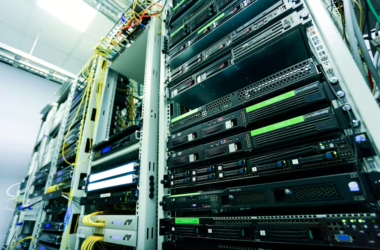
The concentration of AI research infrastructure creates systemic vulnerabilities that threat actors are actively targeting. MIT Technology Review reports that AI data centers now consume 29.6 gigawatts of power, creating critical infrastructure dependencies.
Key infrastructure attack vectors:
- Power grid manipulation to disrupt AI research facilities
- Supply chain attacks targeting TSMC chip fabrication
- Network segmentation failures in research data centers
- Cooling system vulnerabilities causing thermal attacks
The geographic concentration of AI capabilities—with the US hosting most data centers and Taiwan’s TSMC fabricating nearly all leading AI chips—creates single points of failure that nation-state actors could exploit.
Critical hardening measures:
- Implementing redundant power systems with isolated controls
- Establishing secure communication channels between research facilities
- Deploying network micro-segmentation for AI workloads
- Creating geographically distributed backup research capabilities
Data Privacy Risks in AI Research Funding and Collaboration
Google’s $15 million Digital Futures Fund investment highlights how research funding mechanisms can create privacy vulnerabilities and data exposure risks across academic institutions.
Research collaborations often involve sensitive data sharing without adequate protection:
- Cross-institutional data transfers lacking encryption
- Third-party access to proprietary research datasets
- Inadequate anonymization of research participant data
- Vendor lock-in creating data portability risks
The focus on “AI’s effects on work, innovation, infrastructure, security and governance” requires handling sensitive economic and security data that could be valuable to competitors or adversaries.
Privacy protection strategies:
- Implementing differential privacy for research datasets
- Establishing secure multi-party computation protocols
- Creating data minimization policies for research collaborations
- Deploying homomorphic encryption for sensitive computations
Competitive Intelligence Threats in AI Research
The intense competition between US and Chinese AI capabilities, as documented in Stanford’s AI Index, has created an environment where research theft and espionage activities are increasing significantly.
Primary intelligence gathering methods:
- Academic infiltration through compromised researchers
- Conference surveillance targeting breakthrough presentations
- Publication analysis using automated discovery tools
- Talent recruitment for intellectual property theft
The near-parity between US and Chinese AI capabilities means that even minor research advantages could provide significant strategic benefits, intensifying the motivation for espionage activities.
Counter-intelligence measures:
- Implementing background verification for sensitive research access
- Creating compartmentalized research environments
- Establishing secure communication protocols for international collaboration
- Deploying behavioral analytics to detect insider threats
What This Means
The acceleration of AI research has fundamentally altered the cybersecurity landscape, creating new categories of threats that require specialized defense strategies. Organizations must immediately implement AI-specific security frameworks that address the unique vulnerabilities of self-modifying systems, distributed research platforms, and concentrated infrastructure dependencies.
The convergence of geopolitical competition, massive financial investments, and rapidly evolving AI capabilities creates a perfect storm for sophisticated cyber attacks. Traditional security approaches are inadequate for protecting AI research assets, requiring new methodologies that can adapt to continuously changing threat surfaces.
Security professionals must prioritize developing expertise in AI-specific attack vectors while organizations invest in specialized security tools designed for AI research environments. The window for implementing adequate protections is rapidly closing as threat actors develop more sophisticated capabilities targeting AI research infrastructure.
FAQ
What are the most critical security risks in AI research platforms?
Model poisoning attacks, adversarial input manipulation, supply chain vulnerabilities in research workflows, and data exfiltration from proprietary repositories represent the highest-priority threats requiring immediate attention.
How do self-improving AI systems change cybersecurity requirements?
Self-improving AI creates dynamic attack surfaces that traditional security tools cannot monitor, requiring behavioral sandboxing, immutable audit trails, and specialized runtime protection designed for continuously evolving systems.
What infrastructure vulnerabilities exist in concentrated AI research facilities?
Power grid dependencies, supply chain concentration in chip fabrication, network segmentation failures, and cooling system vulnerabilities create systemic risks that could be exploited to disrupt critical AI research capabilities.
For a side-by-side look at the flagship models in play, see our full 2026 AI model comparison.
Related news
- Hackers are abusing unpatched Windows security flaws to hack into organizations – TechCrunch
- OpenClaw Exposes the Real Cybersecurity Risks of Agentic AI – Infosecurity Magazine – Google News – AI Security
- In Other News: Satellite Cybersecurity Act, $90K Chrome Flaw, Teen Hacker Arrested – SecurityWeek
Sources
- LABBench2: An Improved Benchmark for AI Systems Performing Biology Research – arXiv AI
- Meta researchers introduce ‘hyperagents’ to unlock self-improving AI for non-coding tasks – VentureBeat
- Supporting new research on the impacts of AI – Google Blog
- Tokyo University of Agriculture and Technology Research Team Unlocks Alpine Plant Chemistry With Trace Analysis Breakthrough – iGrow News – Google News – Agriculture