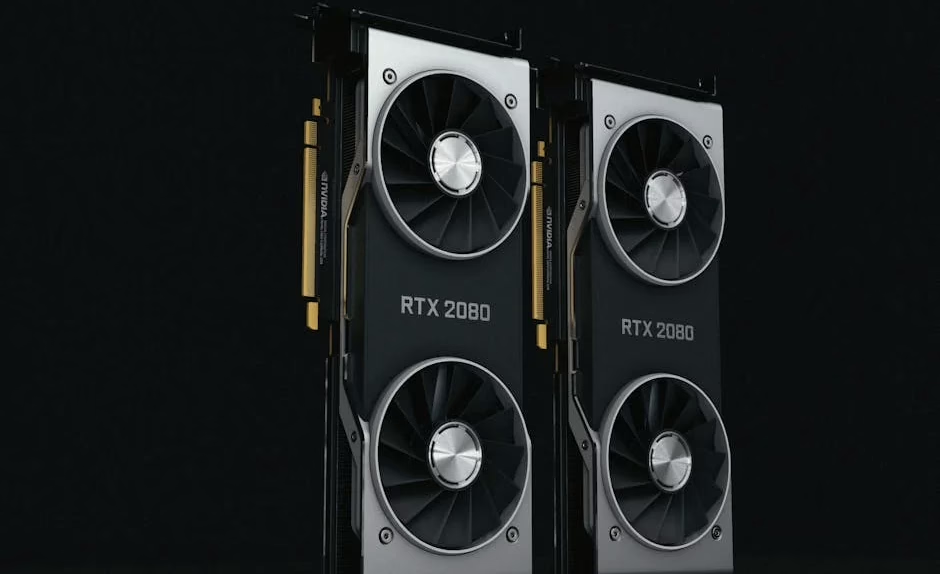

NVIDIA Corporation revealed that artificial intelligence has dramatically reduced GPU design timelines from 10 months with eight engineers to an overnight task, while simultaneously facing significant export approval delays for AI chips to China due to government regulatory bottlenecks. According to Tom’s Hardware, the company emphasizes it remains “a long way” from AI designing chips without human oversight, highlighting critical questions about automation’s role in technology development.
Meanwhile, export approvals for NVIDIA and AMD AI chips to China have stalled under a government bottleneck, with the Bureau of Industry and Security experiencing 20% staff turnover that has hobbled approval processes. These developments underscore the complex intersection of technological advancement, international trade policy, and ethical considerations surrounding AI development.
The Acceleration Paradox: AI Designing AI
NVIDIA’s revelation about AI-assisted chip design represents a profound shift in how we approach technological development. The company’s ability to compress months of human engineering work into overnight automated processes raises fundamental questions about the democratization versus concentration of technological power.
While efficiency gains appear remarkable, this acceleration creates several ethical concerns:
- Transparency gaps: Automated design processes may obscure decision-making pathways that human engineers would traditionally document
- Accountability challenges: When AI systems make design choices, determining responsibility for potential flaws or biases becomes complex
- Employment implications: The displacement of engineering roles raises questions about workforce transition and economic equity
The company’s acknowledgment that human oversight remains essential suggests awareness of these concerns. However, the pressure to maintain competitive advantage may gradually erode these safeguards as AI capabilities expand. This tension between innovation speed and responsible development requires careful regulatory attention.
Export Controls and Global AI Governance
The stalling of chip export approvals to China illuminates the broader challenge of governing AI technology in a multipolar world. The Bureau of Industry and Security’s staffing crisis, with 20% turnover hampering operations, reveals how bureaucratic capacity constraints can inadvertently shape global technology distribution.
These delays create several stakeholder impacts:
For NVIDIA and AMD: Revenue uncertainty and strategic planning challenges in key markets
For Chinese companies: Limited access to cutting-edge AI hardware, potentially driving domestic alternatives
For global AI development: Fragmentation of technological ecosystems along geopolitical lines
The current bottleneck system lacks the nuance needed for effective AI governance. Binary approve/deny decisions cannot adequately address the spectrum of AI applications, from beneficial medical research to potentially concerning surveillance systems. A more sophisticated framework considering end-use applications, rather than blanket restrictions, would better serve both security and innovation interests.
Market Concentration and Democratic Access
Analyst projections suggesting NVIDIA could become “the first $22 trillion stock” highlight concerns about market concentration in AI infrastructure. Such valuation levels would represent unprecedented corporate power over foundational AI technologies.
This concentration poses several democratic challenges:
- Innovation gatekeeping: A single company controlling essential AI hardware could limit research directions
- Economic inequality: Massive valuations may further concentrate wealth among existing shareholders
- Policy influence: Companies of this scale often wield disproportionate influence over regulatory frameworks
The current trajectory suggests need for proactive policy intervention to ensure competitive markets and equitable access to AI infrastructure. This might include public investment in alternative chip architectures, open-source hardware initiatives, or antitrust measures to prevent excessive market dominance.
Ethical AI Development in Practice
NVIDIA’s approach to AI-assisted design offers insights into responsible automation practices. The company’s emphasis on maintaining human oversight, despite efficiency gains, demonstrates recognition of accountability principles. However, this stance may face pressure as competitive dynamics intensify.
Key ethical considerations include:
Bias prevention: AI design systems may perpetuate or amplify existing biases in chip architectures
Safety assurance: Automated systems require robust testing to ensure reliability in critical applications
Workforce impact: Companies must consider retraining and transition support for displaced engineers
The industry needs standardized frameworks for evaluating AI-designed systems, including bias audits, safety validation protocols, and impact assessments. Without such standards, the rush toward automation may compromise both technical quality and social responsibility.
Regulatory Frameworks for Emerging Technologies
Current export control mechanisms, designed for traditional technologies, prove inadequate for AI’s dual-use nature. The Bureau of Industry and Security’s staffing challenges reflect broader governmental struggles to keep pace with technological change.
Effective AI governance requires:
- Technical expertise: Regulators need deep understanding of AI capabilities and limitations
- Adaptive frameworks: Rigid rules cannot accommodate AI’s rapid evolution
- International cooperation: Unilateral controls may simply redirect technology flows rather than managing risks
The quantum computing developments mentioned alongside NVIDIA’s announcements further complicate this landscape. As IonQ and NVIDIA make strides on World Quantum Day, regulators must simultaneously address multiple converging technologies with transformative potential.
What This Means
NVIDIA’s AI acceleration capabilities and export bottlenecks represent two sides of the same challenge: governing transformative technology in a complex global environment. The company’s technical achievements demonstrate AI’s potential to revolutionize development processes, while regulatory struggles highlight governance gaps that could undermine both innovation and security.
The path forward requires balancing multiple objectives: maintaining technological leadership, ensuring democratic access to AI benefits, protecting national security interests, and preserving human agency in technological development. This balance cannot be achieved through market forces alone—it demands thoughtful policy intervention and international cooperation.
Most critically, these developments underscore the need for anticipatory governance frameworks that can adapt to technological change while preserving democratic values. The current reactive approach, evident in both export control bottlenecks and corporate concentration trends, risks ceding control over AI’s societal impact to narrow commercial interests.
FAQ
How does AI-assisted chip design affect employment in the semiconductor industry?
While AI dramatically reduces design timelines, NVIDIA emphasizes continued human oversight requirements. The industry will likely see role evolution rather than wholesale displacement, with engineers focusing on higher-level design decisions and AI system management.
Why are AI chip export approvals to China experiencing delays?
The Bureau of Industry and Security faces a 20% staff turnover rate, creating bottlenecks in processing export applications. This reflects broader challenges in government agencies keeping pace with rapidly evolving AI technologies and their security implications.
What are the risks of market concentration in AI hardware?
Concentration could limit innovation diversity, create supply chain vulnerabilities, and concentrate economic and political power. Potential solutions include public investment in alternative architectures, open-source initiatives, and antitrust measures to maintain competitive markets.
Related news
- Nvidia’s New AI Models Spark Rally in Quantum Computing Stocks – Bloomberg.com – Google News – NVIDIA
- Nvidia stock is on a 10-day winning streak and up 18% over that stretch – CNBC Tech
- Microsoft will rent 30,000 Nvidia chips from Nscale in Norway deal; expands Wyoming ops (MSFT:NASDAQ) – Seeking Alpha – Google News – NVIDIA
Sources
- Here are Monday’s biggest analyst calls: Nvidia, Apple, Tesla, CoreWeave, Blackstone, Starbucks, Netflix & more – CNBC – Google News – NVIDIA
- Nvidia says AI cuts 10-month, eight-engineer GPU design task to overnight job — company is still ‘a long way’ from AI designing chips without human input – Tom’s Hardware – Google News – NVIDIA
- Approvals for Nvidia and AMD AI chip exports to China stall under government bottleneck — 20% staff turnover hobbles Bureau of Industry and Security – Tom’s Hardware – Google News – NVIDIA
For the broader 2026 landscape across research, industry, and policy, see our State of AI 2026 reference.