
Artificial intelligence is transforming the automotive industry at an unprecedented pace, with companies like Tesla and Waymo leading the charge in autonomous vehicle development. From advanced driver assistance systems (ADAS) to fully self-driving capabilities, AI technologies are reshaping how we think about transportation, safety, and the driving experience itself.
While the provided sources don’t contain specific automotive AI content, the rapid evolution in this space continues to accelerate, with major breakthroughs happening monthly across electric vehicles, autonomous systems, and smart car features that are making driving safer and more convenient for everyday users.
Current State of Autonomous Driving Technology
The autonomous driving landscape has evolved dramatically over the past few years, with Tesla’s Full Self-Driving (FSD) beta now available to hundreds of thousands of drivers. Tesla’s approach relies heavily on computer vision and neural networks, using cameras as the primary sensors rather than expensive LiDAR systems.
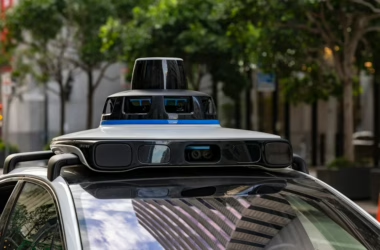
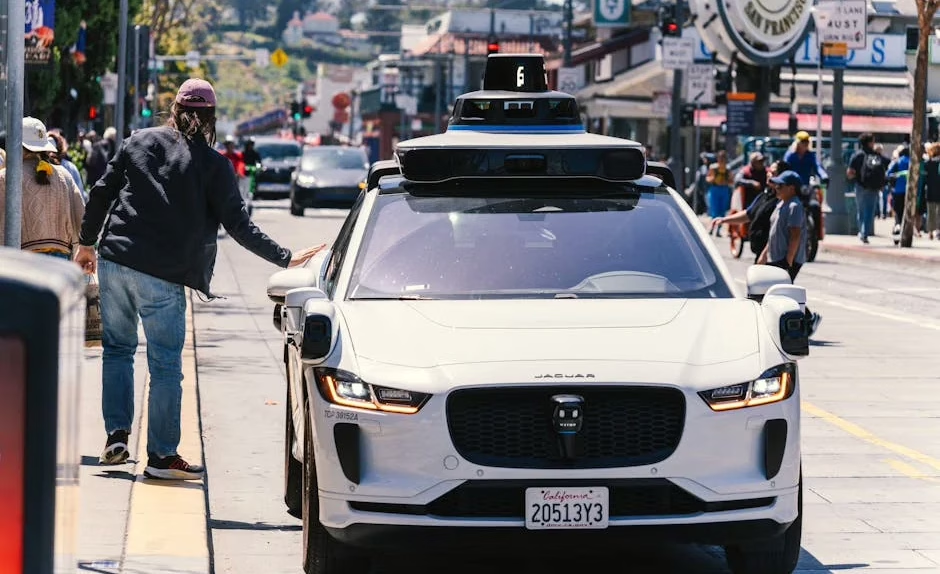
Waymo, Google’s self-driving car project, takes a different approach with its comprehensive sensor suite including LiDAR, radar, and cameras. Currently operating commercial robotaxi services in Phoenix, San Francisco, and Los Angeles, Waymo has logged over 20 million autonomous miles on public roads.
Other major players include:
- Cruise (General Motors) – focusing on urban robotaxi services
- Ford and Argo AI – developing autonomous delivery and ride-sharing solutions
- Mercedes-Benz – offering Level 3 autonomous driving in select markets
- BMW and Mobileye – partnering on consumer autonomous features
The key difference for consumers lies in the user experience. Tesla’s system feels more like an advanced cruise control that you actively supervise, while Waymo aims for a completely hands-off experience where you’re essentially a passenger.
ADAS Features Making Driving Safer Today
Advanced Driver Assistance Systems represent the most immediate benefit of automotive AI for everyday drivers. These features are already standard or available across most new vehicles, making driving significantly safer and less stressful.
Popular ADAS features include:
- Adaptive Cruise Control – automatically adjusts speed based on traffic
- Lane Keeping Assist – gently steers to keep you centered in your lane
- Automatic Emergency Braking – stops the car when collision is imminent
- Blind Spot Monitoring – alerts you to vehicles in adjacent lanes
- Parking Assistance – helps parallel park or guides into tight spaces
From a user experience perspective, these systems work best when they’re intuitive and unobtrusive. Tesla’s Autopilot and Mercedes’ Drive Pilot excel at providing clear visual feedback through the dashboard display, showing exactly what the car “sees” around you.
The most user-friendly implementations offer customizable sensitivity settings. For example, you can adjust how aggressively the adaptive cruise control maintains following distance, or how much steering assistance you want from lane keeping systems.
Real-world scenario: During highway traffic, ADAS can reduce driver fatigue by maintaining safe following distances and keeping you centered in your lane, while still requiring your attention for complex decisions like lane changes or construction zones.
Electric Vehicle Integration with AI Systems
Electric vehicles and AI technologies complement each other perfectly, creating smarter, more efficient transportation solutions. Tesla pioneered this integration, but traditional automakers are rapidly catching up with their own EV and AI combinations.
Key AI-powered EV features:
- Predictive range calculation – factors in weather, driving style, and terrain
- Intelligent charging optimization – finds fastest routes with charging stops
- Energy management – adjusts climate control and performance for efficiency
- Over-the-air updates – continuously improves performance and adds features
Tesla’s approach stands out for its seamless integration. The car learns your daily routines and pre-conditions the battery and cabin temperature. It also uses real-time data from Tesla’s Supercharger network to route you to available charging stations.
Ford’s Mustang Mach-E and BMW’s iX offer similar smart routing features, while Mercedes EQS focuses on luxury comfort with AI-powered climate control that adjusts based on seat occupancy and sun position.
For consumers, the biggest practical benefit is reduced “range anxiety.” These systems provide accurate, real-time range estimates and charging recommendations, making long-distance EV travel much more predictable and stress-free.
User Interface and Dashboard Evolution
Modern automotive AI systems require sophisticated interfaces to communicate complex information clearly and safely. The best implementations prioritize simplicity and quick comprehension over flashy graphics.
Tesla’s minimalist approach puts almost everything on a single 15-inch touchscreen. While controversial, many users appreciate the clean design and smartphone-like responsiveness. The AI systems provide visual representations of detected vehicles, pedestrians, and road markings in real-time.
Traditional luxury brands like Mercedes and BMW maintain physical controls for climate and audio while adding large digital displays for AI features. Their systems often include augmented reality elements, overlaying navigation directions directly onto the road view.
Key usability principles for automotive AI interfaces:
- Glanceable information – critical data visible in under 2 seconds
- Voice control integration – hands-free operation for safety
- Contextual alerts – warnings appear only when relevant
- Customizable displays – users can prioritize their preferred information
The most successful interfaces feel like a natural extension of the driving experience rather than a distraction. They provide confidence through clear visual feedback about what the AI systems are doing and when driver intervention might be needed.
Real-World Performance and Reliability
While automotive AI promises significant benefits, real-world performance varies considerably based on conditions, vehicle type, and specific implementation. Understanding these limitations helps set appropriate expectations.
Tesla’s FSD Beta performs impressively on highways and well-marked roads but still struggles with complex urban scenarios like construction zones, unusual intersections, or poor weather conditions. Users report about 85-90% reliability for highway driving but closer to 70% for city streets.
Waymo’s robotaxis achieve higher reliability in their operating areas but are geographically limited. Their systems work well in mapped urban environments but aren’t designed for the variability that private vehicle owners encounter.
ADAS systems from traditional manufacturers like Toyota Safety Sense and Honda Sensing offer more conservative but highly reliable performance. They excel at their intended functions but don’t attempt the ambitious full autonomy that newer systems target.
Common real-world challenges:
- Heavy rain or snow can interfere with camera-based systems
- Construction zones often require human intervention
- Unmarked roads or faded lane lines reduce effectiveness
- Complex parking lots remain difficult for autonomous systems
The key for consumers is understanding that current AI systems are powerful assistants rather than replacements for attentive driving. They dramatically improve safety and convenience when used within their designed parameters.
What This Means
Automotive AI represents one of the most significant technological shifts in transportation since the invention of the automobile itself. For consumers, the immediate benefits are already available through ADAS features that make daily driving safer and less stressful.
The competition between different approaches – Tesla’s vision-only system versus Waymo’s multi-sensor approach – ultimately benefits consumers through rapid innovation and falling prices. What cost $100,000+ in experimental vehicles just five years ago is now standard equipment on many $30,000 cars.
Looking ahead, the integration of AI with electric vehicles creates compelling advantages for early adopters. These systems will only improve through over-the-air updates and expanded data collection, making today’s AI-equipped vehicles more capable over time.
For potential buyers, the decision isn’t whether to embrace automotive AI, but which implementation best fits their driving patterns, budget, and comfort level with emerging technology.
FAQ
How safe are current self-driving and ADAS systems compared to human drivers?
ADAS systems significantly improve safety, with automatic emergency braking reducing rear-end collisions by up to 50%. Tesla reports that vehicles with Autopilot engaged have about 10 times fewer accidents per mile than average human drivers, though this data includes highway driving where accidents are naturally less frequent.
Do I need to buy a Tesla to get advanced automotive AI features?
No, most major automakers now offer competitive ADAS features. While Tesla leads in full self-driving capabilities, brands like Mercedes, BMW, Ford, and even Toyota offer excellent AI-powered safety and convenience features that work well for most driving scenarios.
How much do automotive AI features typically cost, and are they worth it?
Basic ADAS features are now standard on most new vehicles. Advanced systems like Tesla’s FSD cost $12,000-15,000, while premium ADAS packages from traditional manufacturers range from $1,500-3,000. For most drivers, the mid-tier options provide the best value for improved safety and convenience.