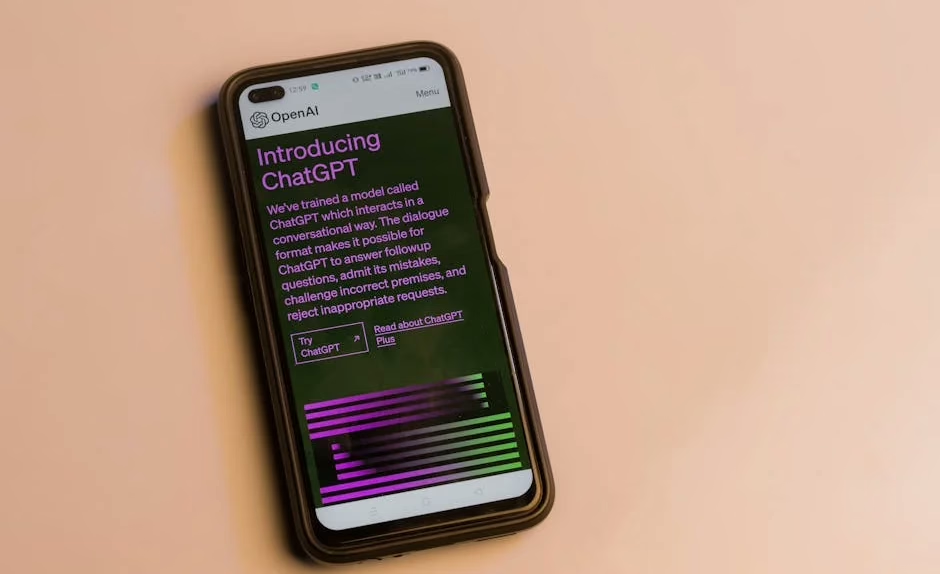

OpenAI has released Privacy Filter, a specialized 1.5-billion-parameter open-source model designed to detect and redact personally identifiable information (PII) before data reaches cloud servers. According to VentureBeat, the model launched on Hugging Face under an Apache 2.0 license, marking a significant shift toward local-first privacy infrastructure for enterprise AI deployments.
The Privacy Filter represents OpenAI’s continued commitment to open-source development, following the company’s return to releasing open models with the gpt-oss family launched earlier this year. This on-device approach addresses critical enterprise concerns about sensitive data exposure during AI training and inference processes.
Technical Architecture and Implementation
Privacy Filter builds upon OpenAI’s gpt-oss foundation models but incorporates a fundamentally different architectural approach for PII detection. Unlike standard autoregressive language models that predict tokens sequentially, Privacy Filter employs a bidirectional token classifier that analyzes text from both directions simultaneously.
This bidirectional processing enables more accurate context-aware detection of sensitive information patterns. The model can identify complex PII scenarios where traditional regex-based filters fail, such as:
- Contextual identifiers: Names that appear in professional contexts
- Composite information: Combinations of seemingly innocuous data that become identifying
- Cross-linguistic detection: PII patterns across multiple languages
The 1.5-billion parameter count strikes an optimal balance between detection accuracy and computational efficiency, allowing deployment on standard laptops or direct browser execution without requiring specialized hardware.
Enterprise Privacy Infrastructure
The Privacy Filter addresses a critical bottleneck in enterprise AI adoption: the risk of sensitive data “leaking” into training datasets or being exposed during high-throughput inference operations. Traditional cloud-based PII detection requires uploading potentially sensitive data before sanitization occurs, creating inherent security vulnerabilities.
By operating entirely on-device, Privacy Filter functions as what OpenAI describes as a “sophisticated, context-aware digital shredder.” This approach enables:
- Zero-trust data processing: Sensitive information never leaves the local environment
- Real-time sanitization: Immediate PII detection without network latency
- Compliance automation: Automated adherence to GDPR, HIPAA, and other privacy regulations
- Scalable deployment: Easy integration into existing enterprise workflows
The Apache 2.0 licensing allows enterprises to modify and redistribute the model according to their specific privacy requirements, providing unprecedented flexibility in privacy-by-design implementations.
Concurrent AI Model Developments
The Privacy Filter release coincides with significant advancements across the AI model landscape. OpenAI also launched ChatGPT Images 2.0, which demonstrates remarkable improvements in text generation within images. According to TechCrunch, the new model can create restaurant menus with accurate spelling, addressing historical weaknesses in diffusion-based image generators.
The Images 2.0 model showcases technical evolution beyond traditional diffusion approaches. While OpenAI declined to specify the underlying architecture, the improved text rendering suggests potential integration of autoregressive mechanisms that function more like large language models. This represents a significant technical achievement, as text generation within images has traditionally been challenging due to the pixel-level reconstruction process in diffusion models.
Key capabilities of ChatGPT Images 2.0 include:
- Multi-image generation: Creating complete study booklets from single prompts
- Multilingual text rendering: Accurate text in Chinese, Hindi, and other languages
- Reasoning integration: Leveraging ChatGPT’s analytical capabilities for contextual image creation
- Flexible aspect ratios: Supporting dimensions from 3:1 wide to 1:3 tall
Industry-Wide Model Release Trends
The current AI model release cycle reflects unprecedented acceleration in capability development. Google’s blog documents over 1,300 real-world generative AI use cases across leading organizations, demonstrating the rapid transition from experimental to production-ready agentic systems.
This proliferation of use cases spans multiple technical domains:
- Agentic enterprise systems: Autonomous decision-making workflows
- Multimodal reasoning: Integration of text, image, and structured data processing
- Domain-specific optimization: Models tailored for healthcare, finance, and manufacturing
- Edge deployment: Efficient inference on resource-constrained devices
The diversity of applications highlights the maturation of foundational model architectures and the increasing sophistication of fine-tuning methodologies for specific enterprise requirements.
Technical Performance Metrics
While specific benchmark results for Privacy Filter haven’t been disclosed, the model’s architecture suggests significant advantages over traditional PII detection approaches. Bidirectional token classification typically achieves:
- Higher recall rates: Reduced false negatives in PII detection
- Improved precision: Fewer false positives that disrupt legitimate content
- Context sensitivity: Understanding of domain-specific terminology and formats
- Computational efficiency: Optimized inference suitable for real-time processing
The 1.5-billion parameter scale represents careful optimization for the PII detection task. Larger models would provide marginal accuracy improvements at significant computational cost, while smaller models would sacrifice the contextual understanding necessary for enterprise-grade privacy protection.
What This Means
The Privacy Filter release signals a fundamental shift in enterprise AI deployment strategies. By providing robust on-device PII detection, OpenAI enables organizations to implement AI solutions while maintaining strict data governance requirements. This approach removes a significant barrier to AI adoption in regulated industries.
The concurrent advancement of multimodal capabilities through ChatGPT Images 2.0 demonstrates the rapid evolution of AI model architectures. The improved text rendering suggests breakthrough innovations in image generation methodologies that extend beyond traditional diffusion approaches.
These developments collectively indicate the AI industry’s maturation toward production-ready, enterprise-grade solutions that balance capability advancement with practical deployment constraints. The emphasis on privacy-preserving architectures and open-source availability reflects growing recognition of the need for transparent, auditable AI systems.
FAQ
What makes Privacy Filter different from existing PII detection tools?
Privacy Filter uses a bidirectional token classifier architecture that analyzes text from both directions, providing superior context-aware detection compared to regex-based or simple ML approaches. Its 1.5B parameter scale enables nuanced understanding of complex PII scenarios.
Can Privacy Filter run on standard enterprise hardware?
Yes, the model is optimized for deployment on standard laptops and can even run directly in web browsers, eliminating the need for specialized GPU infrastructure while maintaining real-time processing capabilities.
How does the Apache 2.0 license benefit enterprise users?
The permissive Apache 2.0 license allows enterprises to modify, customize, and redistribute Privacy Filter according to their specific requirements, enabling seamless integration into existing privacy workflows without licensing restrictions.
Related news
- OpenAI unveils Workspace Agents, a successor to custom GPTs for enterprises that can plug directly into Slack, Salesforce and more – VentureBeat
- OpenAI now lets teams make custom bots that can do work on their own – The Verge
- What Anthropic, OpenAI, Nvidia, AMD and other top American technology companies are spending millions on – The Times of India – Google News – NVIDIA