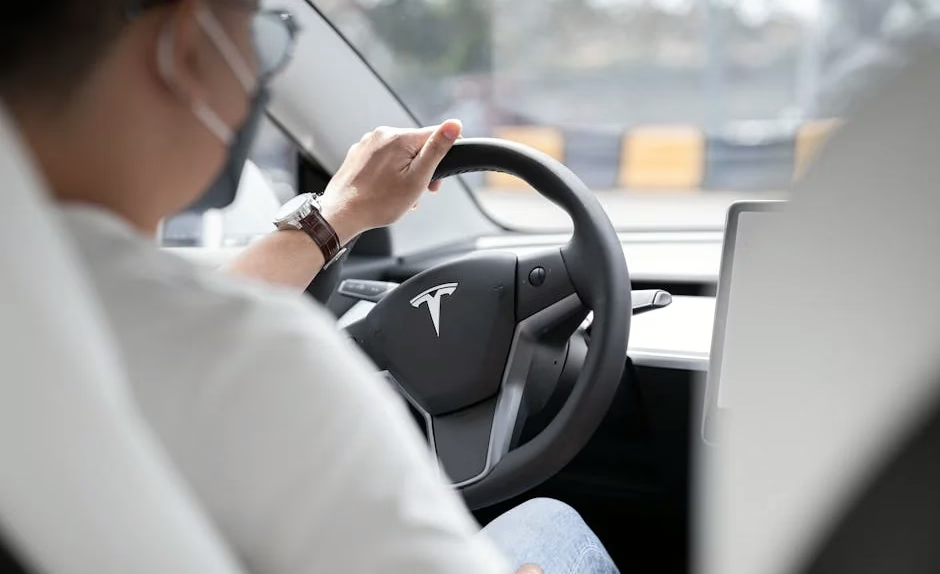

Chinese automaker XPENG launched its VLA 2.0 autonomous driving system in March 2026 as a shipping product, moving beyond the testing phase that Tesla’s Full Self-Driving (FSD) remains in. According to Forbes, the system is already driving sales growth for XPENG vehicles in the competitive Chinese market.
The VLA 2.0 system demonstrated advanced capabilities during testing at the Beijing Auto Show, navigating urban streets, traffic, and complex junctions without human intervention across 40+ minutes of driving. He Xiaopeng, XPENG’s Chairman and CEO, told Forbes that “autonomous driving is our best feature” and VLA 2.0 has delivered “very good results.”
VLA 2.0 Performance Capabilities
The autonomous driving system showcased human-like decision-making during real-world testing in Beijing’s urban environment. Key performance indicators include:
- Zero human interventions required during 40+ minutes of city driving
- Proactive lane management including pulling across lanes to avoid potential conflicts
- Complex navigation through narrow streets, unpredictable motorbikes, and complicated intersections
- Confident traffic handling in dense urban conditions
Forbes testing revealed VLA 2.0’s more intuitive operation compared to Tesla’s FSD, particularly in anticipatory driving behaviors. The system successfully managed barrier-controlled parking entry and exit as the only scenarios requiring human input.
Tesla FSD Faces New Competition
While Tesla’s FSD remains in public testing phases, XPENG has moved to full commercial deployment of autonomous driving capabilities. CNBC reported on Tesla owners using xAI’s Grok chatbot while driving, highlighting ongoing integration challenges between AI systems and vehicle operations.
Tesla owner Mike Nelson, a lawyer with auto insurance background, demonstrated Grok usage in his Tesla during New York City driving. However, he characterized the AI chatbot as “useful, nearly irresistible, and dangerous” when used while driving, pointing to safety concerns around AI integration in vehicles.
The competitive landscape intensifies as Chinese automakers export their technology to European markets, where brand heritage traditionally influences purchasing decisions more than in China.
Enterprise AI Infrastructure Challenges
The automotive industry’s AI advancement faces broader enterprise data infrastructure limitations. According to MIT Technology Review, many organizations discover that “the biggest obstacle to meaningful adoption is the state of their data.”
Bavesh Patel, senior vice president at Databricks, explained that “the quality of that AI and how effective that AI is, is really dependent on information in your organization.” This challenge particularly affects automotive companies integrating multiple AI systems across vehicle platforms.
Data Architecture Requirements
Successful automotive AI deployment requires:
- Unified data formats across legacy and modern systems
- Real-time context preservation for safety-critical decisions
- Rigorous access controls for sensitive vehicle and user data
- Cross-functional accessibility for engineering and operations teams
Rajan Padmanabhan, unit technology officer at Infosys, emphasized the importance of “precision in the outputs driving business decisions,” particularly relevant for autonomous vehicle safety systems.
Autonomous Delivery Milestones
Beyond passenger vehicles, autonomous technology reaches new deployment milestones. Starship Technologies claimed ten million autonomous deliveries across Europe and the USA, demonstrating commercial viability of self-driving systems in logistics applications.
The delivery robot company’s achievement represents significant real-world validation of autonomous navigation technology, complementing developments in passenger vehicle automation. These deployments provide valuable data for improving autonomous systems across different use cases and environments.
What This Means
XPENG’s VLA 2.0 commercial launch marks a significant shift in the autonomous driving landscape, moving from testing to actual product delivery while Tesla’s FSD remains in beta. The Chinese automaker’s success in deploying fully functional autonomous driving capabilities could pressure Western competitors to accelerate their own commercial releases.
The integration challenges highlighted by Tesla’s Grok implementation suggest that combining multiple AI systems in vehicles requires careful safety consideration. As autonomous driving technology matures, manufacturers must balance feature richness with operational safety, particularly as systems move from controlled testing to real-world deployment.
For the broader automotive industry, XPENG’s achievement demonstrates that autonomous driving technology has reached commercial viability, at least in specific markets. This development may accelerate investment and development timelines across the industry as companies compete to match or exceed VLA 2.0’s capabilities.
FAQ
How does XPENG VLA 2.0 differ from Tesla FSD?
VLA 2.0 is a shipping commercial product available to consumers, while Tesla FSD remains in public beta testing. XPENG’s system demonstrated more human-like decision-making and required zero interventions during 40+ minutes of urban driving in Beijing.
Is VLA 2.0 available outside China?
Currently, VLA 2.0 is deployed in China where XPENG reports it’s driving sales growth. The company is expanding to European markets, though availability of the full autonomous driving system in other regions hasn’t been confirmed.
What safety concerns exist with AI integration in vehicles?
CNBC testing of Tesla’s Grok chatbot integration revealed potential distraction risks, with one expert calling it “dangerous” while driving. The challenge involves balancing AI capabilities with driver attention and safety requirements in moving vehicles.