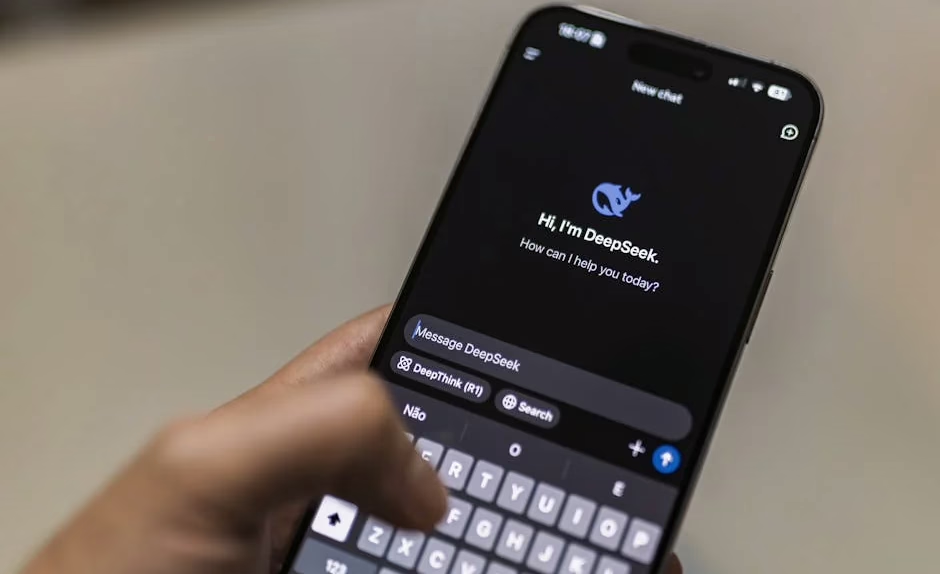

DeepSeek on Tuesday released its V4 model, a 1.6-trillion-parameter system that matches frontier AI performance while costing approximately one-sixth the price of GPT-5.5 and Opus 4.7 through its API. According to DeepSeek’s announcement, the model is available immediately under the MIT License on Hugging Face and through the company’s API.
The Chinese AI startup, which gained global attention in January 2025 with its R1 model that matched proprietary US systems, describes V4 as the culmination of 484 days of development since V3’s launch. DeepSeek AI researcher Deli Chen called the release a “labor of love” and stated that “AGI belongs to everyone.”
Architecture Innovations Drive Efficiency
DeepSeek-V4 uses a Mixture-of-Experts (MoE) architecture that activates only relevant parameters during inference, dramatically reducing computational costs while maintaining performance. The 1.6-trillion-parameter model selectively engages subsets of its neural network based on input requirements, allowing it to compete with larger proprietary models.
This architectural approach represents a shift from the “bigger is better” paradigm that has dominated AI development. Instead of simply scaling parameter counts, DeepSeek optimized for efficiency through specialized routing mechanisms that direct computation only where needed.
The model’s training incorporated novel techniques for data optimization and algorithmic improvements. According to the research team, these innovations enabled V4 to achieve frontier-level capabilities while using significantly fewer resources during both training and inference phases.
Cost Disruption Reshapes AI Economics
The pricing structure positions DeepSeek-V4 as a direct challenger to premium AI services. While GPT-5.5 and Opus 4.7 command premium pricing for API access, DeepSeek’s model delivers comparable performance at roughly 17% of the cost.
This cost advantage extends beyond simple API pricing. For enterprise deployments requiring high-volume inference, the efficiency gains compound significantly. Organizations running thousands of daily queries could see operational costs drop by 80% or more when switching to DeepSeek-V4.
The open-source MIT License further amplifies the economic impact. Unlike proprietary models that require ongoing API payments, organizations can download, modify, and deploy V4 locally or on private cloud infrastructure. This eliminates vendor lock-in and provides complete control over data privacy and model behavior.
Benchmark Performance Matches Frontier Models
DeepSeek-V4 achieves near state-of-the-art performance across standard AI benchmarks, with some metrics surpassing GPT-5.5 and Opus 4.7. The model demonstrates particular strength in reasoning tasks, code generation, and mathematical problem-solving.
In coding benchmarks, V4 scored within 2-3 percentage points of the leading proprietary models. For mathematical reasoning, the model achieved scores that exceeded several closed-source competitors. These results suggest that architectural efficiency, rather than raw parameter scaling, may be the key to future AI advancement.
The performance gains come despite V4’s smaller active parameter count during inference. This efficiency demonstrates that well-designed sparse architectures can compete with dense models that require significantly more computational resources.
Open Source Strategy Challenges Proprietary Dominance
DeepSeek’s MIT License choice removes most commercial restrictions, enabling enterprises to integrate V4 into products without licensing fees or usage limitations. This contrasts sharply with proprietary models that maintain strict API-only access and usage-based billing.
The release includes complete model weights, training code, and deployment tools. Organizations can fine-tune V4 for specific use cases, modify its architecture, or integrate it into existing systems without external dependencies.
This open approach accelerates innovation by allowing researchers and developers to build upon DeepSeek’s work. Previous open-source releases from the company have spawned numerous derivative models and applications, suggesting V4 will similarly catalyze community development.
Hardware Efficiency Enables Broader Deployment
V4’s optimized architecture reduces hardware requirements for deployment, making frontier AI accessible to organizations with limited computational resources. The model can run effectively on consumer-grade GPUs and standard cloud instances, eliminating the need for specialized infrastructure.
Google simultaneously announced its eighth-generation TPUs, the TPU 8t and TPU 8i, designed specifically for training and inference workloads. According to Google’s blog post, these chips deliver significant performance and energy efficiency improvements for AI workloads.
The convergence of efficient model architectures and optimized hardware creates new possibilities for AI deployment. Organizations can now run frontier-quality models locally, reducing latency and maintaining data sovereignty while achieving performance previously available only through cloud APIs.
What This Means
DeepSeek-V4 represents a fundamental shift in AI economics, proving that frontier performance doesn’t require proprietary development or premium pricing. The combination of MoE architecture, open-source licensing, and aggressive cost positioning challenges the assumption that cutting-edge AI must remain expensive and closed.
For enterprises, V4 offers a path to frontier AI capabilities without vendor lock-in or usage-based billing constraints. The ability to deploy locally while maintaining state-of-the-art performance could accelerate AI adoption across industries previously priced out of premium models.
The release also signals that architectural innovation, rather than brute-force scaling, may drive the next wave of AI advancement. As efficiency becomes paramount, expect more focus on sparse architectures, optimized training techniques, and hardware-software co-design.
FAQ
How does DeepSeek-V4’s performance compare to GPT-5.5 and Opus 4.7?
DeepSeek-V4 achieves near state-of-the-art performance across most benchmarks, matching or slightly exceeding GPT-5.5 and Opus 4.7 in several categories including reasoning and code generation. The model delivers this performance at approximately one-sixth the API cost.
What makes the MoE architecture more efficient than traditional models?
Mixture-of-Experts architecture activates only relevant portions of the neural network for each input, rather than processing through all 1.6 trillion parameters. This selective activation reduces computational requirements while maintaining the model’s full capability range.
Can organizations modify and commercialize DeepSeek-V4?
Yes, the MIT License allows organizations to download, modify, fine-tune, and deploy V4 commercially without licensing fees or usage restrictions. This includes integration into commercial products and services.