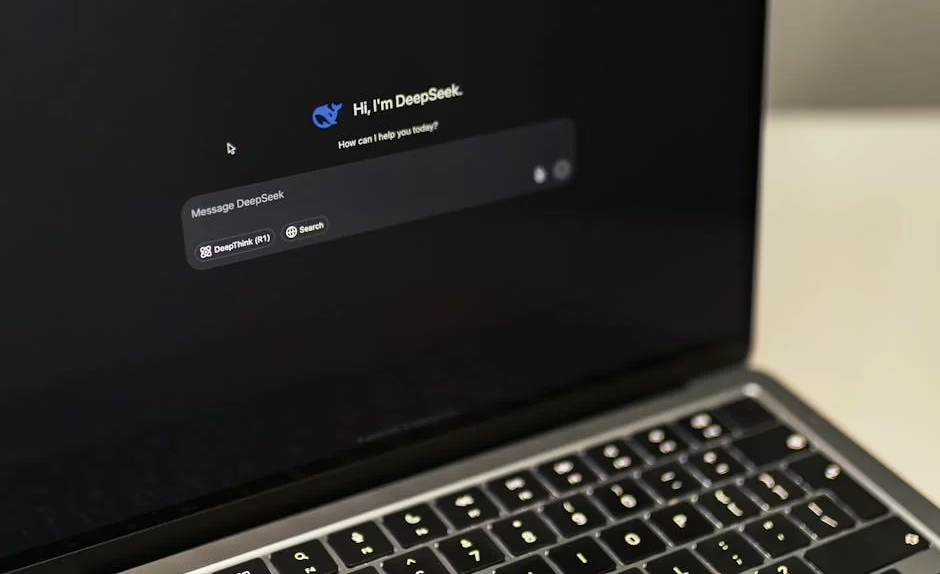

DeepSeek released its V4 model on Monday, delivering near state-of-the-art performance at one-sixth the cost of GPT-5.5 and Claude Opus 4.7, while Xiaomi simultaneously launched MiMo-V2.5 models optimized for agentic tasks. According to DeepSeek’s announcement, the 1.6-trillion-parameter Mixture-of-Experts model achieves frontier-class intelligence under an MIT license.
The dual releases mark what researchers are calling the “second DeepSeek moment” — a reference to the Chinese startup’s January 2025 breakthrough that disrupted the AI industry. Xiaomi’s MiMo-V2.5 and V2.5-Pro models complement this trend by targeting enterprise agentic workflows with token-efficient architectures.
Both companies are pushing open-source alternatives that challenge the pricing models of proprietary systems from OpenAI, Anthropic, and Google. The developments signal a shift toward cost-effective AI architectures that maintain competitive performance while reducing computational overhead.
DeepSeek-V4 Architecture and Performance Metrics
DeepSeek-V4 employs a Mixture-of-Experts architecture with 1.6 trillion parameters, activating only a subset during inference to optimize computational efficiency. According to DeepSeek’s API pricing, the model costs approximately $0.14 per million tokens compared to $15 for GPT-5.5.
DeepSeek AI researcher Deli Chen described the release as a “labor of love” developed over 484 days since V3’s launch. The model demonstrates competitive performance across standard benchmarks including MMLU, HumanEval, and GSM8K while maintaining significantly lower operational costs.
The architecture incorporates several efficiency improvements:
- Sparse activation patterns that reduce computational load during inference
- Optimized attention mechanisms for handling long context windows up to 1 million tokens
- Hardware-agnostic design supporting deployment across diverse infrastructure
- Dynamic routing algorithms that direct queries to relevant expert modules
Benchmark results show V4 matching or exceeding proprietary models on reasoning tasks while using substantially fewer computational resources per query.
Xiaomi’s Agentic Task Optimization
Xiaomi’s MiMo-V2.5 series specifically targets agentic “claw” tasks — autonomous systems that complete user-delegated work through third-party applications. According to Xiaomi’s published benchmarks, the Pro model achieves 63.8% accuracy on ClawEval while using fewer tokens than competing open-source alternatives.
The models excel at:
- Content generation and publishing across social media platforms
- Email organization and scheduling through calendar integrations
- Account management for multiple service providers
- Marketing automation with brand-consistent messaging
Xiaomi designed the architecture to minimize token consumption, addressing the shift toward usage-based billing models like Microsoft’s GitHub Copilot. The company’s ClawEval benchmark positions both V2.5 variants in the high-performance, low-cost quadrant compared to alternatives.
Both models operate under MIT licensing, enabling commercial deployment without restrictive terms. Enterprise teams can modify the weights, run local instances, or deploy on virtual private clouds according to their security requirements.
Google’s TPU 8t and 8i Hardware Response
Google countered the software advances with its eighth-generation Tensor Processing Units, featuring specialized chips for training (TPU 8t) and inference (TPU 8i). According to Google’s announcement, the hardware targets “the complex, iterative demands of AI agents.”
The TPU 8t focuses on massive model training with:
- Enhanced memory bandwidth for handling trillion-parameter architectures
- Optimized interconnect fabric reducing communication overhead
- Power efficiency improvements lowering training costs per parameter
- Scalable pod configurations supporting distributed training workflows
The TPU 8i emphasizes low-latency inference for real-time applications:
- Reduced inference latency enabling responsive agentic interactions
- Higher throughput capacity supporting concurrent user sessions
- Dynamic workload allocation optimizing resource utilization
- Custom instruction sets accelerating transformer operations
Google positions the hardware as infrastructure for organizations deploying large-scale agentic systems, though pricing and availability details remain limited to enterprise customers.
Automated AI Research Framework Developments
Researchers at SII-GAIR introduced ASI-EVOLVE, an autonomous framework that optimizes training data, model architectures, and learning algorithms without human intervention. According to the research paper, the system uses a continuous “learn-design-experiment-analyze” cycle to discover novel designs.
The framework demonstrated:
- 18-point benchmark improvements through automated data pipeline optimization
- Novel architecture discovery outperforming human-designed baselines
- Efficient algorithm generation for reinforcement learning tasks
- Reduced engineering overhead for enterprise optimization cycles
ASI-EVOLVE addresses the manual bottleneck in AI research where teams can only explore limited design spaces due to resource constraints. The system preserves and transfers insights across projects, potentially accelerating the development cycle for future architectures.
The framework’s agentic approach to AI development mirrors the broader trend toward autonomous systems that reduce human intervention in complex optimization tasks.
Enterprise Deployment Patterns
Google documented 1,302 real-world generative AI implementations across leading organizations, revealing deployment patterns for cost-effective architectures. According to Google’s analysis, the majority showcase “impactful applications of agentic AI” built with tools like Gemini Enterprise and AI Hypercomputer infrastructure.
Key deployment trends include:
- Hybrid cloud strategies combining open-source models with proprietary infrastructure
- Cost optimization focus driven by usage-based billing adoption
- Agentic workflow integration replacing traditional rule-based automation
- Multi-model architectures leveraging specialized models for specific tasks
Organizations increasingly prioritize total cost of ownership over raw performance metrics, creating demand for efficient architectures like DeepSeek-V4 and Xiaomi’s MiMo series. The shift reflects broader enterprise concerns about sustainable AI economics as workloads scale.
Production deployments favor models with commercial-friendly licensing, transparent pricing, and proven reliability over cutting-edge capabilities with uncertain costs.
What This Means
The simultaneous release of cost-effective, high-performance models from DeepSeek and Xiaomi represents a fundamental shift in AI economics. By delivering near state-of-the-art capabilities at dramatically reduced costs, these architectures challenge the pricing power of proprietary model providers and accelerate enterprise AI adoption.
The trend toward specialized architectures — DeepSeek’s general-purpose efficiency, Xiaomi’s agentic optimization, Google’s hardware acceleration — suggests the industry is moving beyond the “bigger is better” paradigm toward targeted solutions for specific use cases. This specialization enables organizations to optimize their AI stack for particular workflows rather than paying premium prices for general-purpose capabilities they don’t need.
For enterprises, the developments create new strategic options: deploying open-source alternatives for cost-sensitive applications while reserving proprietary models for mission-critical tasks requiring maximum performance. The MIT licensing on both DeepSeek-V4 and Xiaomi’s models removes legal barriers to commercial deployment, potentially accelerating adoption timelines.
The emergence of automated research frameworks like ASI-EVOLVE hints at a future where AI systems design their own successors, potentially compressing innovation cycles and democratizing access to cutting-edge architectures.
FAQ
How much cheaper is DeepSeek-V4 compared to GPT-5.5?
DeepSeek-V4 costs approximately $0.14 per million tokens versus $15 for GPT-5.5, representing an 83% cost reduction while maintaining competitive performance on standard benchmarks.
What makes Xiaomi’s MiMo models different from other open-source alternatives?
Xiaomi optimized MiMo-V2.5 specifically for agentic “claw” tasks that require autonomous completion of user-delegated work. The models achieve high performance while using fewer tokens, reducing costs for usage-based billing scenarios.
Can enterprises use these models commercially without restrictions?
Both DeepSeek-V4 and Xiaomi’s MiMo models operate under MIT licensing, which permits commercial use, modification, and redistribution without significant restrictions. Organizations can deploy them locally or on private clouds according to their security requirements.
Sources
- New AI framework autonomously optimizes training data, architectures and algorithms — outperforming human baselines – VentureBeat
- Open source Xiaomi MiMo-V2.5 and V2.5-Pro are among the most efficient (and affordable) at agentic ‘claw’ tasks – VentureBeat
- DeepSeek-V4 arrives with near state-of-the-art intelligence at 1/6th the cost of Opus 4.7, GPT-5.5 – VentureBeat