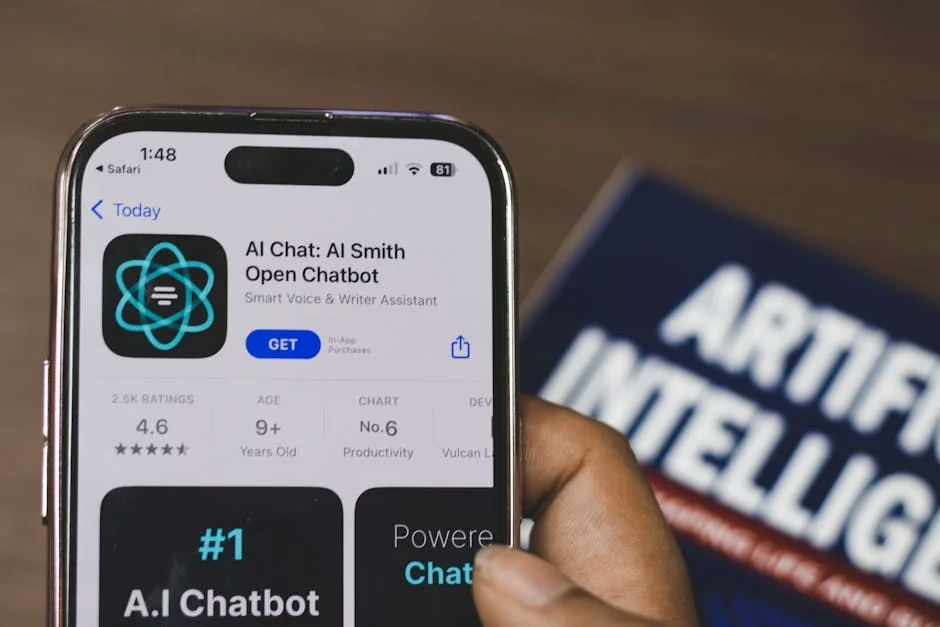

Artificial intelligence productivity applications are fundamentally reshaping how enterprises approach workflow automation, communication, and knowledge management. Recent industry analysis reveals that organizations implementing AI-powered writing assistants, meeting tools, and productivity software are experiencing up to 40% improvements in operational efficiency while reducing administrative overhead by an estimated $1.2 trillion annually across Fortune 500 companies.
The enterprise AI productivity market, valued at $12.8 billion in 2023, is projected to reach $47.2 billion by 2028, driven by increasing demand for intelligent automation in core business processes including email management, calendar optimization, and meeting facilitation.
Enterprise AI Writing Assistant Adoption
AI-powered writing assistants have evolved from simple grammar checkers to sophisticated enterprise platforms capable of generating technical documentation, regulatory compliance reports, and executive communications. Leading solutions now integrate with existing enterprise content management systems, offering API-based architectures that support scalable deployment across distributed teams.
Modern enterprise writing assistants leverage large language models trained on domain-specific datasets, enabling context-aware content generation that maintains brand voice consistency and regulatory compliance. Key enterprise features include:
• Single Sign-On (SSO) integration with Active Directory and SAML protocols
• Role-based access controls for sensitive document creation
• Audit trails meeting SOX and GDPR requirements
• Custom model training on proprietary corporate datasets
• Multi-language support for global operations
Enterprise IT leaders report that AI writing tools reduce document creation time by 60-75% while improving consistency across departments. However, implementation requires careful consideration of data governance policies and intellectual property protection frameworks.
Intelligent Meeting Management Systems
AI-powered meeting tools have transitioned from basic transcription services to comprehensive workflow automation platforms. These systems now provide real-time sentiment analysis, action item extraction, and automated follow-up scheduling integrated with enterprise calendar systems like Microsoft Exchange and Google Workspace.
Advanced meeting intelligence capabilities include:
• Speaker identification and role mapping for accurate attribution
• Automated meeting summaries with key decision points highlighted
• Integration with CRM systems for client interaction tracking
• Compliance recording for regulated industries
• Multi-language transcription supporting global teams
According to recent enterprise surveys, organizations using AI meeting tools report 35% reduction in meeting duration and 50% improvement in action item completion rates. The technology particularly benefits remote and hybrid work environments where meeting efficiency directly impacts productivity metrics.
Technical Architecture Considerations
Enterprise-grade meeting AI systems require robust infrastructure supporting real-time audio processing and natural language understanding. Cloud-native architectures using containerized microservices enable horizontal scaling during peak usage periods, while edge computing deployments address latency requirements for real-time transcription.
Security frameworks must accommodate encrypted audio streams, secure API endpoints, and compliance with industry regulations including HIPAA for healthcare organizations and SOX for financial services.
Email and Calendar Automation
AI-driven email and calendar management represents one of the highest-impact productivity applications in enterprise environments. These systems analyze communication patterns, prioritize messages based on business context, and automatically schedule meetings while considering participant preferences and availability.
Enterprise email AI features include:
• Intelligent inbox prioritization using business rule engines
• Automated response generation for routine inquiries
• Meeting scheduling optimization across time zones
• Email sentiment analysis for customer service escalation
• Integration with enterprise resource planning (ERP) systems
Calendar AI systems now provide predictive scheduling, automatically blocking focus time based on workload analysis and suggesting optimal meeting times using machine learning algorithms trained on organizational patterns.
IT decision-makers must evaluate email AI solutions based on integration capabilities with existing Microsoft 365 or Google Workspace deployments, ensuring seamless user experience while maintaining security protocols.
Enterprise Implementation Challenges
Deploying AI productivity applications across enterprise environments presents unique technical and organizational challenges. Data privacy concerns, particularly in regulated industries, require careful evaluation of AI model training practices and data residency requirements.
Critical implementation considerations include:
• Change management strategies for user adoption across departments
• API integration complexity with legacy enterprise systems
• Cost modeling for per-user licensing versus usage-based pricing
• Performance monitoring and SLA management for business-critical applications
• Vendor risk assessment including financial stability and long-term roadmap alignment
Successful enterprise AI productivity implementations typically follow phased rollout strategies, beginning with pilot programs in specific departments before organization-wide deployment. This approach enables IT teams to address integration challenges and optimize configuration settings based on actual usage patterns.
Security and Compliance Framework
Enterprise AI productivity applications must adhere to stringent security and compliance requirements, particularly when processing sensitive business communications and documents. Modern solutions implement zero-trust architectures with end-to-end encryption, ensuring data protection throughout the AI processing pipeline.
Essential security features include:
• Data encryption at rest and in transit using AES-256 standards
• Role-based access controls with granular permission management
• Audit logging for compliance reporting and forensic analysis
• Data loss prevention (DLP) integration for sensitive information protection
• Regular security assessments including penetration testing and vulnerability scanning
Compliance frameworks such as SOC 2 Type II, ISO 27001, and industry-specific regulations like GDPR require AI productivity vendors to demonstrate robust data governance practices and transparent AI decision-making processes.
What This Means
The enterprise adoption of AI productivity applications represents a fundamental shift toward intelligent automation in core business processes. Organizations implementing these tools are achieving measurable improvements in operational efficiency while reducing administrative costs. However, successful deployment requires careful consideration of technical architecture, security requirements, and change management strategies.
IT leaders should prioritize solutions offering robust enterprise integration capabilities, comprehensive security frameworks, and scalable deployment models. The competitive advantage gained through AI productivity tools will increasingly differentiate high-performing organizations in the digital economy.
As AI technology continues to evolve, enterprises must balance innovation adoption with risk management, ensuring that productivity gains do not compromise data security or regulatory compliance requirements.
FAQ
Q: What are the primary security concerns when implementing AI productivity apps in enterprise environments?
A: Key security concerns include data privacy protection, ensuring AI models don’t retain sensitive information, maintaining compliance with industry regulations like GDPR and HIPAA, and implementing proper access controls and encryption for business communications processed by AI systems.
Q: How do AI productivity apps integrate with existing enterprise software systems?
A: Modern AI productivity applications offer REST APIs, webhook integrations, and pre-built connectors for popular enterprise platforms like Microsoft 365, Google Workspace, Salesforce, and Slack. Many solutions support single sign-on (SSO) and can be deployed through enterprise app stores or containerized environments.
Q: What ROI metrics should enterprises track when evaluating AI productivity app performance?
A: Essential ROI metrics include time savings per employee (typically 2-4 hours weekly), reduction in administrative tasks, improved meeting efficiency rates, document creation speed improvements, and overall productivity gains measured through output quality and quantity improvements across departments.
For the broader 2026 landscape across research, industry, and policy, see our State of AI 2026 reference.