
Enterprise organizations are rapidly deploying AI-powered productivity applications across writing, meeting management, and workflow automation, with 73% of IT leaders planning significant investments in AI assistants and productivity tools by 2025. These applications span from intelligent writing assistants and automated meeting transcription to comprehensive workflow orchestration platforms that handle complex business processes autonomously.
The shift represents a fundamental change in how enterprises approach productivity software, moving beyond simple automation to intelligent agents capable of understanding context, making decisions, and executing multi-step workflows without human intervention.
Enterprise Writing Assistant Deployment Strategies
Modern AI writing assistants have evolved far beyond basic grammar checking to become sophisticated enterprise tools capable of generating technical documentation, compliance reports, and customer communications at scale. Enterprise deployments require careful consideration of data governance, model selection, and integration architectures.
Key enterprise requirements include:
- Data residency controls ensuring sensitive content remains within organizational boundaries
- Role-based access management with granular permissions for different user types
- Audit trails tracking all AI-generated content for compliance purposes
- Custom model training on proprietary documentation and style guides
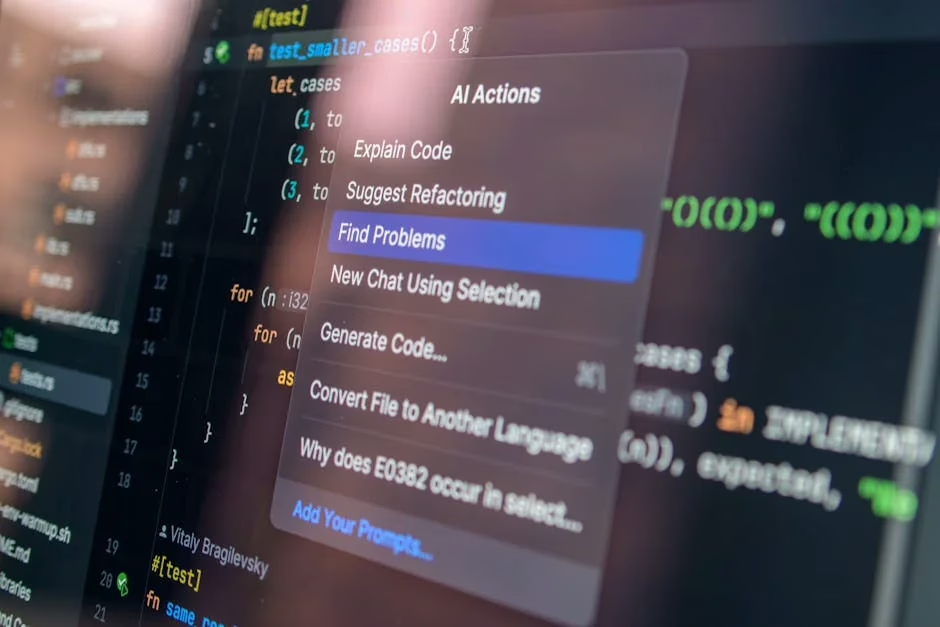
According to Towards Data Science, AI coding assistants need persistent memory layers to overcome the statelessness of large language models and improve code quality by systematically providing context across sessions. This principle applies equally to enterprise writing tools, where maintaining context across documents, projects, and organizational knowledge bases becomes critical for productivity gains.
Enterprise writing platforms must integrate with existing content management systems, customer relationship management platforms, and collaboration tools to provide seamless workflows that don’t disrupt established business processes.
Meeting Intelligence and Automated Documentation
AI-powered meeting tools have become essential infrastructure for distributed teams, offering real-time transcription, automated note generation, and intelligent action item extraction. Enterprise implementations focus on scalability, security, and integration with existing calendar and communication systems.
Core capabilities driving enterprise adoption:
- Real-time transcription with speaker identification and technical terminology recognition
- Automated meeting summaries highlighting key decisions, action items, and follow-up requirements
- Integration with project management tools for automatic task creation and assignment
- Compliance recording with retention policies and access controls for regulated industries
The technology stack typically includes speech-to-text engines optimized for business terminology, natural language processing models trained on meeting contexts, and integration APIs connecting to enterprise software ecosystems. Many organizations deploy hybrid architectures combining cloud-based processing for advanced AI capabilities with on-premises components for sensitive discussions.
Meeting intelligence platforms must handle diverse audio quality conditions, multiple languages, and industry-specific terminology while maintaining accuracy rates above 95% for enterprise acceptance.
Agentic AI Platforms for Workflow Automation
The emergence of agentic AI represents the next evolution in enterprise productivity, where intelligent agents autonomously handle complex, multi-step business processes that previously required human intervention. According to VentureBeat, smart, semi-autonomous AI Agents Learn Complex Tasks Through Visual Imitation Learning” target=”_blank” rel=”noopener noreferrer”>AI agents handling complex, real-time business work requires clear goals, data-driven workflows, and enterprise platforms that balance autonomy with governance.
Successful agentic implementations focus on:
- Outcome-anchored designs tied to production systems and key performance indicators
- Operational grey zones where handoffs, reconciliations, and approvals currently rely on humans
- Multi-agent coordination for complex workflows spanning multiple departments
- Guardrails and observability ensuring agent actions align with business policies
Enterprise agentic platforms require sophisticated orchestration engines capable of coordinating multiple AI models, external system integrations, and human oversight mechanisms. The architecture must support both reactive agents responding to events and proactive agents identifying optimization opportunities.
Implementation strategies typically begin with well-defined, high-volume processes like invoice processing, customer service routing, or compliance checking before expanding to more complex scenarios requiring contextual decision-making.
Security and Compliance Considerations
The rapid adoption of AI productivity tools has created new security challenges for enterprise IT teams, particularly around data governance, model transparency, and local inference capabilities. According to VentureBeat, employees are increasingly running AI models locally on laptops, creating a “bring your own model” era that traditional data loss prevention tools cannot monitor.
Critical security frameworks include:
- Data classification policies determining which content types can be processed by AI systems
- Model governance ensuring AI tools meet enterprise security and compliance requirements
- Endpoint monitoring for locally-run AI models that bypass traditional network controls
- Vendor assessment covering model training data, inference infrastructure, and data handling practices
Enterprise security teams must adapt traditional cloud access security broker policies to address AI-specific risks while enabling productivity gains. This includes implementing AI-aware data loss prevention tools, establishing model approval processes, and creating policies for local AI inference on corporate devices.
The challenge extends beyond data protection to include model bias assessment, output validation, and ensuring AI-generated content meets regulatory requirements in industries like healthcare, finance, and legal services.
Integration Architecture and Technical Requirements
Successful enterprise AI productivity deployments require sophisticated integration architectures connecting AI capabilities with existing business systems, data sources, and workflow engines. The technical foundation must support real-time data access, secure model inference, and seamless user experiences across multiple applications.
Essential integration components:
- API management platforms providing secure, scalable access to AI services
- Data pipeline orchestration ensuring AI tools access current, relevant information
- Identity and access management integration for single sign-on and role-based permissions
- Monitoring and observability tools tracking AI performance, usage patterns, and business impact
Enterprise architectures increasingly adopt hybrid approaches combining cloud-based AI services for advanced capabilities with on-premises components for sensitive data processing. This requires careful consideration of data residency requirements, latency constraints, and disaster recovery procedures.
The integration layer must also handle model versioning, A/B testing of AI capabilities, and graceful degradation when AI services are unavailable, ensuring business continuity while maximizing productivity benefits.
What This Means
The enterprise adoption of AI productivity applications represents a fundamental shift in how organizations approach knowledge work, moving from tool-assisted productivity to AI-augmented decision-making and autonomous process execution. IT leaders must balance the significant productivity potential with robust governance frameworks that ensure security, compliance, and business alignment.
Success requires treating AI productivity tools as critical enterprise infrastructure rather than experimental technologies, with corresponding investments in integration architecture, security controls, and change management. Organizations that establish comprehensive AI governance frameworks while enabling rapid experimentation will gain significant competitive advantages in operational efficiency and employee productivity.
The trend toward local AI inference and agentic automation suggests that traditional IT control mechanisms must evolve to address new risk vectors while supporting increasingly sophisticated AI capabilities that can transform business operations at scale.
FAQ
Q: What are the primary security risks of enterprise AI productivity tools?
A: Key risks include data exfiltration through cloud-based AI services, unmonitored local AI inference on corporate devices, potential bias in AI-generated content, and lack of audit trails for AI-assisted decisions. Organizations need AI-specific data loss prevention tools and governance frameworks.
Q: How should enterprises evaluate AI writing assistant solutions?
A: Evaluate based on data residency options, integration capabilities with existing systems, customization for industry terminology, audit and compliance features, user management capabilities, and total cost of ownership including training and support requirements.
Q: What infrastructure changes are needed for agentic AI deployment?
A: Agentic AI requires robust API management platforms, real-time data access infrastructure, sophisticated monitoring and observability tools, integration with existing business systems, and hybrid cloud architectures supporting both autonomous operations and human oversight mechanisms.
For a side-by-side look at the flagship models in play, see our full 2026 AI model comparison.