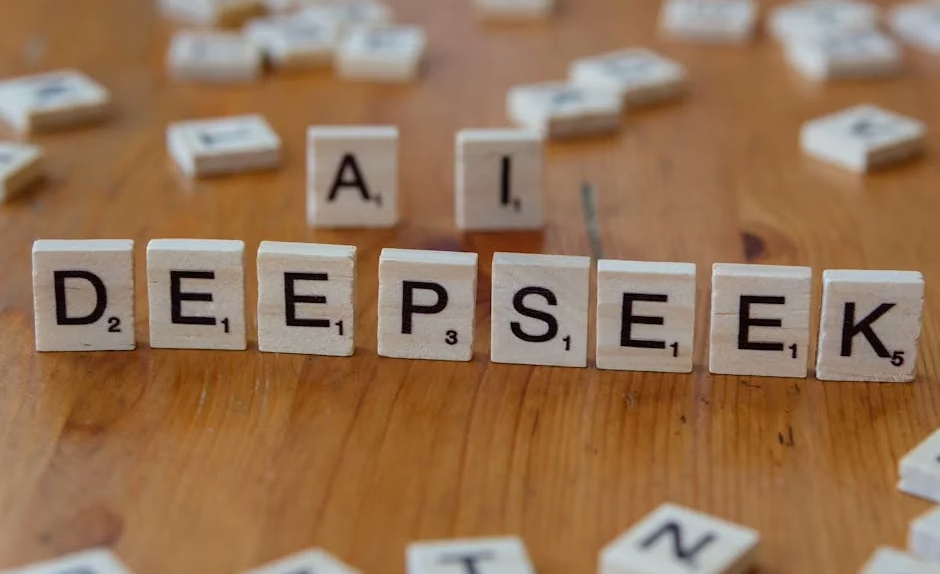

DeepSeek released V4 on Monday, delivering frontier-class AI performance at approximately one-sixth the cost of GPT-5.5 and Anthropic’s Opus 4.7 through breakthrough architectural compression techniques. The 1.6-trillion-parameter Mixture-of-Experts model achieves near state-of-the-art intelligence while reducing API costs by 83% compared to leading proprietary systems.
According to DeepSeek’s announcement, the model launches under the commercially-friendly MIT License and supports one-million-token context windows — a critical capability for enterprise applications requiring extensive document processing and long-form reasoning.
Hybrid Attention Architecture Solves Context Bottleneck
DeepSeek V4‘s core innovation centers on a hybrid attention design combining Compressed Sparse Attention (CSA) with Heavily Compressed Attention (HCA). This architectural approach compresses memory requirements without sacrificing reasoning capabilities, addressing the fundamental bottleneck facing long-context AI applications.
Traditional transformer architectures require models to store and scan every previous token when generating new content. For applications processing extensive codebases, research documents, or multi-turn conversations, this creates exponentially growing computational costs. DeepSeek’s technical report demonstrates that V4’s compression techniques maintain performance while dramatically reducing the memory footprint.
The release includes two model variants: DeepSeek-V4-Pro with 1.6 trillion total parameters and 49 billion activated parameters, and DeepSeek-V4-Flash with 284 billion total parameters and 13 billion activated parameters. Both models support the full one-million-token context window, enabling applications like enterprise copilots and research tools to process entire codebases or document collections in a single session.
DeepSeek AI researcher Deli Chen described the release as a “labor of love” developed over 484 days since the V3 launch, emphasizing the company’s commitment to making “AGI belong to everyone.”
Efficiency Race Reshapes AI Competition
The V4 release signals a fundamental shift in AI development priorities from raw scale to cost-efficiency optimization. While competitors focus on parameter count increases, DeepSeek’s approach demonstrates that architectural innovation can deliver comparable performance at dramatically lower operational costs.
Concurrent developments from other companies reinforce this efficiency trend. Xiaomi released MiMo-V2.5 and V2.5-Pro models under MIT licensing, specifically optimized for agentic “claw” tasks that require efficient token usage. According to Xiaomi’s ClawEval benchmarks, the Pro model achieves 63.8% task completion rates while using fewer tokens than competing open-source alternatives.
This efficiency focus addresses growing enterprise concerns about AI operational costs. As services like Microsoft’s GitHub Copilot shift to usage-based billing models, organizations face mounting pressure to optimize token consumption without sacrificing capability.
Automated AI Research Framework Emerges
Researchers at SII-GAIR introduced ASI-EVOLVE, an autonomous framework that optimizes training data, model architectures, and learning algorithms without human intervention. The system operates through a continuous “learn-design-experiment-analyze” cycle, automatically discovering novel designs that outperform human-engineered baselines.
In experimental validation, ASI-EVOLVE generated architectures that improved pretraining data pipelines by over 18 benchmark points and designed highly efficient reinforcement learning algorithms. The framework addresses the fundamental bottleneck in AI research: the manual engineering effort required for each optimization cycle.
For enterprise teams running repeated model optimization workflows, ASI-EVOLVE offers potential cost savings while matching or exceeding human-designed performance baselines. The system preserves and transfers knowledge across experiments, preventing the typical siloing of insights within individual teams or projects.
Enterprise Orchestration Infrastructure Advances
Mistral AI launched Workflows in public preview, a production-grade orchestration layer designed to move enterprise AI systems beyond proof-of-concept stages. The platform, powered by Temporal’s workflow engine, already processes millions of daily executions for enterprise customers.
“Organizations are struggling to go beyond isolated proofs of concept,” Elisa Salamanca, head of product at Mistral AI, told VentureBeat. “The gap is operational. Workflows is the infrastructure to run AI systems reliably across business-critical processes.”
The release addresses a critical market reality: despite the agentic AI market’s projected growth from $10.9 billion in 2026 to $199 billion by 2034, over 40% of agentic AI projects face abandonment by 2027 due to operational complexity and unclear value propositions. Mistral’s orchestration approach separates execution from control, enabling enterprises to maintain data privacy while scaling AI operations.
Workflows integrates with Mistral’s Studio platform, providing enterprises with production-ready infrastructure for deploying AI agents across revenue-generating business processes rather than limiting them to experimental use cases.
What This Means
DeepSeek V4’s architectural breakthrough demonstrates that the next phase of AI competition will center on efficiency rather than raw parameter scaling. The model’s 83% cost reduction while maintaining frontier performance creates new economic dynamics for AI deployment, potentially democratizing access to advanced capabilities for smaller organizations.
The convergence of efficient architectures, automated research frameworks, and production orchestration infrastructure suggests the industry is maturing beyond the initial “bigger is better” paradigm. Companies that master cost-effective deployment while maintaining performance advantages will likely capture disproportionate market share as AI adoption accelerates across enterprise segments.
For enterprises evaluating AI strategies, these developments indicate that waiting for more efficient solutions may be more prudent than rushing into expensive deployments with current-generation proprietary models. The rapid pace of efficiency improvements suggests significant cost advantages for organizations that time their AI investments strategically.
FAQ
How much does DeepSeek V4 cost compared to GPT-5.5 and Claude Opus 4.7?
DeepSeek V4 costs approximately one-sixth the price of GPT-5.5 and Anthropic’s Opus 4.7 through API access, representing an 83% cost reduction while delivering comparable performance on most benchmarks.
What makes DeepSeek V4’s architecture more efficient than traditional transformers?
V4 uses a hybrid attention design combining Compressed Sparse Attention (CSA) with Heavily Compressed Attention (HCA), which compresses memory requirements without losing reasoning capabilities. This allows the model to process one-million-token contexts without the exponential cost increases of traditional architectures.
Can enterprises use DeepSeek V4 for commercial applications?
Yes, DeepSeek V4 is available under the MIT License, making it suitable for commercial use. Enterprises can download, modify, and deploy the model locally or on private clouds without licensing restrictions, unlike many proprietary alternatives.
Sources
- New AI framework autonomously optimizes training data, architectures and algorithms — outperforming human baselines – VentureBeat
- DeepSeek-V4 arrives with near state-of-the-art intelligence at 1/6th the cost of Opus 4.7, GPT-5.5 – VentureBeat
- DeepSeek V4 Shows That The Next AI Race Is About Efficiency – Forbes Tech