
Tesla reported 1.28 million active Full Self-Driving subscriptions in Q1 2026, a 51% year-over-year increase that helped drive $22.38 billion in quarterly revenue. The milestone comes as Chinese automaker XPENG claims its VLA 2.0 autonomous driving system has surpassed Tesla’s FSD capabilities in real-world deployment.
According to Tesla’s Q1 earnings report, the company’s automotive revenue rose to $16.2 billion, with FSD subscription growth contributing significantly to the 16% revenue increase from $19.3 billion in Q1 2025.
XPENG’s VLA 2.0 Claims Autonomous Driving Leadership
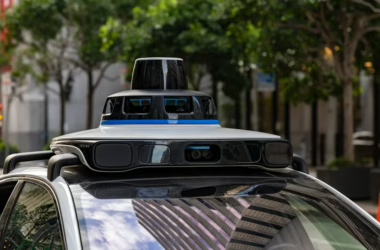
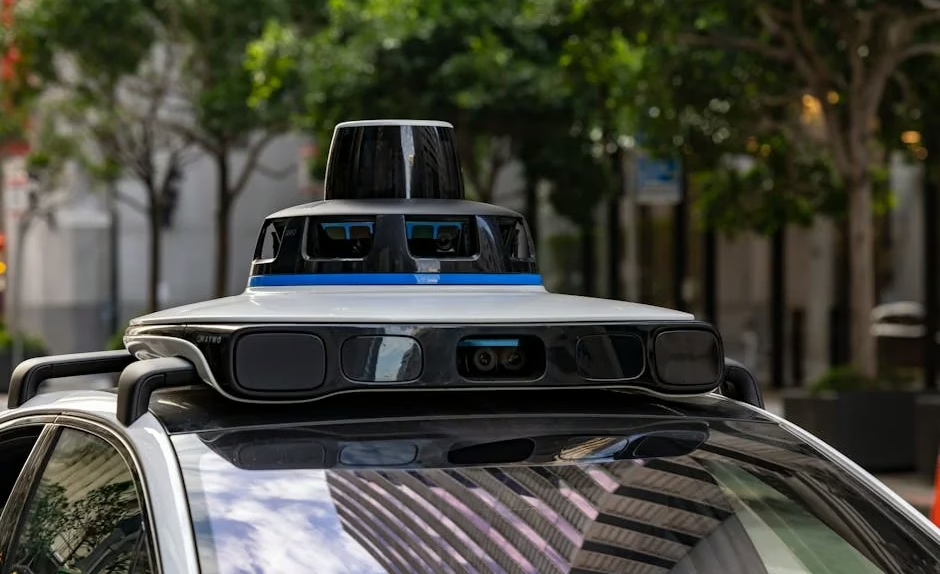
XPENG launched its VLA 2.0 autonomous driving system in March 2026 as a shipping product rather than a beta test program like Tesla’s FSD. Forbes reported that VLA 2.0 demonstrated “human-like operation” during testing in Beijing, navigating urban traffic, unpredictable motorbikes, and complex intersections without human intervention across 40 minutes of driving.
“Our best feature is autonomous driving,” said He Xiaopeng, XPENG’s Chairman and CEO, according to the Forbes report. The company positions VLA 2.0 as already surpassing first-generation systems that were “the top autonomous driving system” in previous iterations.
The Chinese automaker’s system reportedly handles lane changes proactively, such as moving away from trucks that might enter the vehicle’s lane — a level of predictive behavior that distinguishes it from reactive autonomous systems.
Tesla’s Mixed Q1 Performance Despite FSD Growth
Tesla’s Q1 results showed positive momentum in revenue and subscriptions but revealed underlying challenges in vehicle delivery. The company delivered 358,023 EVs globally, falling short of analyst expectations of approximately 368,000 vehicles. Production reached 408,386 vehicles, creating a significant delivery gap.
The revenue increase came from higher average vehicle prices, expanded services, and the substantial FSD subscription growth. Tesla’s free cash flow jumped to $1.44 billion, more than doubling from Q1 2025 and surprising analysts who expected higher cash burn.
However, TechCrunch noted that Tesla’s business faced “considerable headwinds in 2025,” with profits falling 46% year-over-year to $3.8 billion, primarily due to lower EV sales following the Trump administration’s elimination of the $7,500 federal EV tax credit.
AI Integration Raises Safety and Security Concerns
As autonomous driving systems become more sophisticated, integration with AI chatbots presents new challenges. CNBC reported on Tesla owner Mike Nelson’s experience using xAI’s Grok chatbot while driving in New York City, describing the combination as “useful, nearly irresistible, and dangerous.”
The integration of conversational AI with autonomous driving systems highlights emerging questions about driver attention and system reliability. Nelson, who has a background in auto insurance law, demonstrated how drivers might interact with AI assistants while relying on autonomous driving features.
Separately, security researchers have demonstrated that AI systems can autonomously exploit cloud infrastructure with minimal oversight. Palo Alto Networks’ Unit 42 developed “Zealot,” an AI system that successfully infiltrated Google Cloud Platform environments and extracted sensitive data without specific instructions, raising concerns about AI’s potential for both beneficial and malicious autonomous operations.
Global Autonomous Driving Market Competition
The autonomous driving sector reflects broader AI deployment trends across industries. Google’s latest report documented 1,302 real-world generative AI use cases from leading organizations, indicating widespread enterprise AI adoption that extends beyond automotive applications.
Chinese automakers like XPENG are leveraging this AI advancement wave to challenge established players in autonomous driving. The company’s VLA 2.0 system represents a shift from testing-phase technology to commercially deployed autonomous capabilities, potentially pressuring Tesla and other Western automakers to accelerate their own deployment timelines.
The competitive landscape suggests that autonomous driving leadership may not remain concentrated among early pioneers like Tesla and Waymo, as Chinese manufacturers demonstrate comparable or superior capabilities in specific market conditions.
What This Means
Tesla’s 1.28 million FSD subscriptions represent significant consumer adoption of autonomous driving technology, but XPENG’s VLA 2.0 deployment challenges Tesla’s technological leadership claims. The Chinese system’s real-world performance in urban environments suggests that autonomous driving capabilities are rapidly maturing across multiple manufacturers.
The integration of AI chatbots with autonomous vehicles, while offering convenience, introduces new safety considerations that regulators and manufacturers must address. As AI systems demonstrate increasing autonomy in both beneficial and potentially harmful applications, the automotive industry faces pressure to balance innovation with safety and security.
For consumers, the expanding autonomous driving options indicate faster-than-expected technology maturation, but also highlight the importance of understanding system limitations and maintaining appropriate oversight during autonomous operation.
FAQ
How many Tesla FSD subscriptions are currently active?
Tesla reported 1.28 million active Full Self-Driving subscriptions in Q1 2026, representing a 51% increase from the same period in 2025.
What makes XPENG’s VLA 2.0 different from Tesla’s FSD?
XPENG’s VLA 2.0 is marketed as a shipping product rather than a beta test program, and reportedly demonstrates more human-like predictive behavior, such as proactively changing lanes to avoid potential hazards.
Are AI chatbots safe to use while driving with autonomous systems?
Experts express concerns about AI chatbot integration with autonomous driving, describing the combination as potentially dangerous despite being useful, as it may further reduce driver attention and oversight of autonomous systems.