
Tesla reported 1.28 million active Full Self-Driving subscriptions in Q1 2026, a 51% year-over-year increase that helped drive $22.38 billion in revenue. Meanwhile, Chinese automaker XPENG launched VLA 2.0, a production-ready autonomous driving system that has already begun shipping to customers, marking a significant milestone in the global race for self-driving technology.
Tesla’s FSD Growth Drives Revenue Surge
Tesla’s Q1 2026 earnings showed strong momentum in autonomous driving adoption, with FSD subscriptions reaching 1.28 million active users. According to TechCrunch, this 51% growth year-over-year contributed to Tesla’s automotive revenue rising to $16.2 billion, compared to $13.96 billion in Q1 2025.
The company’s overall revenue jumped 16% to $22.38 billion, exceeding analyst expectations despite delivering 358,023 vehicles globally — below the anticipated 368,000 units. Tesla shares initially rose 4% in after-hours trading following the earnings release, though gains were later erased during the earnings call.
Free cash flow more than doubled to $1.44 billion, surprising analysts who expected higher cash burn in the quarter. The positive cash flow, combined with higher average vehicle prices and growing FSD subscriptions, offset challenges from lower-than-expected vehicle deliveries.
XPENG VLA 2.0 Enters Production Phase
While Tesla continues expanding its FSD beta program, Chinese automaker XPENG has moved beyond testing with VLA 2.0, launching it as a fully shipping product in March 2026. Forbes reported that the system has already become “a major factor boosting sales” in China’s competitive EV market.
VLA 2.0 demonstrates advanced capabilities in real-world urban driving conditions. During testing at the Beijing Auto Show, the system navigated city streets, handled unpredictable traffic patterns, and managed complex intersections without human intervention across 40 minutes of driving. The only manual inputs required were for entering and exiting barrier-controlled parking areas.
“Our best feature is autonomous driving,” said He Xiaopeng, Chairman & CEO of XPENG. The company positions VLA 2.0 as superior to previous generation systems, with more human-like decision-making patterns including proactive lane changes when anticipating potential traffic conflicts.
xAI Integration Raises Safety Questions
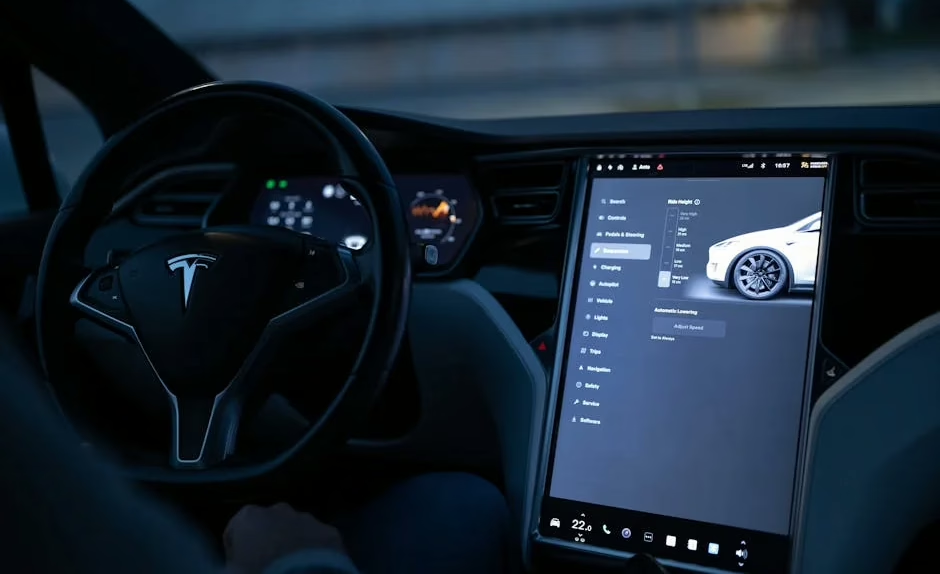
Tesla’s integration of xAI’s Grok chatbot into vehicle systems has sparked both enthusiasm and safety concerns among users. CNBC documented real-world usage in New York City, where Tesla owner and auto insurance lawyer Mike Nelson described the AI assistant as “useful, nearly irresistible, and dangerous.”
The integration allows drivers to interact with Grok’s conversational AI while operating their vehicles, raising questions about driver distraction and safety protocols. Nelson, who has used the system for several months, highlighted the tension between the technology’s utility and potential risks in urban driving environments.
This development occurs as regulators worldwide scrutinize in-vehicle AI systems and their impact on driver attention and road safety.
Enterprise AI Adoption Accelerates
Beyond consumer applications, automotive AI development benefits from broader enterprise adoption trends. Google reported documenting 1,302 real-world generative AI use cases across leading organizations, with many applications supporting automotive research and development workflows.
Google’s Deep Research Max, powered by Gemini 3.1 Pro, now offers autonomous research capabilities that automotive companies use for market analysis, competitive intelligence, and technical development. The system can process both public web data and proprietary datasets to generate professional-grade analyses for complex automotive AI projects.
These enterprise tools accelerate the development cycle for autonomous driving systems by automating research tasks that previously required extensive human resources.
Global Competition Intensifies
The automotive AI landscape shows clear regional differences in approach and deployment. Tesla’s FSD operates primarily in beta/supervised mode across multiple markets, while XPENG’s VLA 2.0 ships as a production system in China. This divergence reflects different regulatory environments and market expectations.
Chinese automakers like XPENG must differentiate in an increasingly competitive domestic market before expanding internationally. VLA 2.0’s production-ready status gives XPENG a potential advantage as it considers European expansion, though success will depend on adapting to different regulatory frameworks and consumer preferences.
European markets traditionally value brand heritage and emotional connection over pure technological capability, presenting challenges for Chinese manufacturers despite technical advantages.
What This Means
The automotive AI sector is entering a critical phase where production deployment, not just testing, determines market leadership. XPENG’s VLA 2.0 shipping as a finished product while Tesla’s FSD remains in supervised mode highlights different strategies for managing liability and regulatory approval.
Tesla’s 1.28 million FSD subscribers generate substantial recurring revenue that funds continued development, creating a sustainable model for autonomous driving advancement. However, Chinese competitors shipping production-ready systems may pressure Tesla to accelerate its timeline for removing “supervised” limitations.
The integration of conversational AI like Grok into vehicles represents a new frontier requiring careful balance between functionality and safety. As these systems become more sophisticated, regulatory frameworks will need updating to address driver distraction and liability concerns.
FAQ
How many Tesla FSD subscriptions are currently active?
Tesla reported 1.28 million active Full Self-Driving subscriptions in Q1 2026, representing 51% growth compared to the same period in 2025.
What makes XPENG’s VLA 2.0 different from Tesla’s FSD?
VLA 2.0 ships as a production-ready autonomous driving system, while Tesla’s FSD operates in “supervised” mode requiring driver attention. XPENG’s system is already commercially available in China without beta limitations.
Is it safe to use AI chatbots while driving?
Safety experts express concerns about driver distraction when using conversational AI systems like Grok while driving. Tesla owner Mike Nelson, an auto insurance lawyer, described the technology as “useful, nearly irresistible, and dangerous,” highlighting the need for careful implementation and regulation.