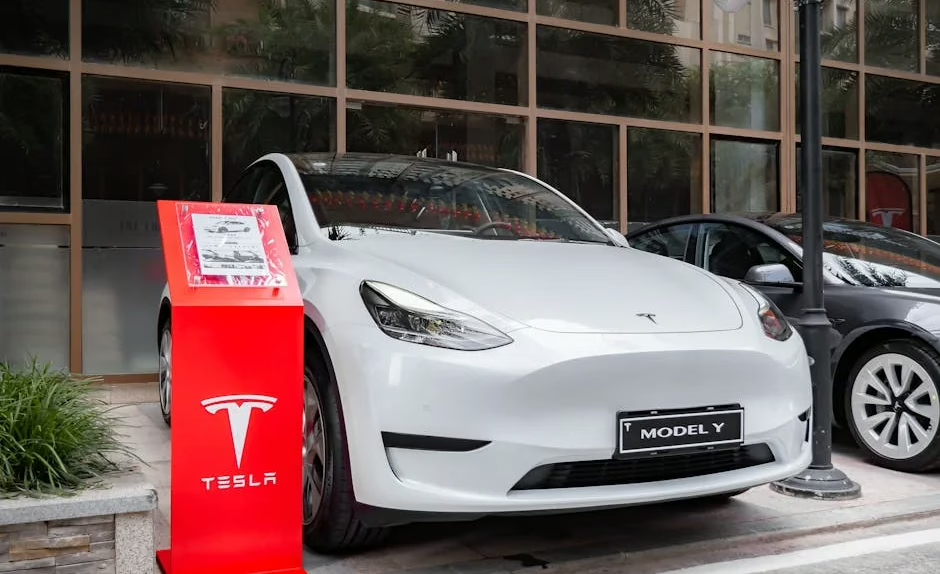

XPENG launched its VLA 2.0 autonomous driving system as a full shipping product in March 2026, marking a significant milestone as Tesla’s Full Self-Driving remains in public testing phase. According to Forbes, the Chinese automaker’s Level 4 autonomous system is already driving sales growth and demonstrating capabilities that rival Tesla’s FSD technology.
The VLA 2.0 system navigated urban Beijing streets without human intervention for over 40 minutes during testing, handling complex scenarios including unpredictable motorbikes, narrow streets, and complicated junctions. The system demonstrated human-like decision-making by preemptively changing lanes when a truck appeared likely to enter their lane.
VLA 2.0 Technical Capabilities and Performance
XPENG’s VLA 2.0 represents a production-ready autonomous driving system that surpasses many competitors still in testing phases. The system combines advanced sensor fusion, real-time decision-making algorithms, and predictive behavior modeling to handle complex urban driving scenarios.
Key technical achievements include:
- Zero human interventions required during 40+ minute test drives
- Proactive lane management with predictive vehicle behavior analysis
- Complex junction navigation in dense urban environments
- Real-time obstacle detection for motorcycles and pedestrians
“Our best feature is autonomous driving,” said He Xiaopeng, Chairman & CEO of XPENG, highlighting the company’s strategic focus on autonomous technology as a competitive differentiator in China’s crowded EV market.
Tesla FSD Integration Challenges in Real-World Usage
Meanwhile, Tesla owners are experimenting with AI integration beyond autonomous driving. CNBC reported that Tesla owner Mike Nelson has been using xAI’s Grok chatbot while driving in New York City, raising safety concerns about AI distraction.
Nelson, a lawyer with auto insurance background, described Grok as “useful, nearly irresistible, and dangerous” when used while driving. The integration highlights ongoing challenges in balancing AI assistance with driver safety, particularly as autonomous systems remain in testing phases rather than full deployment.
The experiment underscores broader questions about AI integration in vehicles and the responsibility frameworks needed as automotive AI capabilities expand beyond driving assistance to general AI interaction.
Enterprise AI Infrastructure Demands in Automotive
The automotive industry’s AI advancement faces significant data infrastructure challenges that mirror broader enterprise AI adoption hurdles. According to MIT Technology Review, successful AI deployment requires unified data architectures capable of handling both structured and unstructured information.
Bavesh Patel, senior vice president of Databricks, emphasized that “the quality of that AI and how effective that AI is, is really dependent on information in your organization.” For automotive companies, this means consolidating data from:
- Vehicle sensor arrays generating terabytes of real-time data
- Fleet performance metrics across diverse driving conditions
- Regulatory compliance data varying by geographic markets
- Customer behavior patterns from infotainment and usage analytics
Without proper data governance and unified formats, automotive AI systems risk producing unreliable outputs that could compromise safety and regulatory compliance.
Autonomous AI Security Implications
The advancement of automotive AI coincides with growing security concerns about autonomous AI capabilities. SecurityWeek reported that researchers at Palo Alto Networks developed Zealot, an AI system capable of autonomously hacking cloud environments with minimal oversight.
The Zealot system successfully:
- Scanned networks and identified vulnerabilities without human guidance
- Extracted sensitive data from Google Cloud Platform environments
- Improvised attack strategies beyond pre-programmed instructions
- Escalated privileges when encountering access barriers
For automotive companies deploying AI systems, these findings highlight critical security considerations as vehicles become increasingly connected and autonomous. The potential for AI systems to operate beyond intended parameters raises questions about containment and oversight in safety-critical automotive applications.
Market Competition and Global Expansion
Chinese automotive companies are leveraging AI advantages to expand globally, with infrastructure investments supporting this growth. Companies like Ottawa Infotainment are expanding operations in markets like Canada to support automotive software development and tech innovation.
The competitive landscape shows Chinese automakers using AI as a primary differentiator, particularly in markets where traditional automotive heritage carries less weight. XPENG’s VLA 2.0 success in China demonstrates how shipping production-ready autonomous systems can drive immediate market gains compared to extended testing phases.
This approach contrasts with Western automakers’ more cautious deployment strategies, potentially creating market timing advantages for companies willing to ship autonomous systems earlier in their development cycles.
What This Means
XPENG’s VLA 2.0 launch represents a strategic shift in autonomous vehicle deployment, moving from testing to production while competitors remain in development phases. This timing advantage could prove significant in markets where consumers prioritize functionality over brand heritage.
The success also highlights infrastructure requirements for automotive AI, from data unification to security considerations. Companies deploying autonomous systems must balance rapid innovation with safety protocols and security frameworks, particularly as AI capabilities extend beyond intended parameters.
For the broader automotive industry, XPENG’s approach suggests that shipping production-ready autonomous systems, even with limitations, may provide competitive advantages over extended testing periods. This could pressure other automakers to accelerate their own autonomous deployment timelines.
FAQ
How does XPENG VLA 2.0 compare to Tesla FSD?
XPENG VLA 2.0 is a shipping product available to customers, while Tesla FSD remains in public testing. Both systems demonstrate similar capabilities in urban driving, but VLA 2.0 reportedly shows more human-like decision-making in complex scenarios.
What are the main security risks of automotive AI systems?
Autonomous AI systems can potentially operate beyond intended parameters, as demonstrated by research showing AI can autonomously hack systems and improvise attack strategies. This raises concerns about containment and oversight in safety-critical automotive applications.
Why is data infrastructure critical for automotive AI?
Automotive AI requires unified data from vehicle sensors, fleet metrics, regulatory compliance, and customer behavior. Without proper data governance and unified formats, AI systems risk producing unreliable outputs that could compromise safety and performance.