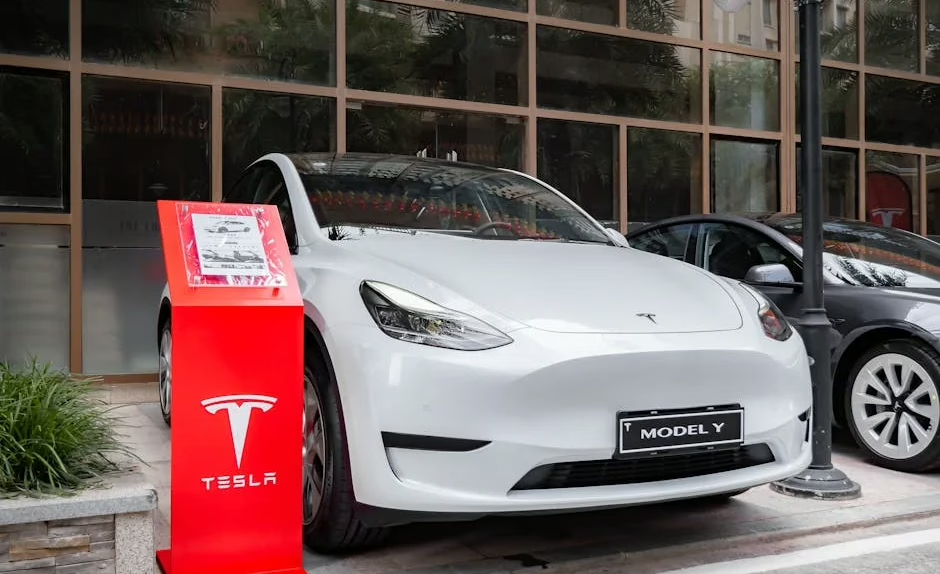

Chinese automaker XPENG launched its VLA 2.0 autonomous driving system in March 2026 as a fully shipping product, moving beyond the testing phase that still defines Tesla’s Full Self-Driving capabilities. According to Forbes, the system has become a major sales driver in China’s competitive EV market.
Real-world testing of VLA 2.0 in Beijing demonstrated capabilities that surpassed Tesla FSD in urban environments. The system navigated complex city streets, handled unpredictable motorbikes, and made human-like decisions such as proactively changing lanes when anticipating potential conflicts with trucks. No human interventions were required during 40 minutes of driving, except for entering and exiting barrier-controlled parking areas.
Tesla FSD Subscriptions Hit 1.28 Million Despite Competition
Tesla’s Full Self-Driving subscriptions reached 1.28 million active users in Q1 2026, representing 51% year-over-year growth according to TechCrunch. This growth helped drive Tesla’s automotive revenue to $16.2 billion, up from $13.96 billion in Q1 2025.
The FSD subscription revenue contributed to Tesla’s overall Q1 2026 revenue of $22.38 billion, a 16% increase from $19.3 billion in the same period last year. Tesla’s free cash flow more than doubled to $1.44 billion, surprising analysts who expected higher cash burn during the quarter.
However, Tesla delivered 358,023 EVs globally in Q1 2026, falling short of analyst expectations around 368,000 units. The company produced 408,386 vehicles during the same period, indicating inventory buildup that suggests demand challenges despite FSD subscription growth.
Safety Concerns Emerge with AI Integration in Vehicles
Tesla owners are increasingly using xAI’s Grok chatbot while driving, raising safety concerns about AI distraction behind the wheel. CNBC reported on Tesla owner Mike Nelson, who described Grok as “useful, nearly irresistible, and dangerous” based on several months of usage.
Nelson, a lawyer with auto insurance background, demonstrated Grok usage during NYC driving sessions. The integration highlights growing concerns about cognitive load and attention division as AI assistants become more sophisticated and engaging for drivers.
Current automotive AI systems like Tesla’s FSD still require human supervision, but the addition of conversational AI creates new distraction vectors. Safety experts warn that even hands-free AI interactions can impair driving performance through increased mental workload.
Chinese Automakers Export AI Advantage to Global Markets
XPENG’s VLA 2.0 success in China positions the company for European expansion, where autonomous driving capabilities could differentiate Chinese brands against established automakers. “Our best feature is autonomous driving,” said He Xiaopeng, XPENG’s Chairman and CEO, highlighting the strategic importance of AI systems.
The Chinese EV market’s competitive intensity has accelerated autonomous driving development, with companies like XPENG achieving production-ready systems while Western competitors remain in testing phases. This technological gap could reshape global automotive market dynamics as Chinese brands enter Europe and other regions.
European markets traditionally value brand heritage and emotional attachment, but advanced autonomous capabilities may override these preferences among tech-savvy consumers. XPENG’s VLA 2.0 demonstrated more human-like driving behavior compared to Tesla FSD, potentially appealing to safety-conscious European buyers.
Enterprise AI Research Capabilities Transform Automotive Development
Google’s Deep Research Max, powered by Gemini 3.1 Pro, represents the next evolution in autonomous research agents that could accelerate automotive AI development. According to Google’s announcement, the system can conduct exhaustive research workflows combining open web data with proprietary information streams.
The automotive industry generates massive datasets from vehicle sensors, manufacturing processes, and customer behavior that require sophisticated analysis. Deep Research Max’s ability to blend public research with proprietary data could accelerate development cycles for autonomous driving systems.
Google documented 1,302 real-world AI use cases across leading organizations, with automotive applications spanning predictive maintenance, supply chain optimization, and customer experience enhancement. These enterprise AI tools enable faster iteration on complex systems like autonomous driving.
Market Dynamics Shift Toward Production-Ready Autonomy
The gap between testing and production deployment has become a critical competitive factor in autonomous driving. While Tesla maintains the largest FSD subscription base at 1.28 million users, the system remains in “Supervised” mode requiring human oversight.
XPENG’s VLA 2.0 represents a strategic shift toward full production deployment, removing the beta testing label that has defined most autonomous driving systems. This approach could pressure competitors to accelerate their own production timelines or risk market share losses.
Regulatory environments vary significantly between China and Western markets, potentially explaining deployment timeline differences. Chinese authorities may approve autonomous systems faster than European or American regulators, giving domestic companies first-mover advantages in production deployment.
What This Means
The automotive AI landscape is fragmenting between testing-focused Western approaches and production-ready Chinese systems. XPENG’s VLA 2.0 success demonstrates that consumers value fully functional autonomous capabilities over beta testing participation, potentially forcing Tesla and other Western automakers to accelerate their deployment timelines.
Tesla’s strong FSD subscription growth shows continued consumer interest in autonomous features, but the company faces pressure to transition from supervised testing to full production. The 51% year-over-year growth in FSD subscriptions provides revenue diversification beyond vehicle sales, but may not sustain if competitors offer superior production-ready alternatives.
Safety concerns around AI integration in vehicles require immediate industry attention. As conversational AI becomes more sophisticated, the risk of driver distraction increases, potentially undermining the safety benefits of autonomous driving systems. Regulatory frameworks must evolve to address these emerging risks.
FAQ
How does XPENG’s VLA 2.0 differ from Tesla’s FSD?
VLA 2.0 is a fully shipping production system, while Tesla FSD remains in “Supervised” testing mode requiring human oversight. XPENG’s system demonstrated more human-like driving behavior and required no interventions during 40-minute urban driving sessions.
What drove Tesla’s Q1 2026 revenue growth despite lower deliveries?
Tesla’s revenue increased 16% to $22.38 billion due to higher average vehicle prices, expanded services revenue, and 51% growth in FSD subscriptions to 1.28 million active users, offsetting the delivery shortfall of 358,023 vehicles versus 368,000 expected.
Why are safety experts concerned about AI chatbots in vehicles?
Conversational AI like xAI’s Grok creates cognitive load and attention division for drivers, even in hands-free mode. The “useful, nearly irresistible, and dangerous” nature of these systems can impair driving performance through increased mental workload during vehicle operation.