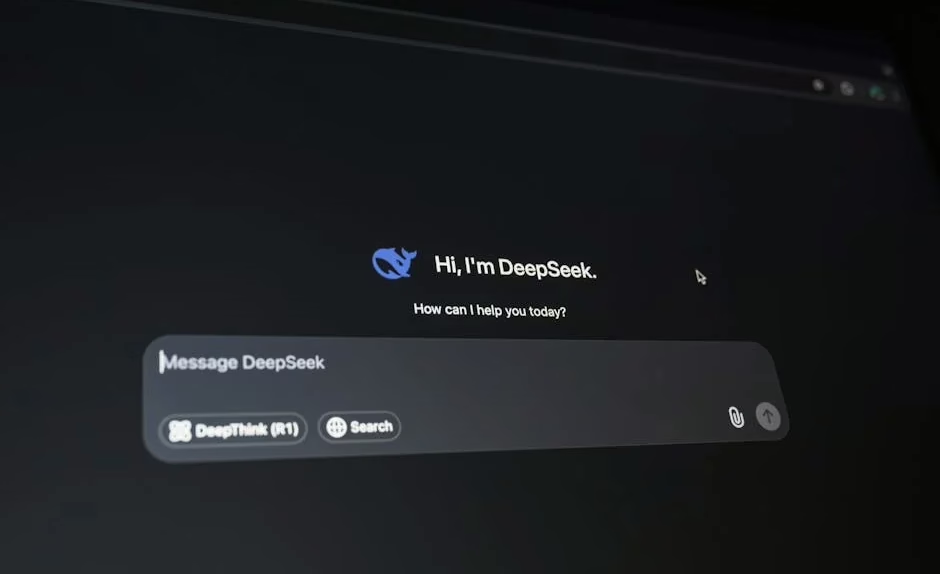

DeepSeek released its V4 model on Monday, delivering near-GPT-5 performance at approximately one-sixth the API cost while maintaining full open source availability under the MIT License. The 1.6-trillion-parameter Mixture-of-Experts model marks what researchers are calling the “second DeepSeek moment” — 484 days after the Chinese startup’s breakthrough R1 model disrupted the AI landscape in January 2025.
According to VentureBeat, the model matches or exceeds performance of leading closed-source systems including OpenAI’s GPT-5.5 and Anthropic’s Claude Opus 4.7 across multiple reasoning benchmarks. DeepSeek AI researcher Deli Chen described the release as a “labor of love” in announcing the model’s availability on Hugging Face and through DeepSeek’s API.
Advanced Reasoning Architecture Drives Performance Gains
DeepSeek-V4’s reasoning capabilities stem from fundamental advances in how large language models process logical inference. Recent research suggests that effective AI reasoning operates through latent-state trajectories rather than surface-level chain-of-thought processes, according to new findings published on arXiv.
The research challenges conventional wisdom about chain-of-thought prompting, arguing that “reasoning is primarily mediated by latent-state trajectories” rather than explicit surface reasoning chains. This distinction matters for benchmark evaluation and inference-time interventions — areas where DeepSeek-V4 demonstrates significant improvements.
Structured reasoning frameworks are emerging as critical differentiators. Another arXiv paper introduces algebraic invariants that enforce logical consistency through what researchers call the “Gamma Quintet” — five mathematical constraints that prevent weak reasoning steps from propagating through inference chains. The strongest constraint, the Weakest Link bound, ensures no conclusion exceeds the reliability of its least-supported premise.
Production AI Applications Scale Across Industries
Real-world deployment of advanced reasoning models is accelerating rapidly. Google’s latest enterprise AI report documents 1,302 production use cases across leading organizations, representing what the company calls “the era of the agentic enterprise.”
The applications span from financial analysis and legal document review to scientific research and software development. Many leverage reasoning capabilities similar to those demonstrated in DeepSeek-V4, particularly for complex problem-solving tasks that require multi-step logical inference.
Google’s analysis using Gemini Enterprise models identified key trends including automated decision-making systems, complex data analysis workflows, and reasoning-intensive customer service applications. The rapid adoption suggests enterprise readiness for sophisticated AI reasoning capabilities.
Probabilistic Reasoning Challenges Drive Innovation
A persistent challenge in AI reasoning involves handling randomness and probabilistic scenarios. Recent research from Forbes introduces String Seed-of-Thought (SSoT) prompting to address what researchers call the “AI options-choosing problem.”
The technique aims to enable proper probabilistic instruction following (PIF) in scenarios requiring randomness, such as game simulation or human behavior modeling. Traditional LLMs struggle with truly random outputs — asking an AI to simulate coin flips rarely produces the expected 50/50 distribution without specific interventions.
SSoT represents one approach to this challenge, though researchers acknowledge significant limitations remain. The development suggests growing recognition that reasoning capabilities must extend beyond deterministic logic to handle uncertainty and probabilistic scenarios effectively.
Cost Economics Reshape AI Development Landscape
DeepSeek-V4’s pricing advantage fundamentally alters competitive dynamics in the AI market. At one-sixth the cost of comparable proprietary models, the release pressures closed-source providers to justify premium pricing while maintaining performance parity.
The model’s MIT License removes typical open-source commercial restrictions, enabling unrestricted enterprise deployment. This combination of performance, cost efficiency, and licensing flexibility represents a significant shift in AI economics.
Industry observers note that DeepSeek’s approach — developing competitive models with substantially lower operational costs — could accelerate AI adoption across price-sensitive markets and applications previously considered economically unfeasible.
Technical Implementation and Availability
DeepSeek-V4 implements a Mixture-of-Experts architecture across 1.6 trillion parameters, optimizing computational efficiency while maintaining reasoning performance. The model supports extended context lengths up to 1 million tokens, enabling analysis of lengthy documents and complex reasoning chains.
Developers can access the model through multiple channels: direct download from Hugging Face, integration via DeepSeek’s API, or deployment on compatible infrastructure. The company provides comprehensive documentation and implementation guides for enterprise integration.
The release includes optimizations for various hardware configurations, from consumer GPUs to enterprise-grade inference clusters. This accessibility broadens potential deployment scenarios beyond well-funded research institutions and major technology companies.
What This Means
DeepSeek-V4’s release accelerates the democratization of advanced AI reasoning capabilities while fundamentally disrupting the economics of frontier AI development. The combination of open-source availability, competitive performance, and dramatic cost reduction creates new possibilities for AI deployment across industries and applications previously constrained by budget limitations.
The timing coincides with growing understanding of AI reasoning mechanisms, from latent-state dynamics to structured logical frameworks. This convergence of theoretical advances and practical implementation suggests we’re entering a new phase of AI development where sophisticated reasoning becomes broadly accessible rather than confined to well-funded organizations.
For enterprises, the release represents both opportunity and challenge — opportunity to deploy advanced AI capabilities at reduced cost, and challenge to existing vendors who must justify premium pricing against increasingly capable open alternatives.
FAQ
How does DeepSeek-V4 compare to GPT-5 and Claude Opus in terms of actual performance?
DeepSeek-V4 matches or exceeds GPT-5.5 and Claude Opus 4.7 performance across multiple reasoning benchmarks while operating at approximately one-sixth the API cost. The model demonstrates particular strength in mathematical reasoning and complex logical inference tasks.
What makes DeepSeek-V4’s reasoning capabilities different from previous models?
The model implements advanced reasoning architectures that operate through latent-state trajectories rather than surface-level chain-of-thought processing. This approach, combined with structured logical frameworks and algebraic invariants, enables more reliable multi-step reasoning and prevents logical inconsistencies from accumulating.
Can enterprises deploy DeepSeek-V4 without licensing restrictions?
Yes, DeepSeek-V4 is released under the MIT License, which permits unrestricted commercial use, modification, and distribution. This removes typical open-source commercial limitations and enables full enterprise deployment without licensing fees or usage restrictions.