
Microsoft launched MAI-Image-2-Efficient this month, delivering flagship-quality image generation at 41% lower cost and 22% faster speeds, while NVIDIA introduced Nemotron 3 Nano 4B featuring hybrid Mamba-Transformer architecture for efficient local deployment. These releases highlight a fundamental shift toward optimized AI architectures that prioritize efficiency and on-device inference capabilities.
The convergence of advanced quantization techniques, specialized hardware acceleration, and novel architectural designs is enabling sophisticated AI models to run locally on consumer-grade devices, fundamentally changing how organizations approach AI deployment and governance.
Efficiency-First Architecture Design
Modern AI architecture development has shifted from pure performance maximization to efficiency optimization. According to Microsoft’s announcement, MAI-Image-2-Efficient achieves 4x greater throughput efficiency per GPU compared to its flagship predecessor while maintaining production-ready quality standards.
This efficiency gain stems from several architectural innovations:
- Parameter optimization: Strategic reduction of model parameters without sacrificing capability
- Inference acceleration: Streamlined computational pathways for faster processing
- Memory efficiency: Reduced VRAM requirements enabling deployment on standard hardware
The model’s pricing structure reflects these improvements, dropping from $33 to $19.50 per million image output tokens. Microsoft reports 40% faster performance compared to competing models including Google’s Gemini 3.1 Flash variants, measured on NVIDIA H100 hardware at 1024×1024 resolution.
Hybrid Architecture Innovations
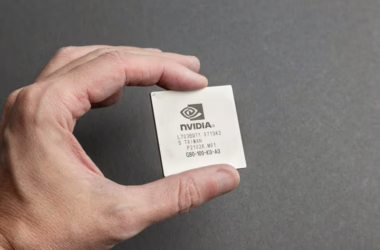
NVIDIA’s Nemotron 3 Nano 4B represents a significant advancement in compact model design through its hybrid Mamba-Transformer architecture. According to the HuggingFace announcement, this 4-billion parameter model combines state-of-the-art instruction following with exceptional tool use capabilities while maintaining minimal VRAM footprint.
The hybrid approach leverages:
- Mamba components: Efficient sequence modeling for reduced computational overhead
- Transformer blocks: Maintained attention mechanisms for complex reasoning tasks
- Optimized inference: Balanced architecture for local deployment scenarios
This architectural fusion addresses the traditional trade-off between model capability and computational efficiency, enabling sophisticated AI functionality on resource-constrained devices.
Local Inference Security Implications
The shift toward on-device AI inference creates new challenges for enterprise security teams. As VentureBeat reports, traditional cloud access security broker (CASB) policies become ineffective when inference occurs locally without API calls or network signatures.
Several factors enable practical local inference:
- Hardware acceleration: MacBook Pro with 64GB unified memory can run quantized 70B-class models at usable speeds
- Quantization advances: Mainstream compression techniques reduce model size without significant capability loss
- Optimized frameworks: Streamlined inference engines for consumer hardware
This “Shadow AI 2.0” phenomenon requires new governance approaches as traditional data loss prevention (DLP) systems cannot monitor local model interactions. Security teams must adapt monitoring strategies to address unvetted inference happening directly on employee devices.
Training Technique Advancements
Modern training methodologies focus on achieving better results with fewer parameters and reduced computational requirements. The development of MAI-Image-2-Efficient demonstrates how targeted optimization during training can yield significant efficiency gains without compromising output quality.
Key training innovations include:
Parameter-Efficient Training
- Selective fine-tuning: Targeting specific model components for optimization
- Knowledge distillation: Transferring capabilities from larger models to compact architectures
- Multi-objective optimization: Balancing quality, speed, and resource consumption
Inference Optimization
- Dynamic batching: Adaptive processing for variable workloads
- Quantization-aware training: Preparing models for post-training compression
- Hardware-specific optimization: Tailoring architectures for target deployment platforms
These techniques enable developers to create models that maintain high performance while meeting strict efficiency requirements for local deployment scenarios.
Performance Monitoring Challenges
The AI community increasingly reports concerns about model performance degradation, as highlighted by user complaints regarding Anthropic’s Claude models. Developers cite issues including reduced reasoning capabilities, increased hallucinations, and inconsistent performance across sessions.
These challenges underscore the importance of:
- Transparent benchmarking: Consistent performance metrics across model versions
- Version control: Clear documentation of model changes and updates
- Community feedback: Systematic collection and analysis of user experiences
The debate around potential “AI shrinkflation” reflects broader concerns about maintaining model quality while optimizing for efficiency and cost reduction.
What This Means
The convergence of efficient architectures, advanced training techniques, and local inference capabilities represents a fundamental shift in AI deployment strategies. Organizations can now access sophisticated AI functionality without relying entirely on cloud-based services, enabling new use cases while introducing novel security and governance challenges.
These architectural advances democratize AI access by reducing computational barriers and enabling deployment on consumer-grade hardware. However, the transition requires updated security frameworks, monitoring strategies, and governance policies to address the unique challenges of distributed, on-device AI inference.
The emphasis on efficiency-first design suggests future AI development will prioritize practical deployment considerations alongside pure performance metrics, potentially accelerating adoption across industries with strict data privacy or connectivity requirements.
FAQ
Q: How do hybrid architectures like Mamba-Transformer improve efficiency?
A: Hybrid architectures combine the sequence modeling efficiency of Mamba components with the reasoning capabilities of Transformer blocks, reducing computational overhead while maintaining performance for complex tasks.
Q: What security risks does local AI inference create for enterprises?
A: Local inference bypasses traditional network monitoring, creating “Shadow AI 2.0” scenarios where employees can run unvetted models on company devices without security team visibility or control.
Q: Why are AI companies focusing on efficiency over pure performance?
A: Efficiency optimization enables broader deployment on consumer hardware, reduces operational costs, and addresses growing demand for on-device AI capabilities while maintaining acceptable performance levels.
Sources
For a side-by-side look at the flagship models in play, see our full 2026 AI model comparison.