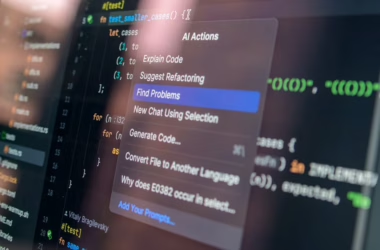

Google CEO Sundar Pichai revealed that artificial intelligence now generates 75% of the company’s code, marking a dramatic shift in how the tech giant develops software internally. According to The Indian Express, Pichai shared this milestone during recent analyst discussions, highlighting Google’s aggressive adoption of AI tools across its engineering organization.
The code generation figure represents one of the most concrete examples of AI’s impact on software development at scale. Pichai emphasized that this AI-assisted coding has accelerated development cycles while maintaining code quality standards. The statistic encompasses various Google products and services, from search algorithms to cloud infrastructure components.
Simultaneously, Google’s enterprise AI solutions have become the primary growth driver for Google Cloud for the first time. Facebook reporting indicates that enterprise AI product sales grew eightfold year-over-year, demonstrating strong market demand for Google’s AI capabilities in business environments.
Enterprise AI Revenue Drives Cloud Growth
Google Cloud’s enterprise AI solutions now represent the division’s fastest-growing segment, surpassing traditional cloud infrastructure services. Pichai told analysts that AI products have fundamentally changed the cloud business trajectory, with customers increasingly adopting Gemini-powered tools and AI development platforms.
The eightfold revenue growth in enterprise AI reflects Google’s success in commercializing its DeepMind research and Gemini language models. Major enterprise customers are integrating Google’s AI capabilities into workflows ranging from customer service automation to complex data analysis tasks.
Key enterprise AI products driving growth include:
- Vertex AI platform for custom model development
- Gemini for Google Workspace productivity tools
- AI-powered data analytics and business intelligence solutions
- Industry-specific AI applications for healthcare, finance, and retail
This shift positions Google Cloud as a direct competitor to Microsoft Azure’s AI services and Amazon Web Services’ machine learning offerings, with AI becoming the primary differentiator in cloud market competition.
Internal AI Adoption Accelerates Development
Google’s 75% AI-generated code statistic reflects the company’s internal use of tools like Codey, its AI coding assistant built on PaLM models. Engineers across Google use AI to generate boilerplate code, debug existing software, and optimize algorithms for performance improvements.
The AI coding tools have reportedly reduced development time for routine programming tasks by 40-60%, allowing engineers to focus on higher-level architecture and product innovation. Google’s software engineering teams use AI for code review processes, automated testing generation, and documentation creation.
Internal AI applications include:
- Automated code generation for APIs and microservices
- Bug detection and security vulnerability identification
- Code optimization for performance and resource efficiency
- Documentation and comment generation
This internal adoption serves as a testing ground for Google’s enterprise AI products, with successful internal use cases often becoming commercial offerings for external customers.
Employee Concerns Over Military AI Applications
Despite Google’s AI success, internal tensions have emerged over potential military applications. Over 600 Google employees, including many from DeepMind, signed a letter demanding that CEO Pichai reject classified Pentagon AI contracts, according to The Washington Post.
The letter, signed by more than 20 principals, directors, and vice presidents, states that “The only way to guarantee that Google does not become associated with such harms is to reject any classified workloads. Otherwise, such uses may occur without our knowledge or the power to stop them.”
This employee pushback reflects ongoing debates within tech companies about AI’s role in defense applications. Google previously faced similar internal resistance during Project Maven in 2018, which involved AI analysis of drone footage for the Department of Defense.
The current letter specifically targets classified military AI use, distinguishing it from Google’s existing public sector AI contracts. Employees express concerns about lack of transparency in classified projects and potential misuse of AI technologies developed for civilian applications.
DeepMind Research Continues Advancing AI Capabilities
Google’s DeepMind division continues pushing AI research boundaries while contributing to the company’s commercial AI products. Recent breakthroughs in multimodal AI, protein folding prediction, and reinforcement learning have strengthened Google’s position in the AI competition with OpenAI, Anthropic, and Meta.
DeepMind’s research directly feeds into Gemini model improvements and new AI capabilities across Google’s product ecosystem. The lab’s work on AI safety and alignment also addresses growing regulatory concerns about AI development and deployment.
Google’s integration of DeepMind research with practical applications has created a competitive advantage in both consumer and enterprise markets. The company’s ability to translate cutting-edge research into commercial products faster than competitors has driven much of its recent AI revenue growth.
What This Means
Google’s 75% AI-generated code milestone represents a inflection point in software development, demonstrating that AI tools have moved beyond experimental use to become core infrastructure for one of the world’s largest tech companies. This internal adoption validates Google’s enterprise AI strategy and provides a compelling case study for potential customers.
The eightfold growth in enterprise AI revenue signals that businesses are moving past AI pilot projects to full-scale deployments. Google’s success in commercializing its AI research gives it a significant advantage in the rapidly expanding enterprise AI market, estimated to reach $50 billion by 2027.
However, employee resistance to military AI applications highlights ongoing ethical challenges that could impact Google’s ability to pursue lucrative government contracts. The company must balance commercial opportunities with internal values and public perception as AI becomes increasingly integrated into national security applications.
FAQ
How does Google’s 75% AI-generated code compare to other tech companies?
Google appears to be among the first major tech companies to publicly share such a high percentage of AI-generated code. Most companies report AI assistance rates between 20-40% for software development tasks, making Google’s 75% figure notably aggressive in AI adoption.
What specific AI tools does Google use for code generation?
Google primarily uses Codey, its internal AI coding assistant built on PaLM language models, along with custom tools developed by DeepMind. These tools handle everything from boilerplate code generation to automated testing and documentation creation.
Will Google’s employee letter affect its AI business strategy?
While the letter demonstrates internal resistance to military AI contracts, it’s unlikely to significantly impact Google’s commercial AI strategy. The company has previously navigated similar employee concerns while maintaining its AI development priorities and business objectives.
Related news
- How Sundar Pichai Pushed Google To the Front of the AI Race – Time Magazine – Google News – Google
- Here’s how Google AI is powering small business growth – Google Blog
- ‘Turn It Off’—Google Update Starts Scanning Your Gmail – Forbes Tech
Sources
- Google employees ask Sundar Pichai to say no to classified military AI use – The Verge
- 75% Google code now AI-generated, says Sundar Pichai: How company is putting AI to work – The Indian Express – Google News – Google
- Google CEO Sundar Pichai says AI generates 75% codes at the company: Why this number matters – The Times of India – Google News – Google
- ‘Our enterprise AI solutions have become our primary growth driver for cloud for the first time,’ CEO Sundar Pichai tells analysts, noting that sales on those products grew eightfold from a year ago – facebook.com – Google News – AGI
- Google CEO Sundar Pichai says 75% of the company’s code is AI-generated – Fast Company – Google News – Google