
- Artificial intelligence is the capability of computational systems to perform tasks usually associated with human intelligence — learning, reasoning, problem-solving, perception, and decision-making, as defined by Wikipedia.
- AI was founded as an academic discipline at a 1956 workshop at Dartmouth College. Progress has moved in cycles — bursts of optimism followed by “AI winters” of reduced funding.
- Today’s AI is “narrow” — it does one thing well (recognize faces, translate text, play chess). “General” AI that matches human intelligence across all domains does not exist.
- The field has four main subfields that often overlap: machine learning, deep learning, natural language processing, and computer vision.
- According to the Stanford AI Index 2025, 78% of organizations reported using AI in 2024, up from 55% the year before.
A working definition
Artificial intelligence is a branch of computer science concerned with building machines that do things which, done by humans, we would call intelligent. The Britannica definition frames AI as “the ability of a digital computer or computer-controlled robot to perform tasks commonly associated with intelligent beings.”
There is no single agreed test for when software crosses the line from “just a program” into “AI”. In practice, the label is usually applied when a system learns from data rather than following fixed rules, adapts to new situations, or exhibits behaviour (perception, language, judgement) that used to require humans. Expect the target to keep moving — tasks that impressed people as “AI” thirty years ago, like chess or spell-checking, are now routine software.
Why the definition matters
When policymakers, companies, and journalists talk about “AI”, they often mean very different things. A customer-service chatbot, a medical-imaging classifier, and a self-driving car are all “AI” but share little of the underlying technology. Keeping the definition broad is useful for discussion but vague enough to cause confusion. When you see an AI claim, it is worth asking which subfield the system belongs to.
A short history in cycles
The term “artificial intelligence” was coined by John McCarthy for the 1956 Dartmouth Summer Research Project, widely considered the founding event of the field. Early optimism was high — researchers predicted human-level machine intelligence within a generation.
Reality was more stubborn. Progress stalled, funding dried up, and the field went through two “AI winters” — in the 1970s and again in the late 1980s. The modern resurgence began in 2012, when deep neural networks trained on graphics processing units (GPUs) dramatically outperformed prior techniques at the ImageNet image-recognition competition. That single result convinced a generation of researchers and investors that neural networks were the path forward.
From 2012 to today, the field has expanded faster than most observers predicted. The release of large language models — most visibly ChatGPT in late 2022 — moved AI from a specialist tool into mainstream consumer software. You can follow ongoing developments in our large language models coverage.
Narrow AI vs. general AI
Almost every AI system you have ever interacted with is narrow AI, also called weak AI. It is trained or programmed to do one task — recognize cats in photos, transcribe speech, recommend movies. Remove it from that task, and it can do nothing.
Artificial general intelligence (AGI) would, in contrast, match or exceed human performance across any cognitive task a human can do. AGI does not exist today, and there is serious disagreement among researchers about whether it is five years away or fifty. A 2023 industry survey of machine-learning researchers produced median forecasts spanning decades. When you read about “AGI” in the news, treat it as speculative.
A third concept — superintelligence — refers to AI that surpasses human intelligence by a wide margin. This is purely theoretical and is the focus of much of the long-term AI safety debate.
The four main subfields
Machine learning
Machine learning is the subfield most responsible for the last decade of AI progress. Instead of writing explicit rules, engineers train a model by showing it many examples. The model finds the statistical patterns and uses them on new data. Machine learning comes in three main flavors: supervised (learn from labelled examples), unsupervised (find structure without labels), and reinforcement learning (learn by trial and error, rewarded for good outcomes). We cover this in depth in our machine learning explainer.
Deep learning
Deep learning is a particular style of machine learning that uses artificial neural networks with many layers (“deep”). Deep learning is what powers nearly all today’s headline AI systems — large language models, image generators, speech recognizers. Its rise since 2012 is inseparable from the rise of GPUs and the availability of large training datasets.
Natural language processing
Natural language processing (NLP) gives computers the ability to read, understand, and generate human language. Early NLP used hand-written grammars; today it is dominated by large language models (LLMs) — deep-learning systems trained on vast text corpora. Chatbots, translation, search ranking, and voice assistants all rely on NLP.
Computer vision
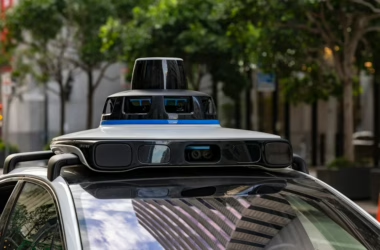
Computer vision gives computers the ability to interpret images and video. Applications include face recognition, medical-image analysis, self-driving perception, content moderation, and manufacturing-line inspection. The convolutional neural network, introduced in the 1990s and scaled up dramatically in the 2010s, is the workhorse architecture.
Where you already use AI
AI is less a futuristic technology than a set of tools already shipping inside products you use daily. Email spam filters are AI. The ranking of your social-media feed is AI. Voice assistants are AI. Credit-card fraud alerts, map routing, real-time translation, photo-album face grouping, spell-check, auto-correct, and recommendation systems on Netflix and Spotify are all AI.
Industry adoption has accelerated sharply. According to the Stanford HAI AI Index 2025, U.S. private AI investment reached $109 billion in 2024 — nearly 12 times China’s investment and 24 times the United Kingdom’s. U.S. AI-related legislation at the state level more than doubled from 49 laws (cumulative through 2023) to 131 by the end of 2024. Enterprise AI has gone from experimental to mandatory budget line in three years. For current company moves, see our ai industry coverage.
What AI is not — common misconceptions
AI is not consciousness. Today’s systems do not have feelings, desires, or subjective experience, regardless of how fluent their conversation seems. Confusing linguistic fluency with understanding is called the ELIZA effect and has been documented since the 1960s.
AI is not infallible. Machine-learning systems reflect the data they were trained on — and can pick up biases, mistakes, and outdated information in that data. AI systems frequently “hallucinate”, meaning they produce plausible-sounding but false statements. Any production use of AI should include a human review layer for consequential decisions.
AI is not the same as robotics. Robotics is the engineering of physical machines; AI is the software that (sometimes) controls them. Most AI today runs entirely on server computers with no physical embodiment.
Frequently asked questions
Is artificial intelligence the same as machine learning?
Not quite. Artificial intelligence is the broader umbrella — the goal of building machines that behave intelligently. Machine learning is a specific family of techniques (learn from data) for achieving that goal. Today ML is the dominant approach, so in casual usage the two terms often get conflated, but earlier AI research (expert systems, symbolic reasoning) did not rely on ML at all.
Will AI replace human jobs?
AI is already changing the work of many jobs and will continue to. The realistic expectation is task-level automation — parts of a job get automated, other parts need new skills, and the overall mix of work shifts. Some roles will shrink, some will grow, and new roles (AI engineer, prompt engineer, AI safety researcher) have emerged that did not exist ten years ago. The Stanford AI Index 2025 documented a 20% rise in U.S. demand for AI skills between 2023 and 2024 — a strong signal that the near-term impact is growing demand for AI-literate workers, not mass displacement.
Is AI dangerous?
AI carries real risks that deserve serious attention — biased outputs, privacy erosion, misinformation at scale, model security vulnerabilities, and long-term safety concerns about highly capable future systems. Whether AI is “dangerous” depends on what is deployed, by whom, with what oversight. Most mainstream AI applications today are low-risk; others (autonomous weapons, unregulated medical AI) raise well-founded concerns. A rapidly growing body of regulation — the EU AI Act, sector-specific rules, and corporate policies — is trying to keep pace.